When Canadian Firms Need an LEI for EU Trades
Canadian firms that trade with European counterparties often assume the regulatory burden sits on the EU side. In practice, that assumption can slow or even stop a transaction before it starts. One of the clearest examples is the Legal Entity Identifier, or LEI.
If your business, fund, charity, or other legal entity is dealing in financial instruments with an EU investment firm, an active LEI may be needed before the trade can move ahead. This is not just a record-keeping detail. It is tied to transaction reporting rules that have applied in the EU since 3 January 2018.
Why Canadian legal entities need an LEI for EU trading
An LEI is a 20-character alpha-numeric code based on ISO 17442. It is designed to identify legal entities in financial markets. GLEIF, the Global Legal Entity Identifier Foundation, oversees the broader LEI system, while registration and renewal are handled through issuing organisations and registration agents.
For a Canadian entity, the practical issue is simple: an EU investment firm may need your LEI in order to meet its own reporting duties under MiFID II and MiFIR. If the EU-side firm cannot identify a legal-person client with an LEI where required, that can block onboarding, order entry, or settlement preparation.
This is why many Canadian entities first hear about LEIs from someone else. A broker requests one before taking an order. A bank asks for it during account setup. A counterparty flags it during trade documentation. By that stage, the timing is often tight.
| Trading situation | Is an LEI likely needed? | Why it comes up |
|---|---|---|
| Canadian corporation trading with an EU investment firm | Yes, often | The EU firm may need the client LEI for transaction reporting |
| Canadian fund buying or selling EU-listed instruments | Yes, often | Funds are legal entities and may need to be identified in reporting |
| Canadian issuer whose instrument trades on an EU venue | Often, yes | Trading venues identify issuers with an LEI in daily FIRDS submissions |
| Canadian individual trading personally | Usually no LEI for the individual | LEIs are for legal entities, not natural persons |
| Canadian entity with an expired LEI | Problem likely | A lapsed LEI can fail internal controls or compliance checks |
How MiFIR and MiFID II create the LEI requirement for Canadian firms
The key regulatory driver is MiFIR, which applies from 3 January 2018. Under the MiFID II transaction reporting framework, EU investment firms must identify clients that are legal persons with LEIs. That rule reaches beyond EU-incorporated clients. It can affect third-country firms, including Canadian entities, when they trade through EU firms.
That point matters because the obligation does not depend on whether the Canadian business is regulated in Europe. The reporting duty sits with the EU investment firm, yet the Canadian client still needs to supply the identifier that lets the EU firm comply.
In plain terms, if your entity is on the other side of an EU-reportable trade, your LEI can become a pre-trade requirement.
A few common triggers tend to bring this into focus:
- opening a trading relationship with an EU broker
- placing an order in an EU financial instrument
- acting through an EU investment firm as a legal-person client
- issuing securities that are traded on an EU venue
- being checked during compliance or onboarding reviews
MiFIR timing and the historical ESMA implementation period
When MiFIR first came into force, ESMA acknowledged that some market participants were still trying to obtain LEIs. It issued a statement allowing a temporary six-month implementation period for firms that had not yet received LEIs from all relevant clients, and for some non-EU issuers.
That grace period was temporary and belongs to the initial 2018 rollout. It should not be read as an ongoing buffer. Today, Canadian firms should assume that an active LEI is expected before trading activity begins.
Which Canadian entities are most likely to be asked for an LEI by EU counterparties
The term “legal person” is broader than many people expect. It can include corporations, limited partnerships, investment funds, pension structures, charities, and other organised entities that participate in financial transactions. If the entity enters the trade in its own name, it may need its own LEI.
This becomes especially relevant in group structures. A parent company’s LEI does not automatically cover a subsidiary. A fund manager’s LEI does not replace the fund’s LEI if the fund itself is the trading entity. An internal assumption that “someone in the group already has one” is a common source of delay.
The same issue appears with trusts and managed structures. The correct LEI typically depends on which legal entity is actually entering the reportable relationship. EU counterparties will often check that the name on the LEI record matches the contracting entity.
Some patterns come up again and again:
- Corporations: often need an LEI when trading securities or derivatives through EU firms
- Investment funds: frequently need their own LEIs because the fund is the legal entity identified in reporting
- Charities and non-profits: may need an LEI if they invest through EU channels
- Subsidiaries: cannot rely on the parent’s LEI where the subsidiary is the actual client
- Issuers: may need an LEI if their instruments trade on an EU venue and are captured in FIRDS data
Active LEI status and annual renewal for EU trading compliance
Getting an LEI is only half the job. The LEI must remain active. GLEIF states that LEIs are renewed annually, and the renewal process supports data quality by keeping reference data current.
If renewal is missed, the status does not stay neutral. GLEIF states that if renewal is not completed by the renewal date, the LEI status becomes lapsed on the next calendar day. That shift can create an immediate problem if a broker, bank, or trading venue checks the record before a transaction proceeds.
A lapsed LEI does not mean the code disappears. It means the record is no longer current. For compliance teams, that distinction matters a lot. A code that exists but has lapsed can still fail controls because the entity data has not been revalidated on schedule.
This is where firms sometimes get caught off guard:
- Pre-trade checks: a counterparty may reject or pause the trade
- Onboarding reviews: account opening can stall until the LEI is renewed
- Reference data controls: internal systems may flag the entity as non-current
- Issuer identification: venue-related data processes may require a current LEI
- Audit trail concerns: expired maintenance can raise questions during reviews
LEI registration and renewal steps before an EU trade
The best approach is to treat LEI setup the same way you would treat account documentation or settlement instructions: something to complete before the trade window opens.
That starts with confirming which legal entity is entering the transaction. In more complex structures, legal, operations, and treasury teams are wise to verify the exact contracting party early. A mismatch between the entity in the contract and the entity named on the LEI record can create avoidable back-and-forth.
It also helps to check whether an LEI already exists. Duplicate applications can waste time and complicate records. A proper search of the global registry should come before any new registration request.
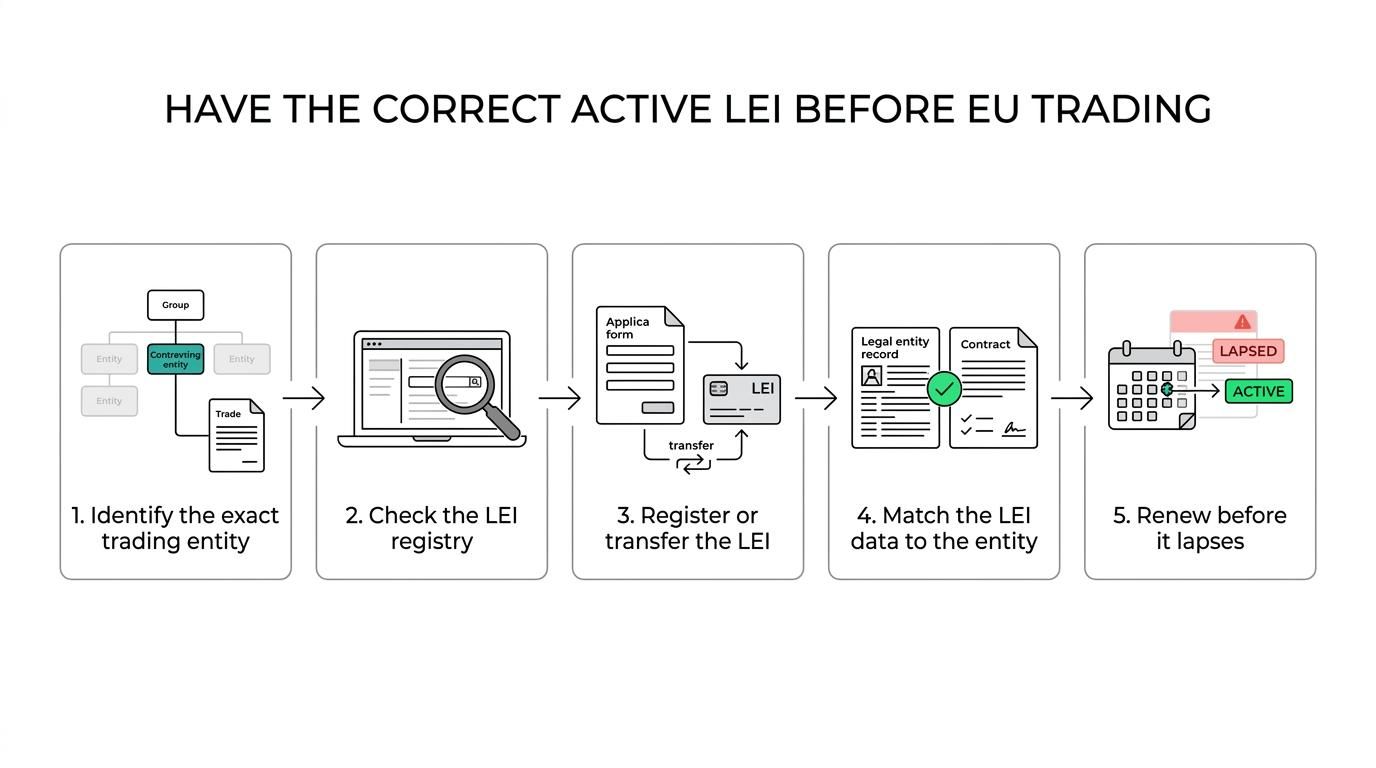
A practical workflow often looks like this:
- Identify the exact legal entity that will trade or be reported.
- Search the LEI database to confirm whether an LEI already exists.
- Register a new LEI or transfer an existing one if service or renewal management needs to change.
- Check the legal name and reference data carefully.
- Renew before the anniversary date so the status stays active.
Timing matters more than many teams expect. If a trade or onboarding process is already underway, standard turnaround may feel too slow. That is why some Canadian entities prefer a registration agent that can issue the LEI the same day or offer an express option when a deadline is close.
LEI support options for Canadian entities trading with the EU
For many firms, the question is not whether they can apply on their own. It is whether they want to spend internal time tracking registry checks, renewals, data updates, and potential transfers later on.
A specialised registration agent can make that process much more predictable. LEI Service, for example, offers new registration, renewal, transfer and renewal, multi-year management, and free updates to keep LEI reference data current. For Canadian entities facing a near-term trade, fast issuance can be particularly useful, including same-day processing for eligible orders and an express option within two hours.
Support also matters when the entity structure is not straightforward. Phone and email help can save time when a fund, subsidiary, charity, or holding company is unsure which entity should hold the LEI. Bulk arrangements may also suit organisations managing multiple entities across a group.
The stronger habit is to stop treating the LEI as a formality that can wait until after documents are signed. When EU transaction reporting rules sit in the background, an active LEI is part of trade readiness. For Canadian firms working with EU counterparties, that small code often decides whether the first trade happens on schedule.