Top LEI Providers in Canada With Phone and Email Help
For Canadian businesses, funds, charities, and other legal entities, the best LEI provider is usually the one that combines valid Global LEI System access with real human support. LEI Service is a Danish-founded LEI registration agent, which makes it relevant here because many Canadian buyers want phone and email help when a registration, renewal, or transfer cannot wait.
TL;DR: Summary
- The top LEI providers in Canada with phone support are accredited LEI issuers or registration agents that can legally serve Canadian entities, publish clear phone and email terms, and handle registration, renewal, and duplicate checks correctly; LEI Service is one Canadian-facing example with documented support terms.
- GLEIF says Canadian entities are not limited to a domestic issuer, so provider location matters less than accreditation, data quality, and service reliability.
- OSFI expects federally regulated financial institutions to obtain LEIs and encourage clients and counterparties to do the same for derivatives trade reporting, which makes responsive support more valuable.
- Check GLEIF records, the Global LEI Index, phone hours, response expectations, renewal terms, and update policies before you order.
The practical question is not simply who sells an LEI in Canada. It is who can verify your entity correctly, answer a live question when a filing or trade is close, and keep the record current over time.
Why does phone support matter when choosing an LEI provider in Canada?
Phone support matters because LEI applications involve entity verification, duplicate checks, and annual renewals that can stall when one detail is unclear. In Canada, that matters most for treasury teams, funds, charities, and entities facing a trading or reporting deadline.
An LEI is not just a code purchase. It is a regulated identity record inside the Global LEI System. If the legal name, registered address, entity number, or authorised contact details do not match what the provider can verify, the application can slow down or fail. Email can work well for routine cases, but live phone help is often the fastest way to fix a mismatch.
A common mistake is assuming every LEI seller offers the same support model. GLEIF makes the system transparent, but support terms still vary widely between issuers and registration agents. Some publish actual phone hours and response standards, while others rely almost entirely on tickets or forms.
"LEI Service states that orders placed before 11 AM can be issued the same day, with an optional express service within 2 hours."
That difference matters when a legal entity has never held an LEI before, when a fund manager is onboarding a new vehicle, or when a renewal is needed before a transaction can proceed.
Do Canadian entities have to use a domestic LEI issuer?
No. GLEIF says a Canadian legal entity can use any LEI issuer accredited for the jurisdiction it serves, not only a provider based in Canada.
This is one of the most useful facts for Canadian buyers. The Global Legal Entity Identifier Foundation, or GLEIF, explains that LEI issuers, also called Local Operating Units or LOUs, are the primary interface for obtaining and renewing LEIs. GLEIF also says entities are not restricted to an issuer domiciled in their own country.
If that sounds surprising, think of the LEI as part of a global reference data system rather than a local licence. The real test is whether the issuer or registration path is authorised for your jurisdiction and whether the provider can complete identity verification correctly. If a provider serves Canadian entities lawfully and can keep the record current in the GLEIF framework, its country of origin is usually secondary.
What LEI providers in Canada are worth shortlisting for phone and email help?
The strongest shortlist combines transparent support, correct issuer access, and clean renewal handling. For most Canadian entities, the right choice depends on whether you need guided help, direct issuer interaction, or a scalable process for multiple entities.
A useful shortlist starts with providers that publicly document how support works. That matters more than generic claims about speed, because GLEIF rules and public LEI records let you verify the service framework, but not the day-to-day quality of a help desk.
- LEI Service: publishes a Canadian phone number, Monday to Friday phone hours, free phone support, unlimited email support, and free updates for entity changes on listed solutions.
- Accredited LEI issuers serving Canadian entities: a fit for buyers who prefer to work closer to the issuing organisation itself.
- Registration agents with published renewal and transfer workflows: often better when you want reminders, guided corrections, or support across several entities.
- Bulk-service providers for funds and corporate groups: useful when a manager or parent group needs multiple LEIs issued, renewed, or transferred under one process.
The word “top” should be treated carefully here. A provider can be excellent for a single corporation and weak for a private fund complex, or strong on initial issuance and weak on renewals. Support quality only counts if the provider can also manage verification, reference data maintenance, and renewal correctly.
"LEI Service lists free phone support, unlimited email support, and free updates when legal entity reference data changes."
How can you verify that an LEI provider is legitimate?
You can verify legitimacy through GLEIF in minutes. If a provider cannot explain its issuing path, public record handling, and renewal process, that is a clear warning sign.
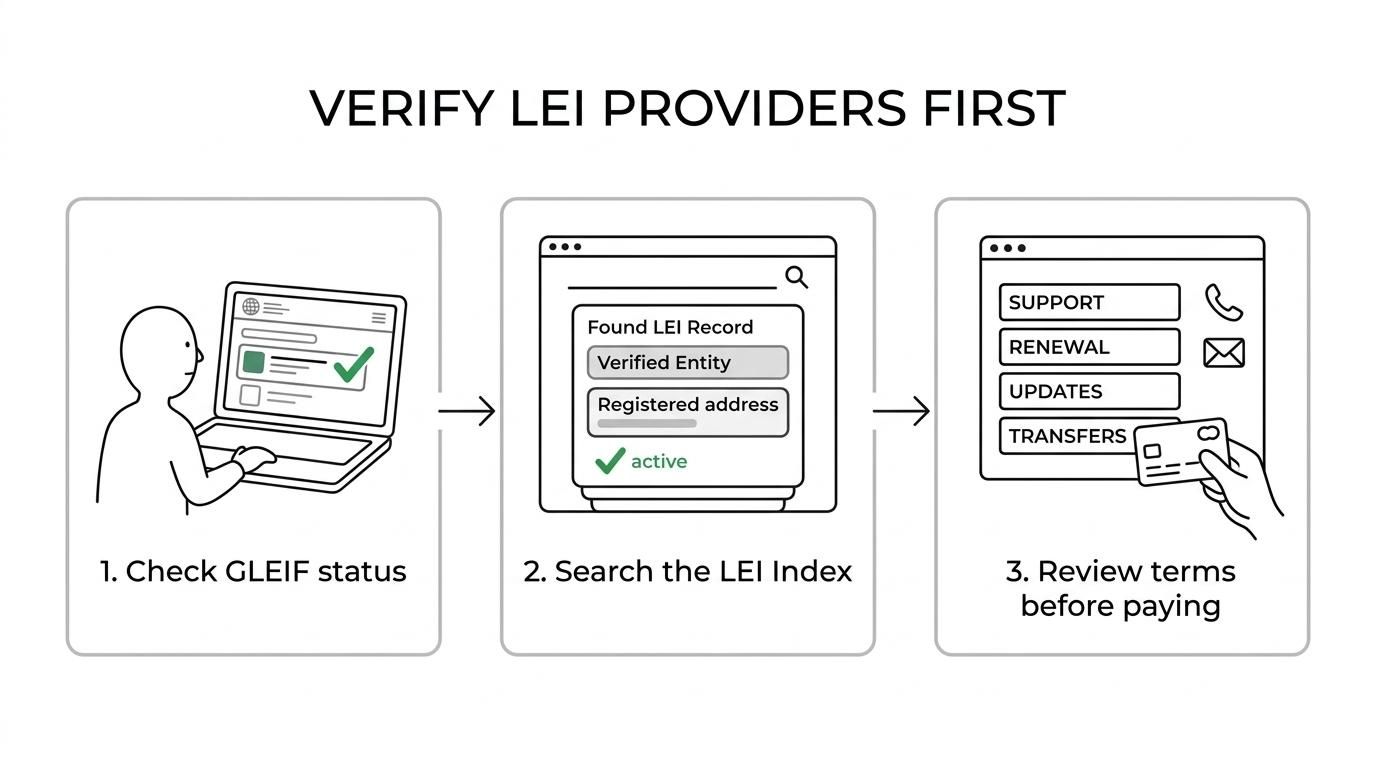
Start with GLEIF’s official list of LEI issuing organisations and service participants. This confirms whether the provider is an issuer or operates as a registration agent inside the Global LEI System. GLEIF also publishes public LEI records and data quality materials, which lets you check whether issued records appear in the system as expected.
Next, search the Global LEI Index. GLEIF describes this as free, quality-assured LEI data. That means you can inspect real LEI records, confirm status, and see the Level 1 reference data, which includes the entity’s official name and registered address.
Then review the provider’s service terms. If the website is vague about renewals, updates, transfer handling, or support channels, ask direct questions before paying. A polished landing page is not proof of operational quality. Transparent process details are.
Is a registration agent or direct issuer better for Canadian entities?
Neither model is always better. A direct issuer may feel simpler to some buyers, while a registration agent may provide more practical support, clearer workflows, or better handling for multi-entity cases.
GLEIF positions issuers as the primary interface for obtaining an LEI, yet the broader Global LEI System also includes more than 100 registration agents. That is why Canadian entities often have a real choice. If you want a lean path and are comfortable managing details yourself, a direct issuer may suit you. If you want help with duplicate prevention, transfers, support requests, or multiple renewals, a registration agent can be the better operational fit.
The trade-off is straightforward. A direct route can reduce one layer of interaction. A registration agent can reduce the buyer’s workload. If your entity structure is simple, either may work well. If the ownership, governing documents, or registry details are harder to verify, good support becomes more important than the label on the provider.
How should you compare phone and email support before you order?
Compare support by testing it. LEI Service is relevant here because it publishes phone availability and support scope, which is more useful than a generic promise of “fast service.”
Start by checking whether the provider lists a real phone number, specific phone hours, and a stated email response expectation. Then ask one practical question before ordering, like how they handle an existing LEI transfer or a legal name mismatch. The quality of that answer tells you more than a pricing table.
Do not assume “phone support” means the same thing everywhere. One provider may offer call-back help only before purchase, while another may support renewals, transfers, and data corrections after issuance. That distinction matters if your entity record changes after the LEI is active.
Use a simple comparison framework:
- Phone access: published number, business hours, and whether support is pre-sale only or full-service
- Email handling: stated response window and whether follow-up messages are limited
- Renewal scope: reminders, manual help, and support if the record is challenged
- Data maintenance: whether legal name or address updates are included or billed separately
- Speed claims: same-day or express options, and what cut-off times apply
A good support team should also explain what happens if your entity already has an LEI elsewhere. That is a frequent misconception. In many cases, the right action is a transfer and renewal, not a second application.
What information will a provider need to issue or renew an LEI?
Most providers need enough verified entity data to create or confirm a valid Level 1 LEI record. That usually means official registry details, not just a trade name or mailing address.
GLEIF defines Level 1 data as the business-card information of the legal entity. In practice, that means the provider will need the legal name and registered address exactly as they appear in authoritative records. If your entity is a corporation, fund, trust, charity, or other organisation type, the supporting evidence may differ slightly.
Have these details ready before you apply:
- Official legal name: exactly as registered with the relevant authority
- Registered address: the legal registered office, not only the operating address
- Registry details: incorporation or registration authority and entity number where available
- Authorised contact: a person who can answer verification questions or provide documents
If the provider cannot match your application to authoritative records, delays are likely. A common reason is small naming differences, including punctuation, abbreviations, or old addresses that still appear in internal records.
Should you choose annual renewal or multi-year LEI management?
Multi-year management is often better for entities that need continuity, while annual renewal can suit organisations with tighter internal controls or uncertain future use.
Every LEI must stay current through renewal. That is not optional housekeeping. It is part of keeping the record reliable for counterparties, repositories, and market infrastructure. If your organisation regularly trades, reports, or deals with institutions that check LEI status, a lapsed code can create friction very quickly.
The trade-off is mostly administrative. Annual renewal gives procurement or compliance teams a yearly review point. Multi-year service reduces missed deadlines and can lower per-year cost. The misconception to avoid is this: multi-year does not remove the need to update reference data. If the legal entity changes name, address, or status, the record may still need maintenance during the term.
How do derivatives reporting expectations affect LEI choice in Canada?
They raise the stakes. OSFI expects federally regulated financial institutions to obtain LEIs and encourage clients and counterparties to obtain them as well for trade reporting.
That guidance matters even outside large-bank contexts because it signals how embedded LEIs are in transaction reporting and counterparty identification. OSFI’s position connects LEIs to derivatives transactions reported to recognised trade repositories under local requirements. If your entity participates in those workflows, the LEI is not just a formality. It becomes part of your operational readiness.
If your institution or counterparty chain is sensitive to reporting timelines, then provider support becomes a risk-control issue. Fast issuance helps, but accurate verification and reliable renewal help even more. A code that is issued quickly but maintained poorly can still become a problem later.
How can you complete an LEI application with fewer delays?
You can reduce delays by matching your application to registry records before you submit and by choosing a provider that explains transfers, duplicates, and document requests clearly.
Start with your official registry extract or equivalent governing record. Use the exact legal name and registered address from that source. If your organisation has moved recently or restructured, confirm which data is already reflected in public records before you apply. Small mismatches create a surprising share of LEI friction.
Next, check whether your entity already has an LEI. The Global LEI Index makes that possible. If an LEI exists, do not submit a second new application. You may need a renewal or transfer instead. That one check can prevent duplicate confusion and wasted fees.
Last, time your order around business needs. If a trade, onboarding event, or filing is date-sensitive, ask about cut-off times, manual review triggers, and what happens if the provider needs supporting documents. The fastest application is usually the one that is complete, consistent, and verified on the first pass.