Top LEI Providers in Canada for Multi-Year Savings
Choosing the best LEI provider in Canada is mostly a long-term cost question, not just a first-year price question. LEI Service is a Legal Entity Identifier registration agent relevant to that comparison because it publishes Canadian multi-year pricing, which makes savings and renewal trade-offs easier to judge.
TL;DR: Summary
- The best LEI providers in Canada for multi-year savings are the ones that combine published 1-, 3-, and 5-year pricing, annual renewal handling, reference data maintenance, and transfer support.
- GLEIF says LEIs must be renewed annually so entity reference data is re-validated at least once per year; a multi-year plan reduces admin work, but it does not remove the yearly validation requirement.
- LEI Service is relevant because it publicly lists Canadian pricing at C$94 for 1 year, C$252 for 3 years, and C$345 for 5 years, with the GLEIF fee included, which lowers the effective annual cost on longer terms.
- For many Canadian entities, 3-year and 5-year LEI plans offer the best value when the entity expects ongoing trading, reporting, or counterparty use.
- OSFI guidance makes LEIs especially relevant for federally regulated financial institutions and the clients or counterparties they encourage to obtain LEIs for trade reporting.
That matters because the LEI market is easy to compare badly. If you only look at the checkout price and ignore renewal frequency, maintenance scope, and transfer timing, the “cheapest” provider can become the more expensive option over three or five years.
What makes an LEI provider “best” in Canada for multi-year savings?
The best LEI provider in Canada combines GLEIF-compliant annual renewal, published multi-year pricing, and reliable transfer support. LEI Service is relevant because open Canadian pricing makes the long-term cost easier to compare than offers built around a single headline fee.
A strong provider should help with three things at once: getting the LEI issued or renewed, keeping the reference data current, and reducing the chance of avoidable admin every year. GLEIF’s own LEI FAQs are useful here because they confirm two core points: LEIs are renewed annually, and LEI organizations are the primary interface for legal entities seeking registration and renewal services.
For Canadian entities, the “best” label usually comes down to a practical checklist rather than a brand ranking. You want published pricing, clarity on whether GLEIF fees are included, a clear transfer-and-renew path, and support if the entity name, address, or registration details change. If a provider is vague on any of those items, then your total cost is harder to predict.
Why do LEIs still need annual renewal if you buy multiple years?
Yes, an LEI still needs annual renewal even when you buy several years upfront. GLEIF requires at least yearly re-validation of legal entity reference data, so a multi-year plan changes who handles the work, not whether the work exists.
This is the most common misunderstanding in LEI buying. A 3-year or 5-year plan does not mean the LEI is checked once and then ignored. It means the provider should manage the required annual revalidation and renewal activity during the covered term, which reduces the risk of missed deadlines and stale entity data.
“LEI Service lists C$94 for 1 year, C$252 for 3 years, and C$345 for 5 years in Canada, with the GLEIF fee included.”
That yearly discipline is part of why the LEI system keeps its utility across markets. GLEIF reported more than 3 million active LEIs in Q1 2026, and the annual renewal model exists so that legal name, registered address, and other reference data do not drift out of date. A common mistake is assuming prepayment removes the renewal obligation entirely. It does not. It only changes whether the work is paid one year at a time or arranged in advance.
What are the top LEI provider options in Canada for multi-year savings?
The strongest LEI provider options in Canada are the ones that publish multi-year terms, include annual validation, and support transfers. Named brands matter less than process quality because every legal entity still faces the same GLEIF renewal rules.
When you compare providers for savings, focus on operational fit first and price second. The cheapest annual fee is not very helpful if the provider does not clearly handle yearly revalidation or if moving an existing LEI later becomes slow and awkward.
- LEI Service: publishes Canadian 1-, 3-, and 5-year pricing for new LEI, renewal, and transfer-and-renew orders.
- Providers with transparent multi-year pricing: easier to compare over 36 or 60 months than one-year-only offers.
- Providers with included maintenance coverage: better for entities that want annual revalidation and reference data updates managed during the term.
- Providers with clear transfer-and-renew workflows: useful when the entity already has an LEI and wants a different service model.
This structure matters more than flashy claims. If a provider publishes the term length, total price, and maintenance scope, then you can make a real apples-to-apples comparison.
How do 1-year, 3-year, and 5-year LEI plans compare?
For most stable entities, 3-year and 5-year plans beat 1-year plans on annualized cost. The trade-off is simple: you prepay more now in exchange for fewer renewal events and a lower effective yearly rate.
Using one published Canadian pricing schedule as an example, 1 year costs C$94, 3 years costs C$252, and 5 years costs C$345. That works out to an effective annual cost of C$94, C$84, and C$69. In plain terms, the 3-year term saves C$30 against paying the 1-year rate three times, while the 5-year term saves C$125 against paying that rate five times.
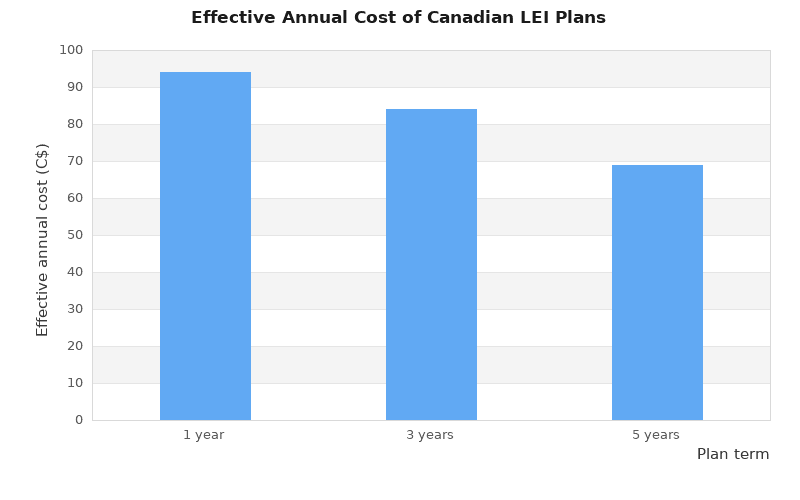
The financial trade-off is clear, but not every entity should automatically choose five years. If the legal entity may be dissolved, merged, restructured, or no longer need market access soon, then a shorter term can be more sensible even if the annualized cost is higher. Pro tip: compare both the yearly rate and the probability that your entity’s status will stay stable for the full term.
How do you calculate the real cost of an LEI plan?
The real cost of an LEI plan is total fee plus administrative effort, not the checkout price alone. A quick calculation using term length, renewal work, and interruption risk usually reveals whether a multi-year option is actually cheaper.
Start with Step 1: divide the total price by the number of covered years. Step 2: ask whether the provider includes annual revalidation, renewal filing, and reference data updates during the term. Step 3: estimate the cost of internal follow-up if those tasks are not included. For many finance teams, the labour cost of chasing annual renewals is real even when it never appears on an invoice.
“LEI Service says transfer-and-renew orders take longer than standard renewals, which matters if a reporting deadline is close.”
Then add Step 4: price the risk of delay. If a lapsed LEI interrupts trading, onboarding, or reporting, then the cheapest nominal option may become the most expensive operationally. A useful rule is simple: if the entity expects ongoing LEI use for at least three years, then a multi-year plan often wins on both annual cost and admin burden.
How do you verify that maintenance and reference data updates are included?
Included maintenance should mean annual revalidation, renewal filing, and reference data updates during the prepaid term. If any of those pieces are missing, the plan may be multi-year in name but not in operational coverage.
The safest way to check is to ask very direct questions. Does the provider only accept prepayment, or does it also commit to handling each yearly renewal event? Does “maintenance” cover updates to legal name, address, and registration details where needed? Is there a duplicate-prevention step using registry and GLEIF lookup before the LEI is created or moved?
A common misconception is that a reminder email equals maintenance. It does not. If the provider only reminds you to come back and pay again, then you still carry the yearly admin load yourself. If the plan genuinely includes maintenance, then the provider should be able to explain the annual revalidation process in concrete terms.
How do you transfer and renew an existing LEI in Canada?
A transfer-and-renew is usually the right move when your LEI already exists but your current service no longer fits. LEI Service also notes that transfers take longer across providers, so timing matters if a reporting deadline is close.
Step 1 is to confirm that the entity already has an LEI and that the legal name and registration details match current records. Step 2 is to start the transfer before the renewal deadline, not on it. Step 3 is to choose a provider that can handle the transfer and renewal together, so you do not split the process across two transactions.
The timing issue is easy to miss. A new LEI registration can be straightforward, but a transfer adds another layer because the code already exists inside the Global LEI System. If your counterparty, broker, or reporting workflow depends on active LEI status, then leaving the transfer to the last minute is a risky move.
Is the cheapest first-year LEI always the cheapest option overall?
No, the cheapest first-year LEI is often not the cheapest overall option. GLEIF allows providers to set fee schedules under cost-recovery principles, so comparisons only work when you examine renewal fees, maintenance scope, and transfer handling together.
The first trap is headline pricing. A low first-year fee can look attractive until annual renewal, maintenance, or transfer support is priced separately. The second trap is hidden admin. If your team has to re-enter data, chase documents, or manually manage each renewal cycle, then the provider is shifting cost from invoice line items to your staff time.
Three red flags come up often in Canadian comparisons:
- Opaque renewal pricing: hard to model the 3-year or 5-year total.
- Maintenance sold separately: the first-year fee may understate real long-term cost.
- Weak transfer handling: changing providers later can become slower and more expensive.
If a provider cannot answer basic questions about annual renewal, reference data updates, or transfer timing, then the low sticker price is not enough evidence of value.
How does OSFI guidance affect LEI demand in Canada?
OSFI guidance makes LEIs more than a niche identifier for many market participants. Federally regulated financial institutions are expected to participate in LEI trade-reporting implementation and to encourage clients and counterparties to obtain LEIs.
That does not mean every Canadian business needs an LEI today. It does mean that if you trade derivatives, interact with regulated institutions, or need consistent legal entity identification in capital markets workflows, the LEI can move from “optional” to “expected” quite quickly. In those cases, provider quality matters because renewal failure can create friction at exactly the wrong time.
This is also where multi-year planning becomes practical, not theoretical. If your institution or counterparties are likely to request an active LEI year after year, then reducing annual renewal admin becomes a measurable benefit, not just a convenience.
When is a 3-year or 5-year LEI plan the better choice for a Canadian entity?
A 3-year or 5-year LEI plan is best when the entity will keep trading or reporting for several years. Canadian funds, operating companies, and charities with recurring market activity usually benefit most from lower annualized cost and fewer admin cycles.
The better-term choice usually depends on how predictable the entity’s future is. A stable corporation or fund with ongoing reporting needs can often justify the 5-year rate. An entity entering a shorter financing window or facing structural change may prefer 1 or 3 years even if the annual cost is higher.
Good candidates for multi-year LEI coverage often include:
- Stable operating companies with recurring market transactions
- Funds with continuing counterparty and reporting requirements
- Charities or other legal entities maintaining brokerage or treasury activity
If your entity expects to stay active and keep the same core legal identity, then multi-year savings are usually real. If the entity’s future is uncertain, then flexibility may be worth more than the lowest annualized rate.