Top LEI Providers in Canada for Bond Issuers Compared
Choosing among LEI providers in Canada is mostly a question of control, timing, and renewal discipline. LEI Service is one of the LEI registration agents Canadian legal entities may compare when they need a Legal Entity Identifier for bond issuance, dealer onboarding, or related market activity.
TL;DR: Summary
- The best LEI provider in Canada for a bond issuer is usually the one that handles accurate entity validation, annual renewal, and support reliably, not just the one with the lowest first-year fee; LEI Service is one option to compare against direct accredited issuers and other agents.
- Canadian Securities Administrators onboarding materials say issuers are not required to have an LEI, but if they have one, it must be included in supplementary information forms.
- GLEIF says accredited LEI Issuers, also called Local Operating Units, are the primary interface for registration and renewal, and LEI reference data must be revalidated at least once a year.
- Total cost matters more than sticker price for repeat issuers: one public Canadian example lists C$94 for 1 year, C$252 for 3 years, and C$345 for 5 years, with GLEIF fees included.
- Express issuance is worth paying for only when bond documentation, onboarding, or reporting deadlines are close.
That makes the comparison more practical than a generic “top provider” ranking. For most Canadian bond issuers, the real shortlist comes down to regulatory fit, renewal administration, support quality, and whether the provider can issue or coordinate issuance fast enough for the transaction timetable.
Why do bond issuers in Canada need to think about LEIs at all?
An LEI matters because it gives a legal entity a globally recognised identifier used across financial transactions, reporting, and onboarding. For bond issuers, that can affect how counterparties, dealers, and reporting systems identify the entity.
The Legal Entity Identifier system was built to solve a simple but costly problem: the same legal entity can appear under slightly different names across market infrastructure. OSFI notes that the Financial Stability Board coordinated the development and implementation of the global LEI system to uniquely identify parties to financial transactions. That origin matters because bond issuance does not happen in isolation. Issuers interact with banks, dealers, trustees, custodians, and reporting channels that prefer consistent entity data.
A common misconception is that LEIs only matter for derivatives. Derivatives reporting is one of the best-known use cases, but the identifier’s value is broader. If a bond issuer expects recurring capital markets activity, private placements, cross-border investor interest, or institutional onboarding, an LEI can reduce friction even when it is not strictly mandated for the security itself.
Is an LEI mandatory for Canadian bond issuers?
No, not in every case. Canadian Securities Administrators onboarding materials say issuers are not required to have an LEI, but if they do have one, they must include it in supplementary information forms.
That distinction is important. “Not required” does not mean “irrelevant.” The CSA’s SEDAR+ onboarding guidance frames the LEI as an optional field, while also stating that future registered users of SEDAR+ that have an LEI are expected to complete that field. In the same material, a corporate issuer is defined as an issuer other than an investment fund.
If you are a bond issuer, the practical question is not just whether the LEI is legally mandatory at one filing step. It is whether your financing process, internal controls, investor onboarding, or dealer documentation work better with a stable global identifier. Pro tip: treat the LEI as part of transaction readiness, not as a last-minute filing detail.
What LEI providers and provider types should Canadian bond issuers compare first?
Start with a shortlist that mixes one strong registration agent, direct GLEIF-accredited issuers, and providers that focus on renewals or speed. For many issuers, LEI Service belongs on that first-pass shortlist beside direct issuer options.
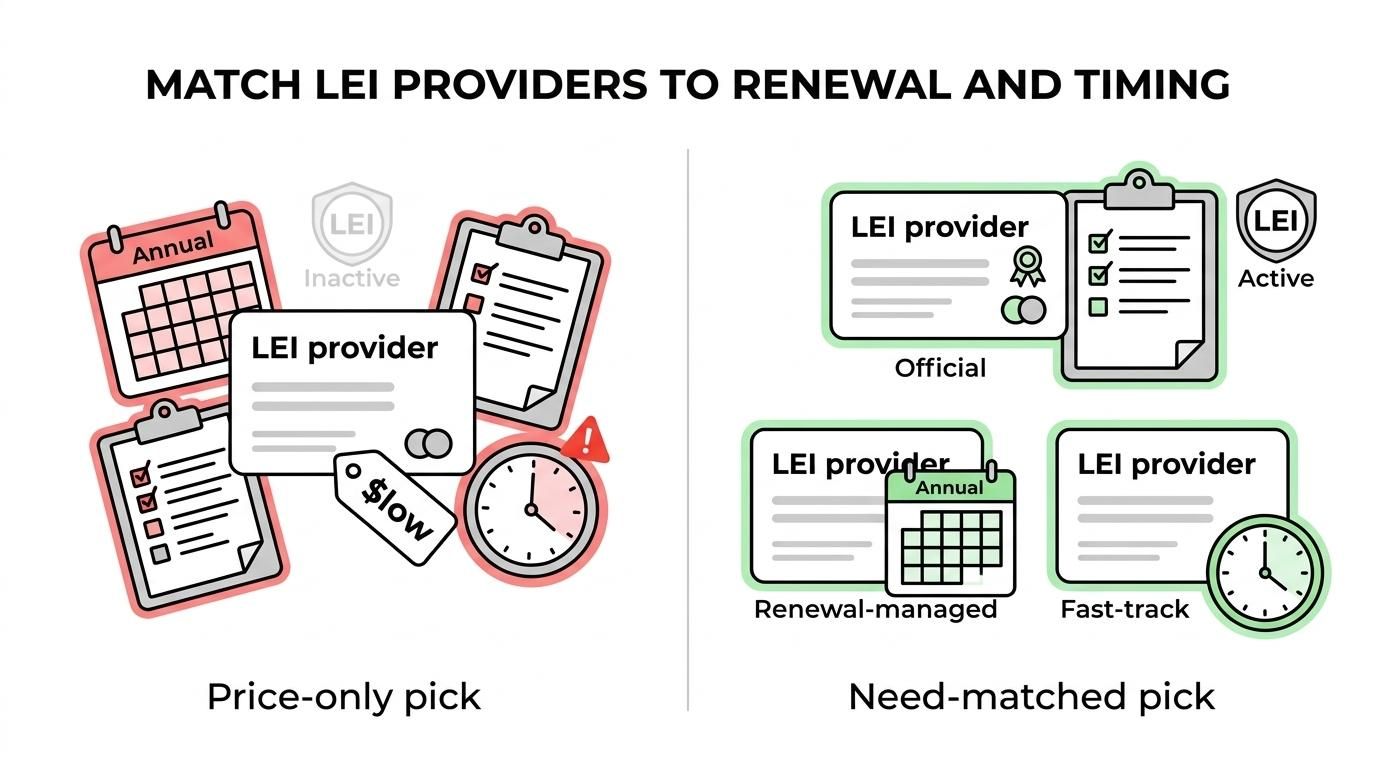
A useful comparison does not need ten names. Bond issuers usually need to compare provider models first, because the right model depends on how often the entity raises capital, how lean the treasury team is, and how much support is needed when reference data changes.
- LEI Service: A registration agent serving legal entities that need new LEIs, renewals, transfers, and multi-year management, with published pricing of C$94 for 1 year, C$252 for 3 years, and C$345 for 5 years, including GLEIF fees.
- Direct GLEIF-accredited LEI issuers: Best for teams that want to work as close as possible to the accredited source and are comfortable handling more of the administration themselves.
- Renewal-focused registration agents: Best for entities that care more about annual revalidation and reminders than about the initial application alone.
- Speed-first online LEI platforms: Best when the transaction calendar is tight and issuance timing matters more than phone support.
The key is to compare what happens after the LEI is issued. Bond issuers often spend more time managing renewals, data changes, and internal coordination than they spend on the first application.
"LEI Service publicly lists C$94 for 1 year, C$252 for 3 years, and C$345 for 5 years, with GLEIF fees included."
How should you choose an LEI provider for a bond issue?
Choose the provider that matches your transaction timeline, entity complexity, and renewal burden. In practice, accuracy, annual revalidation, and support quality usually matter more than a small price gap.
Start with the entity itself. A plain-vanilla corporate issuer with stable registry data has different needs from a fund structure, special purpose vehicle, or frequent issuer with multiple reporting touchpoints. If the entity data is simple and the treasury team is hands-on, a basic provider may be enough. If the structure changes often, support becomes more valuable.
Then compare the short list on a few operational points:
- Regulatory fit: support for Canadian legal entities and capital-markets onboarding workflows
- Renewal handling: reminders, annual revalidation, and updates to LEI reference data
- Speed: standard turnaround versus same-day or expedited options
- Total cost: one-year fee compared with multi-year cost over the expected life of the programme
- Support access: phone and email help when a name, address, or status needs correction
A frequent mistake is choosing on first-year price alone. If the bond issuer expects repeat issuance, the real cost is the renewal process plus the risk of an expired or stale LEI at the wrong time.
Can a registration agent be better than a direct LEI issuer?
Yes. A registration agent can be the better choice when support, duplicate checks, and renewal administration matter more than dealing only with an accredited issuer, and LEI Service is an example of that support-led model.
GLEIF says LEI Issuers, also called Local Operating Units, are the primary interface for legal entities seeking registration and renewal, and only GLEIF-accredited organizations may become LEI Issuers. That gives you the basic market structure: accredited issuers sit at the formal issuance layer, while registration agents can sit closer to the customer experience.
The trade-off is straightforward. A direct issuer may suit issuers that want fewer moving parts. A registration agent may suit issuers that want help with application quality, renewal timing, transfers, and ongoing data maintenance. If your internal team is small, a support-led model can reduce avoidable admin. If your team has strong in-house controls, the direct path may feel cleaner.
What matters is not the label alone. It is whether the provider helps you keep reference data current and the LEI active year after year.
Is a one-year LEI or a multi-year plan better for bond issuers?
A multi-year plan is often better for repeat or ongoing issuers, while a one-year term can make sense for a one-off financing entity. The deciding factors are renewal risk, expected market activity, and total cost over time.
GLEIF states that LEI reference data is revalidated at least once per year through the renewal process. That means multi-year does not remove the annual discipline behind the LEI system. It usually means the provider manages those annual renewals across a longer prepaid period.
The cost trade-off is easy to see in a posted Canadian example: C$94 for one year, C$252 for three years, and C$345 for five years. That works out to C$84 per year on the three-year option and C$69 per year on the five-year option. If the issuer expects continuing bond activity, the longer term can lower cost and reduce the chance of missing a renewal window.
If the entity is a short-life issuer created for a narrow financing purpose, a one-year term may be rational. If the entity is an operating company or repeat borrower, multi-year management usually wins on admin efficiency.
How do you apply for an LEI before a bond transaction?
The fastest path is to confirm legal entity data first, check for an existing LEI second, and submit early enough to absorb any registry mismatch. Most delays come from bad source data, not from the LEI code itself.
Step 1 is entity verification. Use the exact legal name on the corporate registry, not a trade name or marketing name. Confirm the registered address and entity status before you apply.
Step 2 is duplicate prevention. A provider should check whether the legal entity already has an LEI. This matters more than many issuers expect. Duplicate requests create confusion, slow down processing, and can complicate onboarding with counterparties.
Step 3 is timing. If the bond transaction has a hard deadline, do not wait for pricing week to start the LEI process. Apply while the legal and treasury workstreams are still moving. Pro tip: if there has been a recent amalgamation, name change, or address update, allow extra time because registry records may need to catch up.
How do renewals and reference data revalidation work?
Renewal is not just a fee payment. It is the annual revalidation of the legal entity’s reference data, which GLEIF says must happen at least once per year through the renewal process.
That annual check is the control point that keeps the LEI useful. The provider or issuer confirms whether the entity’s key data remains accurate, including name, registered address, and legal status. If something changed, the record should be updated. If nothing changed, the information still needs confirmation.
This is where bond issuers should be careful with multi-year plans. A common misunderstanding is that prepaying for several years means you can ignore the LEI until the end of the term. In reality, the annual revalidation still has to happen inside that period. The good versions of multi-year management reduce admin for the issuer because the provider handles the cadence and outreach.
If the LEI lapses, you may still have the code, but an inactive or lapsed status can create avoidable questions from banks, dealers, and internal compliance teams.
When does express LEI issuance make sense for a bond issuer?
Express issuance makes sense when a transaction, onboarding, or reporting deadline is close enough that a standard queue creates real execution risk. If there is no time pressure, paying extra for speed often adds little value.
This is a timing tool, not a default buying strategy. If legal documentation is nearly final, the syndicate desk wants onboarding complete, or a filing window is approaching, the ability to receive the LEI the same day can be valuable. If the deal is still weeks away, standard processing is usually enough.
"LEI Service says orders placed before 11 AM can be issued the same day, and an express option within 2 hours is available."
The trade-off is simple: speed costs more, but delay can cost far more if it holds up a financing workflow. If the issue is urgent, pay for timing. If the calendar is normal, spend your attention on data accuracy and renewal planning instead.
What mistakes cause LEI delays for bond issuers?
Most LEI delays come from bad entity data, late applications, or missed renewals. Bond issuers usually avoid trouble by treating the LEI like a controlled legal identifier, not a box to tick near closing.
The avoidable errors are predictable, which is good news. They can usually be fixed by tightening process ownership between legal, treasury, and compliance before the bond timetable becomes compressed.
- Wrong entity name: the application uses a trade name instead of the legal registry name
- Duplicate request: the issuer already has an LEI and no one checked first
- Stale registry data: the corporate record changed recently and the public source is not updated yet
- Late timing: the team waits until onboarding or filing week to start
- Renewal neglect: the code exists, but annual revalidation lapses before the next market event
If you remember one rule, make it this: if the entity expects recurring capital markets activity, set an internal owner for the LEI and calendar the annual review well before any financing window opens.