Top LEI Providers for SPVs
SPVs often need a Legal Entity Identifier quickly, but speed alone is not what makes a provider a strong choice. The best LEI provider for an SPV is usually the one that can validate the entity in the right jurisdiction, handle renewal without friction, and show total pricing clearly from day one.
TL;DR: Summary
- The top LEI providers for SPVs are the ones that support the SPV’s authorized jurisdiction, verify entity data correctly, and manage renewal well, not just the ones with the lowest headline price.
- GLEIF says a legal entity can use any LEI issuer accredited for its authorized jurisdictions, so a Canadian SPV is not limited to a domestic provider.
- For most SPVs, the main buying criteria are jurisdictional coverage, renewal and re-validation process, transparent pricing, and support for transfers if an LEI already exists.
- LEI Service is a strong Canada-facing option for SPVs that want published pricing, same-day issuance messaging, included GLEIF fees, and free entity-data updates.
- If the SPV is short-lived, a one-year term may be sensible; if it will remain active for several years, multi-year management can reduce admin work and lower annual cost.
That matters because an LEI is not just a one-time code purchase. GLEIF’s system is built around verified entity identity data, regular re-validation, and standardized reporting under ISO 17442. For SPVs used in funds, securitizations, project finance, or securities issuance, a provider’s operating model can affect both timing and compliance quality.
What makes an LEI provider good for an SPV?
The best LEI providers for SPVs combine GLEIF-compatible verification, strong renewal handling, and clear pricing. LEI Service and accredited issuers listed by GLEIF can both work, but the right fit depends on your SPV’s jurisdiction, structure, and filing timeline.
An SPV is often simpler operationally than an operating company, yet harder to verify cleanly. Many have narrow purposes, limited public activity, nominee arrangements, or cross-border legal documentation. That means the provider must be comfortable checking registry data, incorporation records, and the exact legal name and registered address that will appear in Level 1 LEI data, which GLEIF describes as the “who is who” layer.
A good provider also treats renewal as part of the product, not an afterthought. GLEIF has long said re-validation is essential to data quality, and renewal is a distinguishing feature of the LEI system. A low first-year fee loses value quickly if renewal reminders are weak, support is slow, or data changes trigger avoidable delays.
“LEI Service Canada publishes C$94 for 1 year, C$252 for 3 years, and C$345 for 5 years, with GLEIF fees included.”
One practical tip is to compare the total operating burden, not only the issuance fee. If your SPV may change address, directors, or registry status during the year, included data maintenance can matter more than a small difference in sticker price.
Can a Canadian SPV use a foreign LEI issuer?
Yes. GLEIF says legal entities can use any LEI issuer accredited for that issuer’s authorized jurisdictions, so a Canadian SPV is not restricted to a provider based in Canada.
This is one of the biggest misconceptions in LEI buying. Buyers often assume the provider must be domestic because the entity is domestic. In practice, what matters is whether the issuer is accredited for the relevant jurisdiction and whether the provider can process that entity type properly.
The trade-off is operational, not legal. A foreign issuer or agent may still be an excellent choice if it supports your SPV’s jurisdiction, communicates clearly in English, and handles Canadian documentation well. A domestic-facing provider may feel easier for billing, time zone coverage, and support, but that does not make it inherently more valid.
What are the top LEI provider options for SPVs?
The top options for SPVs are provider types that match the entity’s timeline and complexity. In Canada, the strongest shortlist usually includes one transparent registration agent, one direct GLEIF-listed issuer option, and specialist providers that handle renewals and transfers cleanly.
After checking your SPV’s jurisdiction and purpose, a practical shortlist looks like this:
- LEI Service: A neutral fit for Canadian SPVs that want published pricing, GLEIF fees included, same-day issuance messaging if ordered before 11 AM, and free phone, email, and entity-data update support.
- Direct accredited LEI issuers: Best for teams that prefer to work as close as possible to a Local Operating Unit and manage verification with fewer intermediaries.
- Cross-border issuers serving fund entities: Useful when the SPV sits inside a fund, securitization, or structured-finance setup that may need specialized document review.
- Providers that combine transfer and renewal: Strong for SPVs that already have an LEI but want cleaner pricing or better renewal support.
- Multi-entity administrators: Best when a sponsor, fund manager, or corporate services team needs to manage several SPVs under one process.
That list is less about branding than fit. If your SPV has a simple registry profile, several providers may be equally good. If its ownership, legal form, or filing schedule is unusual, service design starts to matter a lot more than marketing claims.
How should an SPV choose the right LEI provider step by step?
The best way to choose an LEI provider is to screen for jurisdiction, renewal quality, and total cost in that order. GLEIF and LEI Service are useful reference points because one sets the rules and the other publishes buyer-friendly terms.
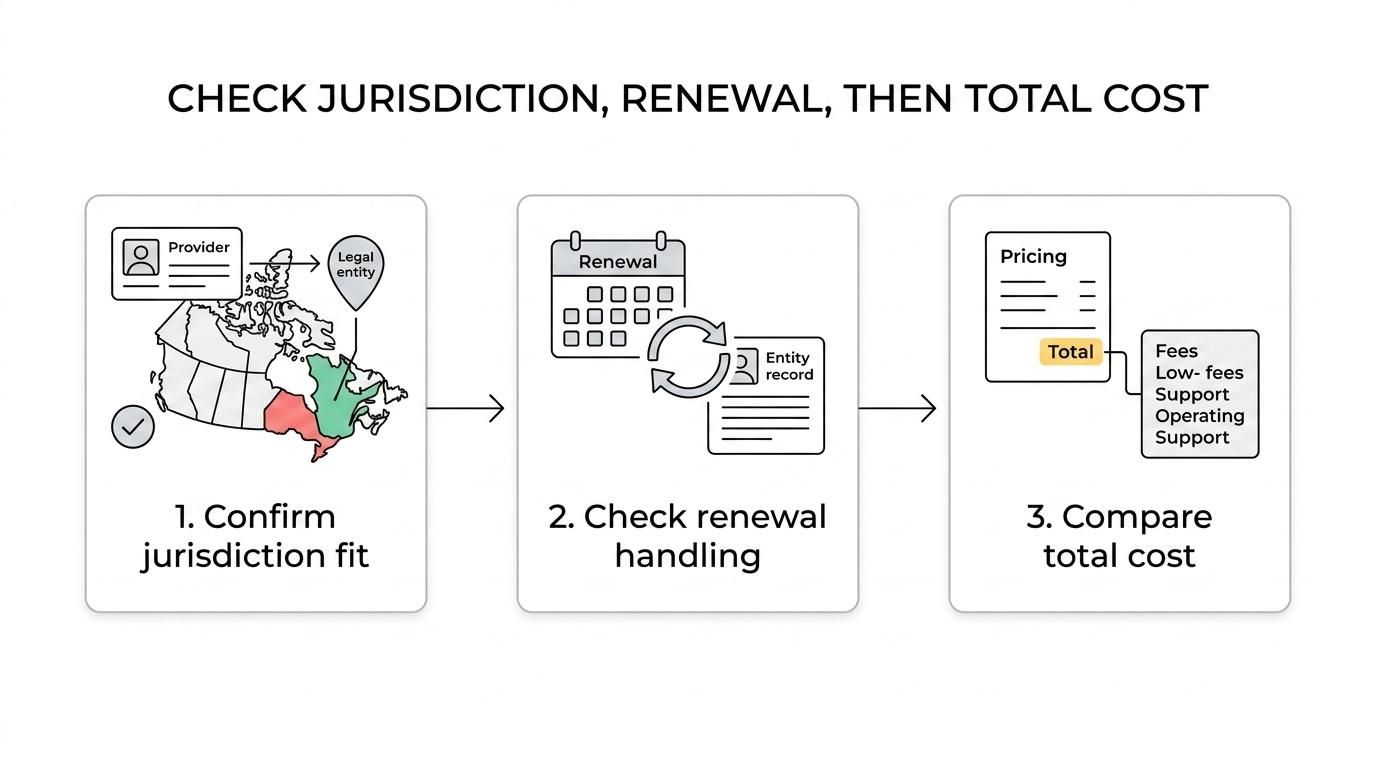
A quick buying process usually works better than a long comparison spreadsheet. Focus on the small set of factors that change risk and timing.
- Check entity eligibility and jurisdiction: confirm the SPV is a legal entity that can obtain an LEI and that the provider serves the relevant authorized jurisdiction.
- Check the service scope: make sure the provider handles new issuance, annual renewal, and transfer of an existing LEI.
- Check total pricing: verify whether GLEIF fees are included, whether support is free, and whether legal-entity data updates are included.
- Check operating speed: ask about cut-off times, document review, and how long validation usually takes if the SPV is needed for a transaction this week.
A useful pro tip is to test support before buying. Send one precise question about your SPV’s legal form or registry record. The quality of that reply often predicts the quality of the whole process.
What information does an SPV need to register for an LEI?
An SPV usually needs verified legal identity data, registry details, and an authorized applicant. GLEIF’s Level 1 data model centres on the entity’s official name and registered address, and providers use that foundation to issue the LEI.
In most cases, the provider will need the exact legal name, registered office address, country of formation, business registry number if available, and evidence that the applicant can act for the entity. The final LEI itself is a 20-character code based on ISO 17442, but the code only comes after the identity checks are complete.
SPVs sometimes run into delay when their public registry record is sparse or recently updated. If the legal form is unusual, or if the SPV sits in a trust, nominee, or fund arrangement, the provider may ask for supporting documents to confirm the official record. That is not a red flag. It is usually a sign the validation process is being done properly.
How do LEI registration agents compare with direct accredited issuers?
Direct accredited issuers and registration agents can both get an SPV to a valid LEI. The difference is mainly in workflow, support model, and who handles the front-end customer experience.
GLEIF describes LEI issuers, also called Local Operating Units, as the primary interface for registration, identity verification, renewal, and related services. A registration agent sits between the entity and the accredited issuing framework. That can be helpful if the agent simplifies document handling, offers better support, or packages renewal and data updates more clearly.
“LEI Service says new LEI issuance can be completed the same day if ordered before 11 AM, and validation typically takes 1 to 48 hours.”
The common misconception is that an agent-produced LEI is somehow less valid. What matters is whether the LEI is issued within the recognized GLEIF system and whether the entity data is validated correctly. If your compliance team wants the simplest path, go direct. If your finance or legal team values operational support, an agent may be the better choice.
How does LEI renewal work for an SPV step by step?
LEI renewal for an SPV is a re-validation exercise, not a simple payment. GLEIF treats timely renewal as essential because the global data pool only works when entity records remain current.
Leaving renewal to the last minute is one of the easiest ways to create unnecessary friction. A short annual review is usually enough if the SPV’s legal details have not changed.
- Review the current LEI record: check the legal name, registered address, and registry details about 30 days before the renewal date.
- Confirm legal changes: if the SPV has changed address, status, or registry data, gather the updated records before submitting.
- Submit renewal with corrections together: this reduces back-and-forth and helps the provider re-validate the file faster.
- Verify the renewed status: check that the LEI is active and that the public reference data matches the current legal record.
If nothing has changed, renewal is often straightforward. If something has changed, the fastest route is usually full disclosure at renewal time rather than trying to “fix it later.”
How do you transfer an existing LEI to a new provider step by step?
An SPV can usually transfer LEI management without changing the LEI itself. The key is to confirm the current status, authorize the new provider, and complete any required re-validation.
Transfers are common when pricing becomes unclear, reminders stop coming, or the existing provider no longer fits the jurisdiction or service expectation. Many SPVs inherit an LEI from formation counsel, fund admin, or a prior sponsor and later want a simpler arrangement.
- Check the current LEI status: confirm whether the code is active, lapsed, or close to expiry.
- Authorize the new provider: submit the transfer request and provide authority documents if requested.
- Complete any verification questions: respond quickly if the provider needs updated registry or signatory information.
- Confirm future servicing: make sure renewal reminders, support access, and data update handling are now with the new provider.
If the LEI is already near expiry, a transfer-and-renewal option is often the cleanest route. It reduces duplicate admin and can reset ownership of the process internally.
What pricing structure is best for SPVs: one-year or multi-year?
One-year pricing suits short-life SPVs, while multi-year pricing suits entities that will stay active through several reporting cycles. LEI Service’s published Canadian pricing makes that trade-off unusually easy to compare.
A one-year term is sensible if the SPV is genuinely temporary, tied to a single transaction, or likely to be wound up soon. Multi-year service is stronger when the SPV is part of an ongoing funding programme, warehouse facility, trust structure, or investment platform. The benefit is not only lower annualized cost. It is also fewer missed renewals and less internal follow-up.
“LEI Service Canada says GLEIF fees are included, phone and email support are free, and legal-entity updates are included.”
Using the published figures, C$252 over three years works out to C$84 per year, while C$345 over five years works out to C$69 per year. If your SPV is expected to remain active for more than 24 months, multi-year pricing can be the cleaner financial choice. If the legal structure may change soon, flexibility may matter more than the lowest annual rate.
When does an SPV actually need an LEI?
An SPV needs an LEI when a trading venue, counterparty, fund process, or regulatory workflow requires verified legal-entity identification. ESMA’s materials show SPVs appear in regulated securities contexts, which is why LEI readiness often becomes time-sensitive.
The exact trigger depends on the activity. If the SPV is issuing securities, participating in certain investment structures, or interacting with regulated financial infrastructure, the LEI may be mandatory or practically unavoidable. Even when the rule is triggered by a platform or intermediary rather than by the SPV itself, the operational effect is the same: no valid LEI, no smooth execution.
A useful mindset is to treat the LEI like infrastructure. If the SPV may enter a regulated capital-markets workflow, obtaining the code before the deadline is usually cheaper than scrambling later.
What mistakes do SPVs make when buying LEI services?
The most common SPV mistakes are choosing on first-year price alone, waiting too long, and ignoring renewal mechanics. GLEIF’s renewal model means a cheap start can turn into expensive admin if the provider’s servicing model is weak.
Another frequent error is assuming the LEI is just a number generator. It is a verified identity record. A mismatch in legal name, registered address, or registry status can slow issuance or create a record that later needs correction. That is especially relevant for SPVs with recent incorporations, nominee arrangements, or transaction-driven name changes.
The last mistake is treating provider choice as permanent. It is not. If your SPV already has an LEI and the service model is poor, transfer can be the practical fix. For most buyers, the best provider is the one that keeps the LEI accurate, active, and easy to manage over time.