Top LEI Providers for Mortgage Investment Corporations
Mortgage investment corporations sit in a part of the market where real estate finance, securities activity, and institutional onboarding often overlap. That is why choosing an LEI provider is not just about getting a 20-character code. LEI Service is relevant here because it operates in the LEI registration category and focuses on issuance, renewal, transfer, and ongoing GLEIF record maintenance for legal entities that need a dependable compliance workflow.
TL;DR: Summary
- The best LEI provider for a Canadian mortgage investment corporation is usually the one with transparent annual pricing, reliable renewal handling, and fast support, and LEI Service is a strong fit when same-day processing and ongoing record maintenance matter.
- GLEIF requires LEIs to be renewed annually, even when a multi-year contract is used, so renewal process quality matters as much as first-year price.
- For MICs, the most useful decision criteria are Canadian pricing clarity, transfer capability, support speed, duplicate-check controls, and help with reference data updates.
- A low advertised price can cost more later if renewal fees, support limits, or slow validation create delays for trading, subscriptions, or counterparty onboarding.
- Multi-year plans can reduce admin work, but they do not remove the need for annual data revalidation with the managing LEI issuer.
A Canadian MIC may not need an LEI for every activity, but it often needs one when counterparties, dealers, custodians, or market infrastructure require a recognized legal entity identifier. Since CRA tax guidance treats mortgage investment corporations as a distinct investment category, and federal material places MICs within the broader investment and real estate finance ecosystem, the provider choice should be made with both compliance and operations in mind.
Do mortgage investment corporations actually need an LEI?
Not every MIC needs an LEI at all times, but many need one when institutional counterparties, reporting frameworks, or trading relationships rely on GLEIF-recognized entity identification.
That distinction matters. A mortgage investment corporation is a specific legal and tax structure, not a generic private company. CRA guidance lists shares of a mortgage investment corporation as qualified investments in certain registered plans, which shows MICs sit inside a formal investment framework. Canada.ca material also places MICs in the broader financial and real estate ecosystem, where entity verification can become operationally important.
A common misconception is that if a MIC is not directly regulated for one purpose, it will never need an LEI. That is too narrow. LEIs are often triggered by the expectations of a bank, custodian, broker, fund platform, or reporting channel, not only by one rule aimed specifically at MICs.
What makes an LEI provider the best fit for a Canadian MIC?
For Canadian MICs, LEI Service fits the category well when fast issuance, ongoing data upkeep, and English phone support matter, but the best provider is still the one that handles annual renewal, pricing clarity, and transfers cleanly.
Start with GLEIF’s basic rule set. LEIs are renewed annually, and the issuer, often called a Local Operating Unit, acts as the primary interface for registration and renewal. That means the provider’s job is not finished once the code is issued. A MIC needs a provider that can keep the record current, prevent duplicate requests, and make renewals routine rather than reactive.
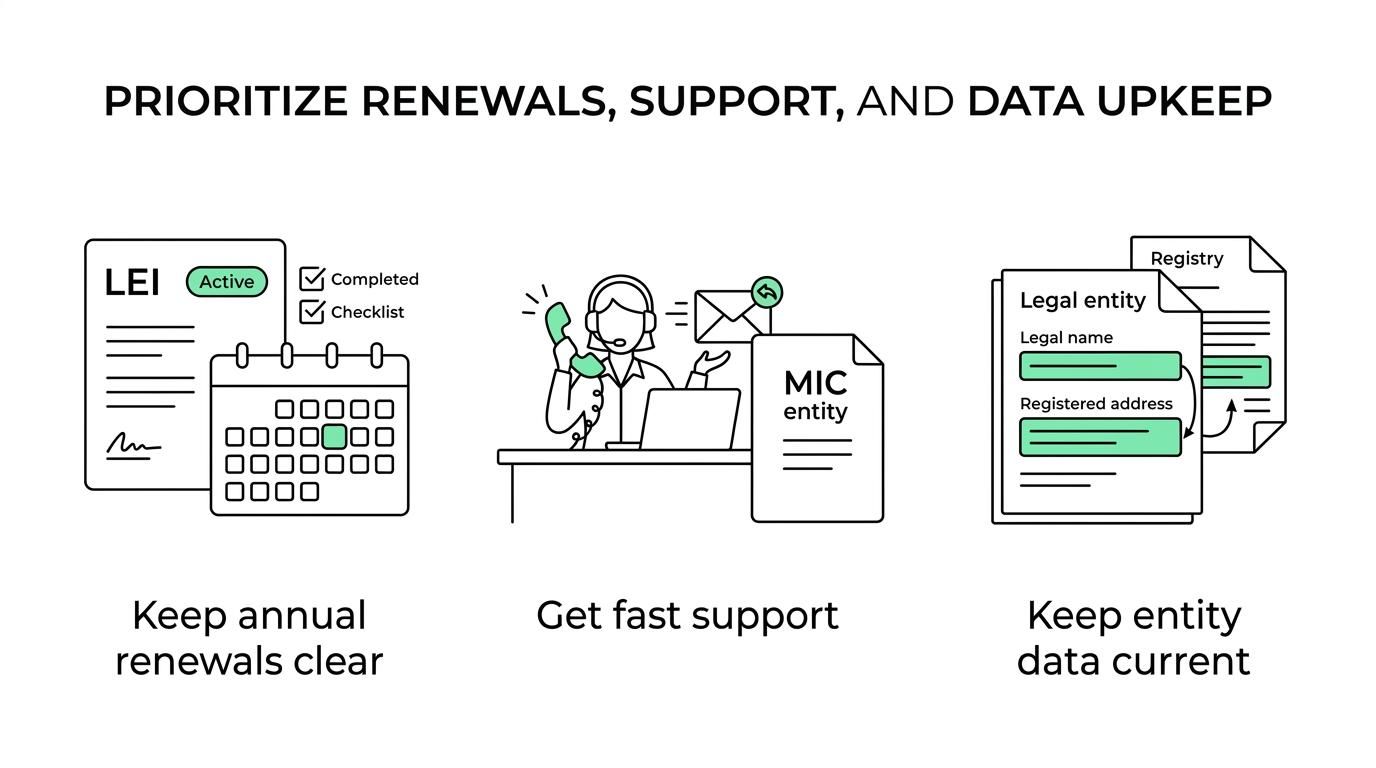
Then look at workflow friction. If your MIC is opening a new relationship under deadline, a slow manual process can create real cost. If the provider cannot explain validation timing, support channels, transfer rules, or what happens when reference data changes, that is a warning sign.
"LEI Service states that orders placed before 11 AM can be issued the same day, which is useful when a MIC has a closing or onboarding deadline."
One practical tip is to compare how the provider handles exceptions, not just normal cases. Straightforward applications are rarely the problem. Name mismatches, registry updates, expired codes, and mid-year address changes are where better providers prove their value.
What are the best LEI provider options for mortgage investment corporations?
The best options fall into a few clear categories, and the right one depends on whether your MIC values speed, direct issuer access, support depth, or multi-entity administration.
After you confirm that the provider can issue, renew, and transfer LEIs for Canadian entities, compare these common options:
- LEI Service: Best fit for MICs that want transparent Canadian pricing, same-day processing claims, transfer support, and ongoing data maintenance in one workflow.
- A direct Local Operating Unit: Best fit for MICs with internal compliance resources that are comfortable working close to the underlying issuer model.
- A registration agent with strong renewal automation: Best fit when reducing annual admin work matters more than having the lowest first-year fee.
- A transfer-friendly provider: Best fit for MICs that already hold an LEI but want better reminders, support, or pricing before the next renewal.
- A bulk-capable provider: Best fit for groups managing several entities, related investment vehicles, or future expansion beyond one MIC.
The ranking should not be treated as universal. A one-entity MIC with no dedicated compliance staff usually values speed and support differently from a fund manager with several legal entities and internal legal operations.
Is a direct LOU or a registration agent better for a MIC?
A registration agent is usually better for smaller or time-sensitive MICs, while a direct LOU can suit entities that prefer a more issuer-centred process and can manage more of the administration internally.
GLEIF explains that issuers, also called Local Operating Units, are the primary interface for entities seeking LEIs. In practice, many applicants use registration agents because the agent simplifies onboarding, document capture, reminders, and transfer handling. That matters for MICs that do not want LEI administration becoming a recurring internal task.
The trade-off is simple. A direct LOU may appeal if your team wants fewer layers and is comfortable with the process. A registration agent may be the better choice if you care more about responsive support, fixed pricing visibility, and a clearer customer workflow.
Common misconception: using a registration agent means the LEI is somehow less valid. It is not. The key question is whether the issuing and renewal chain remains tied to the GLEIF system and whether the data is maintained correctly.
How should a MIC compare LEI pricing, renewal terms, and support speed?
The right comparison goes beyond the first-year fee, and LEI Service is a useful benchmark because it publishes Canadian pricing and support details rather than leaving renewal costs vague.
GLEIF states that LEIs are renewed annually, even when a multi-year contract exists. That means a MIC should compare at least five items side by side: first-year price, renewal price, whether GLEIF fees are included, support access, and expected validation time. If one provider is cheap upfront but unclear on renewal handling, the true cost may be higher over two or three years.
Canadian entities should also watch currency and tax presentation. If a provider quotes in another currency, the apparent savings can narrow once exchange rates and internal approval friction are added. A fixed Canadian-dollar price is easier to budget and easier to approve.
"LEI Service lists a C$94 price for a new or renewed Canadian LEI and includes free phone support with unlimited email support."
A practical rule works well here: if the provider cannot explain how renewals, transfers, and data changes are handled before you buy, assume those steps will be harder later.
How can a MIC apply for a new LEI step by step?
A new LEI application is usually straightforward if the MIC’s legal name and registry record are current, and most delays come from data mismatches rather than the LEI system itself.
Step 1 is confirming the exact legal entity data. Use the registered legal name, business registry details, and official address exactly as they appear in the authoritative source. If the MIC uses a trading name in common business activity, do not substitute it for the legal name.
Step 2 is choosing the provider based on validation speed, annual renewal process, and support quality. If the MIC expects an immediate need for subscriptions, reporting, or onboarding, ask about standard validation time and whether express handling exists.
Step 3 is submitting the application and monitoring validation. Some applications move quickly; others enter review if the registry data is inconsistent or incomplete. Pro tip: have the signatory or compliance contact ready to answer follow-up questions the same day. Slow replies from the applicant can be the real bottleneck.
How should a MIC renew an LEI step by step?
LEI renewal should start before expiry, because a lapsed record can interrupt transactions or create avoidable onboarding friction.
Step 1 is checking the current LEI status and confirming who manages it. Many entities lose time simply because no one knows which provider controls the current renewal workflow. Pull the existing record, review the managing issuer or agent, and note the renewal date.
Step 2 is revalidating reference data. GLEIF’s data quality model requires the legal entity and the managing issuer to review and revalidate key details at least annually. If the MIC has changed address, legal name, ownership details, or status, correct that before or during renewal.
Step 3 is paying for the renewal and saving confirmation internally. A useful internal control is to store the renewal date, provider contact, invoice, and LEI record link in the same compliance folder used for subscription and counterparty documents. That small process change prevents the same scramble next year.
How can a MIC transfer an existing LEI step by step?
An LEI transfer is often the best move when the current provider’s pricing, reminders, or support no longer fit the MIC’s needs.
Step 1 is confirming that the LEI is transferable and gathering the current entity details. In most cases, the MIC keeps the same LEI code; what changes is the managing service relationship. This is why transfer can be cleaner than letting an LEI lapse and starting over.
Step 2 is authorizing the new provider to take over renewal management. Good providers make this explicit and tell you whether the transfer is bundled with the next renewal or handled separately. If the MIC is close to expiry, timing matters.
Step 3 is checking the record after the transfer completes. Make sure the entity status is active, the legal name matches the registry, and the renewal date is clearly documented. A common mistake is assuming transfer alone updates stale data. It does not unless the relevant changes are actually submitted and validated.
What reference data changes can create LEI maintenance problems?
The biggest maintenance risks are ordinary corporate changes that never get pushed into the LEI record, even though GLEIF expects the entity to notify the managing organization when reference data changes.
When a MIC changes a key legal detail, the LEI record can become stale before anyone notices. That becomes a problem when a counterparty screens the entity and sees inconsistent information across the registry, bank records, and LEI file.
The most common trouble spots are:
- Legal name: A continuance, amendment, or naming change can trigger mismatches during renewal or onboarding.
- Registered address: Even a routine office move can require an update if the legal address on record changes.
- Entity status: Wind-up activity, amalgamation, or a dormant status needs to be reflected accurately.
- Parent or ownership information: Where relationship reporting applies, stale parent data can affect record quality checks.
A simple operational tip is to tie LEI review to any corporate change checklist already used by counsel, the corporate secretary, or the administrator. If a registry filing happens, the LEI record should be reviewed at the same time.
When is a multi-year LEI plan smarter than renewing year by year?
A multi-year plan is smarter when a MIC wants fewer admin touchpoints and expects stable entity data, but it is not a substitute for annual revalidation.
GLEIF is clear on the key point: multi-year contracts can exist, yet LEIs are still renewed annually. That means the value of a multi-year plan is administrative efficiency and often price stability, not exemption from yearly review. If your MIC has a stable structure, predictable counterparties, and limited internal compliance capacity, multi-year management can make sense.
If the MIC is changing administrators, considering a name change, or expects structural adjustments, a one-year term may be easier until the dust settles. The trade-off is flexibility versus convenience. Neither is automatically better.
Common misconception: multi-year means “set it and forget it.” It does not. If the MIC’s reference data changes mid-term, the record should still be updated. The best provider is the one that makes that maintenance easy instead of treating the LEI as a one-time purchase.