Level 1 vs Level 2 LEI Data
An LEI is often described as a 20-character identifier, but the real value sits in the data attached to it. That is where the distinction between Level 1 and Level 2 LEI data matters.
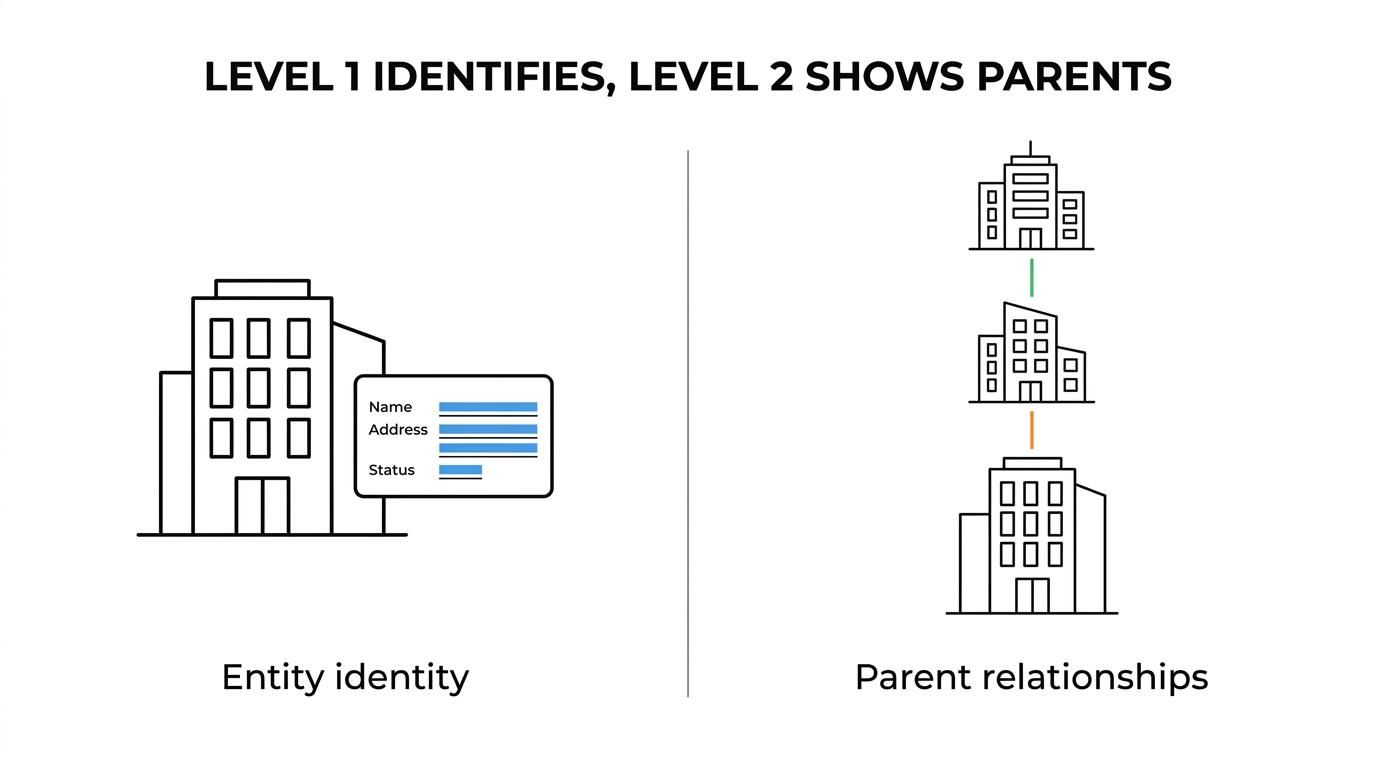
The simplest way to think about the two layers is this: Level 1 tells you who the entity is, while Level 2 tells you who sits above it in the group structure. Both matter, but they do different jobs, and they are not equally easy to collect or verify.
For Canadian businesses, funds, charities, and other legal entities that need an LEI for trading or regulatory reporting, this difference can shape how quickly an LEI can be registered, how complete the record will look, and how useful it will be to counterparties and regulators.
What Level 1 LEI data includes
Level 1 LEI data is the core reference record for the entity itself. GLEIF describes it as the "business card" information in the Global LEI System. If someone looks up an LEI, Level 1 is the first layer they see.
This data answers the question "who is who." It focuses on identity, registration details, and status rather than ownership. In practical terms, it helps a bank, broker, trading venue, or reporting team confirm that the legal entity attached to the LEI is the right one.
Typical Level 1 data includes:
- Official legal name
- Registered address
- Headquarters address
- Country of formation
- Legal form
- Entity status
- LEI issue date
- LEI renewal date
- Managing LOU information
That may sound basic, though it is the foundation on which the rest of the LEI system depends. If the name, address, legal form, or status is outdated, the LEI becomes less useful for onboarding, reporting, and screening.
GLEIF reports this identity layer through the LEI Common Data File, usually called the LEI-CDF. That format sets the structure for how LEI issuers report Level 1 reference data into the global system.
What Level 2 LEI data shows about parent relationships
Level 2 LEI data moves beyond identity and into group structure. GLEIF summarises it with the question "who owns whom," though the technical test is not simple share ownership in every case.
Instead, Level 2 focuses on accounting consolidation relationships. An entity that has an LEI may report its direct accounting consolidating parent and its ultimate accounting consolidating parent. Those are the legal entities that consolidate the child entity into financial statements at different levels of the corporate chain.
This is a useful distinction. A business may be owned through layers of subsidiaries, investment vehicles, or holding companies. Level 2 data tries to create a standard way to identify the relevant parent entities for reporting and risk analysis, not just a loose description of the group.
Level 2 data can include:
- The direct parent relationship
- The ultimate parent relationship
- The LEI of the parent, if the parent has one
- Relationship start and end dates
- Reporting exceptions when parent information is not available or cannot be disclosed
That last point matters a great deal. Level 2 is not always present, and a missing parent record does not always mean the entity has no parent. It may mean the parent has no LEI, the relationship falls outside the reporting rules, or a permitted exception applies.
Level 1 and Level 2 LEI data compared
The two data layers work best when they are read together. One confirms the legal identity of the entity; the other places that entity within a broader corporate structure.
| Feature | Level 1 LEI data | Level 2 LEI data |
|---|---|---|
| Main question answered | Who is who | Who owns whom |
| Focus | Entity identity | Parent relationships |
| Typical content | Name, address, legal form, status, registration details | Direct and ultimate accounting consolidating parent data |
| Data format used by GLEIF | LEI-CDF | RR-CDF |
| Availability | Usually present for active LEIs | May be missing, partial, or reported with exceptions |
| Main use cases | Counterparty identification, onboarding, reporting, screening | Group exposure analysis, consolidation mapping, risk review |
A good way to frame it is that Level 1 is mandatory for the LEI record to function at all, while Level 2 adds context that becomes valuable when regulators, financial institutions, and market participants need a clearer view of group connections.
Why Level 2 LEI data often has coverage gaps
This is where many people expect a cleaner answer than the system can always give.
Level 2 data is harder to complete because it depends on more than the child entity's own registration details. A valid parent relationship must fit the accounting consolidation rules, the parent must be identifiable, and the parent often needs its own LEI for the record to be fully useful in the global system.
A Financial Stability Board review found that many jurisdictions and authorities saw Level 2 data as insufficient for some purposes because of limited coverage or missing information. Canada was among the jurisdictions reporting that only a small proportion of entities were supplying direct and ultimate parent data, and that corroboration was lower than for Level 1 data.
Several practical factors sit behind those gaps:
- Parent eligibility: the relevant parent may not have an LEI
- Accounting basis: consolidation rules do not always match simple ownership expectations
- Jurisdictional variation: reporting practices and market uptake differ across countries
- Data exceptions: some entities can report reasons why parent data is not available
- Ongoing maintenance: group structures change through acquisitions, disposals, and reorganisations
This does not make Level 2 weak or unnecessary. It simply means users should read it with care. Where it exists and is current, it is extremely useful. Where it is absent, the absence itself may need interpretation rather than assumption.
How GLEIF formats Level 1 and Level 2 LEI records
The Global LEI System does not just store data. It also standardises how that data is reported, shared, and consumed across jurisdictions. That is one reason LEIs are valuable for large-scale reporting and data matching.
The distinction between Level 1 and Level 2 appears not only in content, but also in reporting format.
LEI-CDF format for Level 1 reference data
Level 1 reference data is reported through the LEI-CDF, short for LEI Common Data File. This is the structured format used by LEI issuing organisations to publish the identifier itself and the entity's core reference details.
That technical framework matters because consistency is what makes LEI data usable across banks, trade repositories, fund administrators, regulators, and data vendors. Without a common structure, even accurate data would be harder to compare and automate.
RR-CDF format for Level 2 relationship data
Level 2 data is reported separately through the RR-CDF, which stands for Relationship Record Common Data File. This format is built for parent-child relationships rather than the entity's own identity record.
Keeping the formats separate makes sense. Identity data and relationship data are related, though they are not the same thing, and they often change on different timelines. An address update belongs in Level 1. A new consolidating parent after a corporate reorganisation belongs in Level 2.
How Canadian entities use Level 1 and Level 2 LEI data
For many Canadian entities, Level 1 data is the practical minimum needed to access markets and meet reporting requirements. It supports trade reporting, counterparty checks, client onboarding, and internal controls around entity verification.
Level 2 becomes more relevant when the legal entity sits inside a larger group, raises capital through multiple subsidiaries, or needs to show how exposures connect across related entities. In risk management, that extra context can be highly valuable.
Common uses include:
- Onboarding checks: confirming the legal identity of a counterparty
- Trade reporting: attaching consistent entity data to reportable transactions
- Group exposure review: spotting links between subsidiaries and parent entities
- Compliance controls: reducing confusion where similar entity names exist
- Data reconciliation: matching internal records with global reference data
A single LEI lookup can answer very different questions depending on the reader. A trading desk may care first about active status and legal name. A risk team may care about the ultimate parent. A regulator may want both, plus the timing of changes.
What to check before LEI registration or renewal
The quality of LEI data is shaped at the point of application and then tested again at renewal. That is why it helps to prepare the right information before starting.
If the entity only needs the LEI for immediate trading, it can be tempting to focus on speed alone. Speed matters, especially when a transaction deadline is close, but data quality matters just as much. An LEI that is issued quickly still needs accurate supporting details.
A practical checklist looks like this:
- Confirm the exact legal name used in official registries.
- Check the registered address and headquarters address.
- Verify the legal form and country of formation.
- Review whether there is a direct or ultimate accounting consolidating parent.
- Check whether the parent already has an LEI.
- Prepare for annual renewal and any data changes during the year.
This is also where a capable registration agent can make a difference. Automated registry checks can help prevent duplicates, and support with renewals or transfers can reduce the risk of stale reference data staying in the global record.
For entities with active reporting obligations, free updates to reference data during a management period can be especially useful. Group structures, legal names, and addresses do change, and the LEI record should keep pace.
A final practical point: if Level 2 data is missing from an LEI record, ask why before assuming the entity is stand-alone. The answer may lie in parent eligibility, reporting exceptions, or the fact that the relevant parent has not yet obtained an LEI. That small pause can prevent a large interpretive mistake.