LEI for Private Companies: Fast Registration and Annual Renewal Management
Private companies in Canada often need an LEI for trading, reporting, onboarding with financial institutions, or meeting counterparty requirements. When timing matters, the process should be simple: enter the corporate details, verify the record, submit payment, and have the application handled quickly with support available if anything needs clarification.
That is the value of a focused LEI service built for legal entities rather than general business filings.
LEI registration for private companies in Canada
A Legal Entity Identifier is a 20-character code that confirms the identity of a legal entity in financial transactions. For a private company, that can mean a corporation preparing to trade securities or derivatives, a holding company opening access to certain investment products, or a business that has been asked by a bank, broker, or institutional counterparty to provide an LEI before a transaction can proceed.
Many private companies do not apply for an LEI until a deadline appears. In those cases, speed matters, but so does accuracy. If the legal name, registered address, ownership details, or authority of the applicant do not match official records, the LEI can be delayed. A service that checks registry data early helps reduce those setbacks.
LEI registration can be completed fully online, with no need to create an account before starting.
Fast LEI application process for private companies
For most Canadian private companies, the application starts with a federal or provincial registration number, or the company name. When a registry match is available, the official legal entity details can be pulled into the form automatically. That saves time and reduces manual entry.
After that, the applicant confirms the company information, adds contact details, and provides any ownership information required for LEI reporting. Payment completes the order, and the validation process begins. In straightforward cases, issuance is often completed the same day when the order is submitted before 11 AM. Optional express handling may also be available for urgent files.
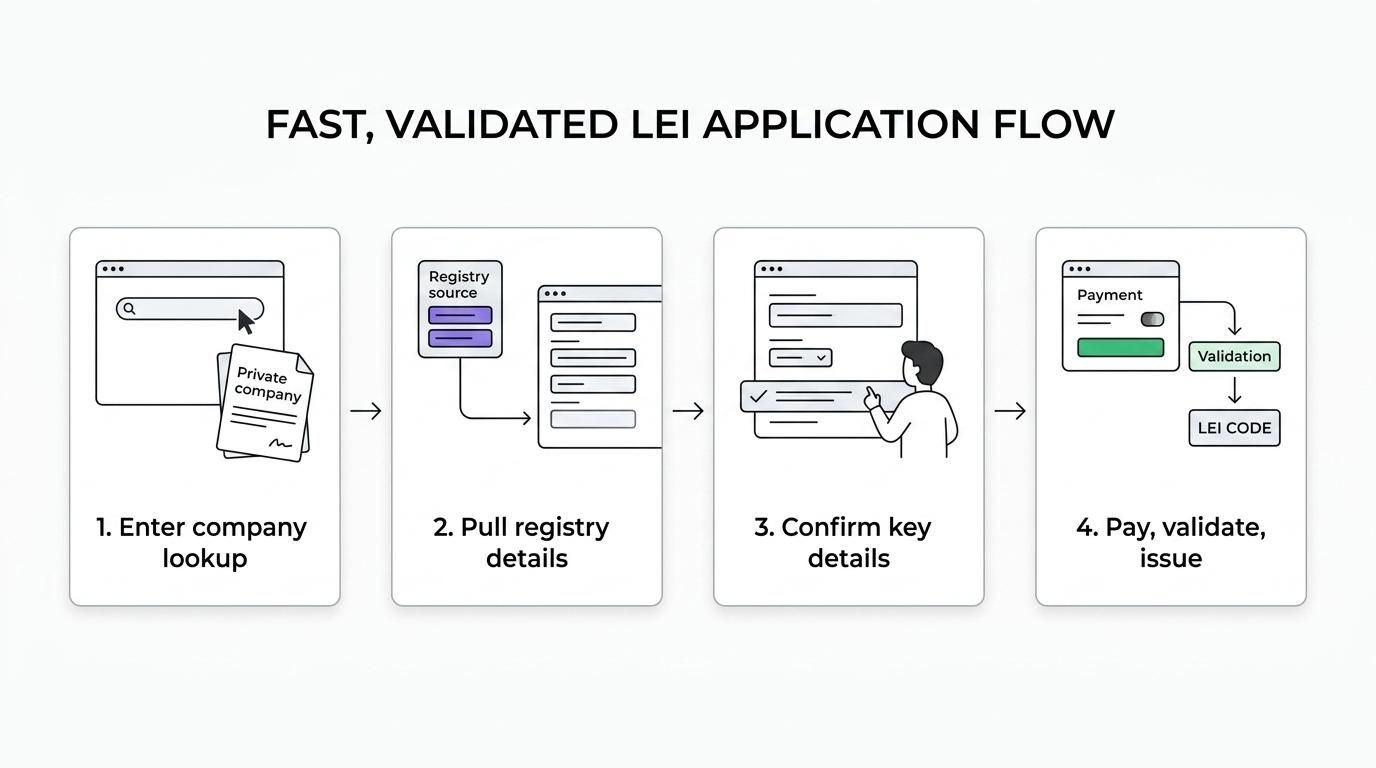
This structure works well for private corporations because the form is built around the records that already exist in public registries. Instead of assembling a long package of documents for a routine application, many entities can move forward with only the core details already attached to their legal registration.
A private company usually benefits most when the application includes:
- Exact legal name
- Federal or provincial corporation number
- Registered office address
- Authorized representative details
- Parent or ownership information, if applicable
If the applicant is not clearly listed as an officer or authorized person in the relevant registry, an authorization form may be requested before the LEI is issued.
What private companies should prepare before applying for an LEI
A quick application still depends on good source information. Private companies should make sure their legal name is entered exactly as registered and that their address matches the official corporate record. Small mismatches can create unnecessary review steps.
Ownership reporting is another area where preparation helps. Some private companies have a simple structure with no accounting consolidating parent. Others are part of a larger corporate group and may need to provide parent entity details. Where a parent relationship must be reported, supporting information may be requested.
The most useful items to have ready are usually these:
- Corporate record details: incorporation number, legal name, jurisdiction, and registered address
- Applicant authority: officer details or proof that the person submitting the form is authorized
- Ownership data: parent company information when the private company is controlled within a broader group
- Contact information: email address and phone number for follow-up if validation questions arise
For standard private company filings, the process is often much lighter than expected.
Annual LEI renewal management for private companies
An LEI is not a one-time filing. It must be renewed each year to remain active. For private companies, this is where many avoidable problems start. A lapsed LEI can interrupt a transaction, delay onboarding, or force a company into a rushed renewal when a trade is already pending.
Annual renewal is more than a payment reminder. The legal entity reference data must still be current. If the company has changed its registered address, legal name, ownership structure, or other core details, those updates need to be reflected in the LEI record as part of ongoing maintenance.
This is why many private companies choose multi-year management rather than dealing with the file once a year under pressure.
Multi-year LEI management and data updates
Multi-year plans give private companies a more stable way to manage compliance. Instead of remembering each annual deadline, the renewal cycle can be handled in advance, often at a lower yearly cost. With LEI Service, pricing starts from C$69 per year on longer plans, with GLEIF fees included.
That kind of structure is useful for corporations, holding entities, family investment companies, charities with investment activity, and fund-related entities that want fewer administrative interruptions.
| Service option | Typical use | Price level |
|---|---|---|
| 1-year registration or renewal | Immediate need, short planning horizon | C$94 |
| Multi-year management | Lower annual cost and less admin | From C$69/year |
| Same-day processing | Orders submitted before 11 AM | Available for eligible files |
| Express processing | Urgent time-sensitive filings | Optional |
Along with renewal handling, updates to LEI reference data can also be managed when company information changes. That matters because an LEI is only useful when the public record remains accurate.
LEI transfer and renewal support for private companies
Some private companies already have an LEI but are unhappy with their current provider. A transfer and renewal can place the LEI under a service model that is easier to manage, with support available by phone and email and a more direct renewal workflow.
This is especially helpful when the previous registration was done quickly and the company is now trying to clean up the file, confirm the next renewal date, or update its legal data after a corporate change. Instead of starting over, the existing LEI can be transferred and then renewed through the new service arrangement.
Private companies often request transfer support for a few clear reasons:
- Pricing: lower long-term cost through multi-year renewal options
- Support: English-speaking phone and email assistance without extra support fees
- Data accuracy: registry and GLEIF checks that help prevent duplicate or inconsistent records
- Administration: one place to manage new LEIs, renewals, and updates
That makes transfer a practical option, not just an administrative change.
Why speed and validation both matter for a private company LEI
A fast LEI service should not mean a careless one. Private companies need both quick turnaround and proper validation against registry and LEI database records. That helps avoid duplicate applications, mismatched legal names, and delays caused by preventable corrections.

Automated registry lookup is useful because it pulls information from official sources early in the process. GLEIF database checks are just as important, since they reduce the chance that an entity applies for a second LEI when one already exists or has simply lapsed.
For finance teams and corporate administrators, that means less manual checking and fewer last-minute surprises.
Support for private companies with urgent LEI deadlines
Not every private company applies months in advance. Some are told they need an LEI just before a trade, a reporting deadline, or an account activation. In those cases, responsive support becomes part of the service itself.
Phone and email support can help clarify what the application needs, whether an authorization document may be required, and whether the company should apply for a new LEI, renew an existing one, or transfer and renew with a different provider. That kind of guidance is valuable for smaller private companies that do not have in-house regulatory staff.
A straightforward service model usually looks like this:
- Online application with no prior account setup
- Registry lookup to prefill company details
- Fast issuance, often same day for early orders
- Renewal options from one year to multi-year management
- Free support by phone and email
For private companies that need an LEI to keep business moving, the goal is simple: get the code issued quickly, keep it active every year, and make sure the public record stays current.