LEI After Merger or Dissolution
Corporate restructurings do not end when legal paperwork is signed. They also affect the identifiers used in trading, reporting, onboarding, and due diligence. If a Canadian corporation, fund, charity, or other legal entity has a Legal Entity Identifier, that record needs to reflect what actually happened after a merger, acquisition, dissolution, or liquidation.
That is where many teams pause. Does the old LEI stay active? Should the surviving entity keep using its own LEI or switch to another one? What happens if the acquired entity has already stopped operating?
The short answer is simple: the LEI of the entity that ceases to exist should not continue as an active identifier. Under GLEIF rules, completed dissolution, liquidation, and merger-related closure events move that entity’s LEI record to RETIRED. If another legal entity survives the transaction, that successor continues with its own active LEI.
Why LEI records change after mergers and dissolutions
An LEI is not just a code. Under ISO 17442, it is a 20-character identifier linked to reference data about the legal entity behind a financial transaction. That reference data is meant to stay reliable over time, which is why status changes matter so much after corporate events.
If an entity no longer exists, keeping its LEI active would create the wrong signal for trading counterparties, regulators, and data users. GLEIF’s data quality rules address this directly. A completed dissolution or completed liquidation event must change the LEI record’s registration status to RETIRED. The same applies when a completed mergers-and-acquisitions event causes a legal entity to cease operations.
This is not about deleting history.
A retired LEI remains part of the public data set as a historical record. That helps preserve continuity for past trades, archived reports, audit reviews, and risk analysis. The identifier stays visible, but it is no longer the LEI for active use.
What happens to an LEI after a merger
In a merger, the key question is not whether ownership changed. The key question is whether the legal entity attached to the LEI still exists as an operating legal person.
If Entity A is absorbed into Entity B and Entity A ceases to exist, Entity A’s LEI should move to RETIRED once the event is completed. Entity B keeps using Entity B’s own active LEI for ongoing activity. The old code does not migrate across and become the live identifier for the surviving entity.
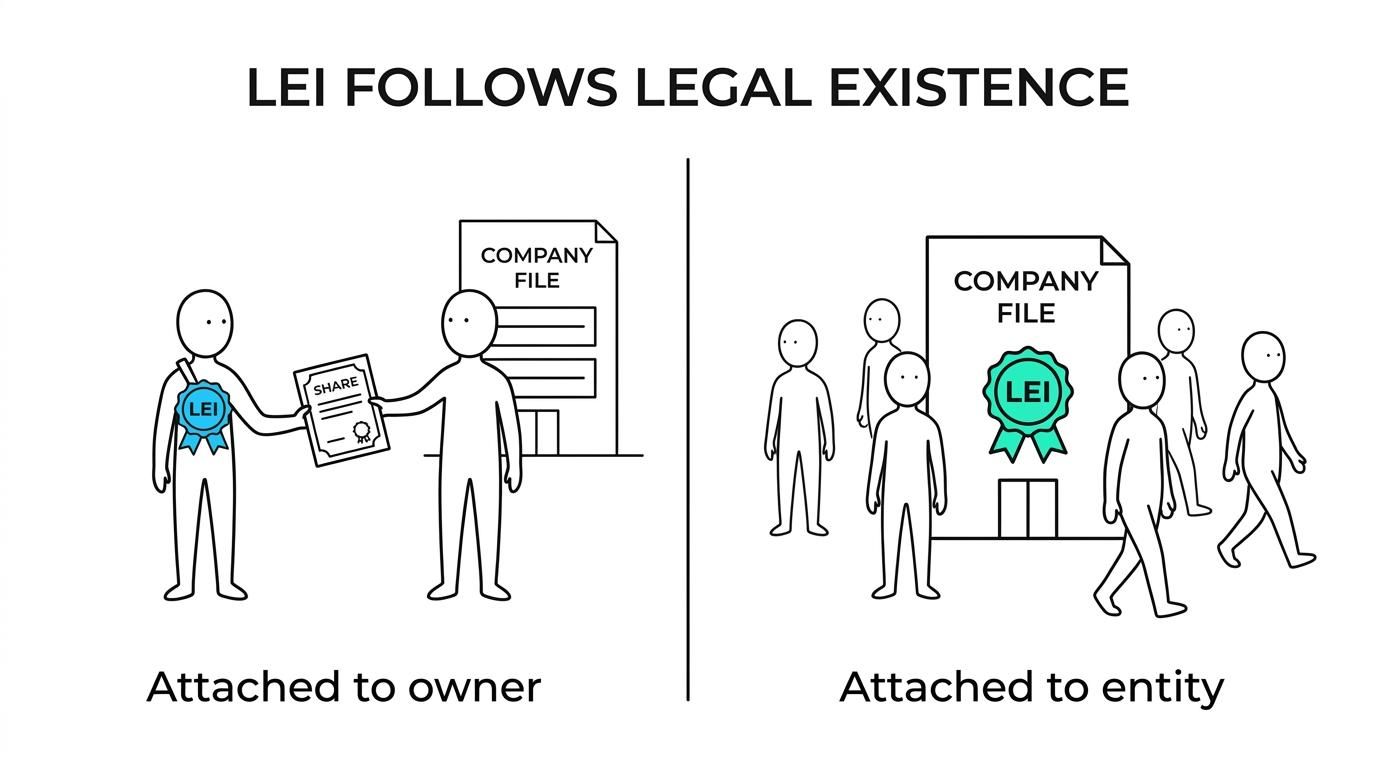
GLEIF’s data model also supports recording the successor relationship. When a legal entity ceases to exist because of a merger, the successor entity can be captured in the LEI data through the relevant event information. That is valuable because it preserves a clear chain between the retired record and the surviving entity.
A practical way to think about it is this:
| Corporate event | Status of ceasing entity’s LEI | Status of surviving entity’s LEI | Main data effect |
|---|---|---|---|
| Absorption into another entity | RETIRED | Remains active | Successor relationship recorded |
| Amalgamation where one entity survives | RETIRED for entity that ends | Surviving entity keeps its own LEI | Historical continuity preserved |
| Group restructuring with no legal extinction | Usually remains active, subject to data updates | Active | Ownership or parent data may need updating |
| Completed dissolution with no successor | RETIRED | Not applicable | Record remains as historical evidence |
That distinction matters in post-deal operations. A merger can trigger more than one data task. The ceasing entity’s LEI may need retirement, while the surviving entity’s LEI may need refreshed legal name, address, or parent relationship details if the structure changed.
What happens to an LEI after dissolution or liquidation
Dissolution is more direct. Once the legal entity has completed dissolution, its LEI record must move to RETIRED. The same rule applies to completed liquidation.
There may be no successor at all. In that case, the LEI does not disappear. It stays in the global data set as a closed historical record, showing that the entity once existed and has now ended.
GLEIF also distinguishes the event data behind that retired status. Dissolution-related closure is not the same as merger-related closure, even though both lead to RETIRED. That distinction helps anyone reviewing the record understand why the entity stopped operating.
Where an already inactive record is being updated and the exact chain of events is not being investigated further, GLEIF allows the use of DISSOLUTION as the event type in the retired record update. After that update, the registration status remains RETIRED and the entity status remains inactive.
RETIRED status does not mean the LEI vanishes
This point deserves extra emphasis because it clears up a common misunderstanding.
A retired LEI is still useful. It supports lookbacks on historical trades, internal controls, old counterparty files, and regulatory reviews. GLEIF treats RETIRED as an end state for the LEI record set, and the update assigning retired status is the last regular update to that record.
That means the record is closed, not erased.
After a retirement update, some data fields linked to entity expiry may be removed or adjusted as part of the status transition, and the associated legal entity event is added with a completed event status. The main operational takeaway is straightforward: keep the retired LEI for historical reference, but stop using it as the live identifier for new activity.
The LEI data fields that matter after restructuring
When finance, legal, and compliance teams review LEI maintenance after a transaction, they are often looking at more than just one status field. GLEIF’s framework connects status updates to legal entity events and related reference data.
The most relevant terms include:
- RETIRED: the registration status used when the entity has ceased following dissolution, liquidation, or merger-related closure
- MERGERS_AND_ACQUISITIONS: the event category used when a completed M&A event causes the entity to cease operating
- DISSOLUTION: the event category used for dissolution-related closure, and also acceptable in some already inactive record updates
- SuccessorEntity: the surviving legal entity recorded as the successor where applicable
- LegalEntityEvent: the event record that documents what happened and when it was completed
These fields help transform a corporate action into consistent public reference data, which is exactly what market participants expect from the LEI system.
Common LEI mistakes after a merger or dissolution
Problems usually appear when teams treat the LEI as a static code rather than a maintained record. The identifier itself may look unchanged, but the legal reality behind it has shifted.
A few mistakes come up often:
- Continuing to use the old LEI in new trades
- Renewing an LEI for an entity that has legally ceased to exist
- Forgetting to update parent or ownership data after a restructuring
- Assuming the surviving entity should adopt the retired entity’s LEI
- Leaving inactive records unresolved after a completed closure
These errors can surface during trade review, reporting validation, onboarding, or counterparty due diligence. They can also slow internal approvals because different teams end up relying on different versions of the entity record.
How to decide which LEI should be used now
A useful approach is to start with one practical question: which legal entity exists today and is entering into the transaction or reporting obligation?
If the old entity ceased through merger, absorption, dissolution, or liquidation, its LEI should not remain in active use. If another legal entity survived, the surviving entity keeps using its own LEI. If no entity survived, the old record should be retired and retained only for historical reference.
That decision process becomes clearer when checked against a few markers:
- Legal existence: Is the original entity still legally in existence?
- Transaction role: Which entity is actually signing, trading, or reporting now?
- Completed event: Has the merger, dissolution, or liquidation legally completed?
- Registry evidence: Do public registry records support the status change?
- Successor path: Is there a surviving entity that already has its own LEI?
The stronger the internal file on these points, the easier the LEI update becomes.
LEI renewal versus LEI retirement after corporate closure
This is another area where timing matters. An LEI that is due for annual renewal should not simply be renewed by default if the entity has already ceased to exist. Once there is a completed dissolution, liquidation, or merger event that ends the legal entity, the proper path is retirement of that record, not ongoing active renewal.
By contrast, if the entity still exists and only some reference data changed during the restructuring, renewal may still be required along with data maintenance.
That is why post-transaction checklists should separate two questions:
- Is the entity still legally alive?
- If yes, what reference data has changed?
Without that split, organisations can end up paying for an active LEI record that no longer matches legal reality.
Practical LEI update steps for Canadian entities
In Canada, the operational side often involves company secretarial teams, tax, treasury, compliance, and outside advisers all touching the same corporate event. LEI maintenance works best when it is assigned clearly and handled early, rather than waiting until the next trade or filing deadline exposes a mismatch.
A sensible process usually looks like this:
- Confirm the legal event: merger, amalgamation, dissolution, or liquidation
- Check entity survival: determine which legal entity continues and which one ceased
- Review current LEIs: identify active records for all entities involved
- Update supporting data: names, addresses, parent relationships, and registry details where relevant
- Submit the correct LEI action: retirement-related update, renewal, transfer, or data change as needed
For entities that trade frequently or operate across several jurisdictions, speed matters. Delays can affect execution, client onboarding, and reporting workflows. A registration agent that checks registry data, helps avoid duplicates, and manages reference data updates can save time at exactly the point where corporate actions create the most pressure.
LEI Service supports new LEI registrations, renewals, transfers, and ongoing data maintenance for Canadian legal entities, including cases where merger-related or dissolution-related changes need to be reflected quickly. Same-day issuance, express processing, and support by phone or email can be especially useful when a filing or transaction window is close.
Why successor entity data matters beyond compliance
Successor links are not just technical metadata. They help preserve continuity across legal entity history, which matters to investors, banks, regulators, auditors, and internal control teams.
A retired LEI tied to a clearly identified successor helps answer important operational questions. Who inherited contractual relationships? Which entity should current due diligence focus on? How should historical positions be mapped to the present group structure?
That clarity builds confidence.
It also makes post-merger integration cleaner, because the surviving entity’s active LEI remains the anchor for future transactions while the retired entity’s record stays available for historical checks. Instead of blurring the record, the LEI framework creates a traceable path from past to present.
For organisations managing a merger or winding down an entity, that is the real value of proper LEI maintenance: current activity points to the right legal entity, while the historical record stays intact and usable.