How to Choose an LEI Provider: Fees, Support, Speed, and Data Quality
Choosing an LEI provider can look simple at first glance. Many sites promise fast issuance, low pricing, and an easy online form. Yet for a Canadian business, fund, charity, or other legal entity, the better choice is rarely the provider with the lowest headline number alone.
An LEI is a unique 20-character alphanumeric code used to identify legal entities in financial transactions. According to GLEIF, that code is tied to verified reference information and published through the Global LEI Index. That means the provider behind the application process is not just selling a number. It is handling validation, renewal, and data quality responsibilities that affect whether the LEI remains active and reliable.
Why LEI provider choice matters for Canadian entities
If an LEI is needed for trading, reporting, or counterparty checks, delays and data errors can create real friction. A cheap application becomes expensive very quickly if it leads to missed deadlines, extra back-and-forth, or a lapsed registration next year.
This is why provider selection should be practical, not just price driven. The best LEI provider is usually the one that combines transparent fees, responsive support, reasonable turnaround times, and solid data-quality processes.
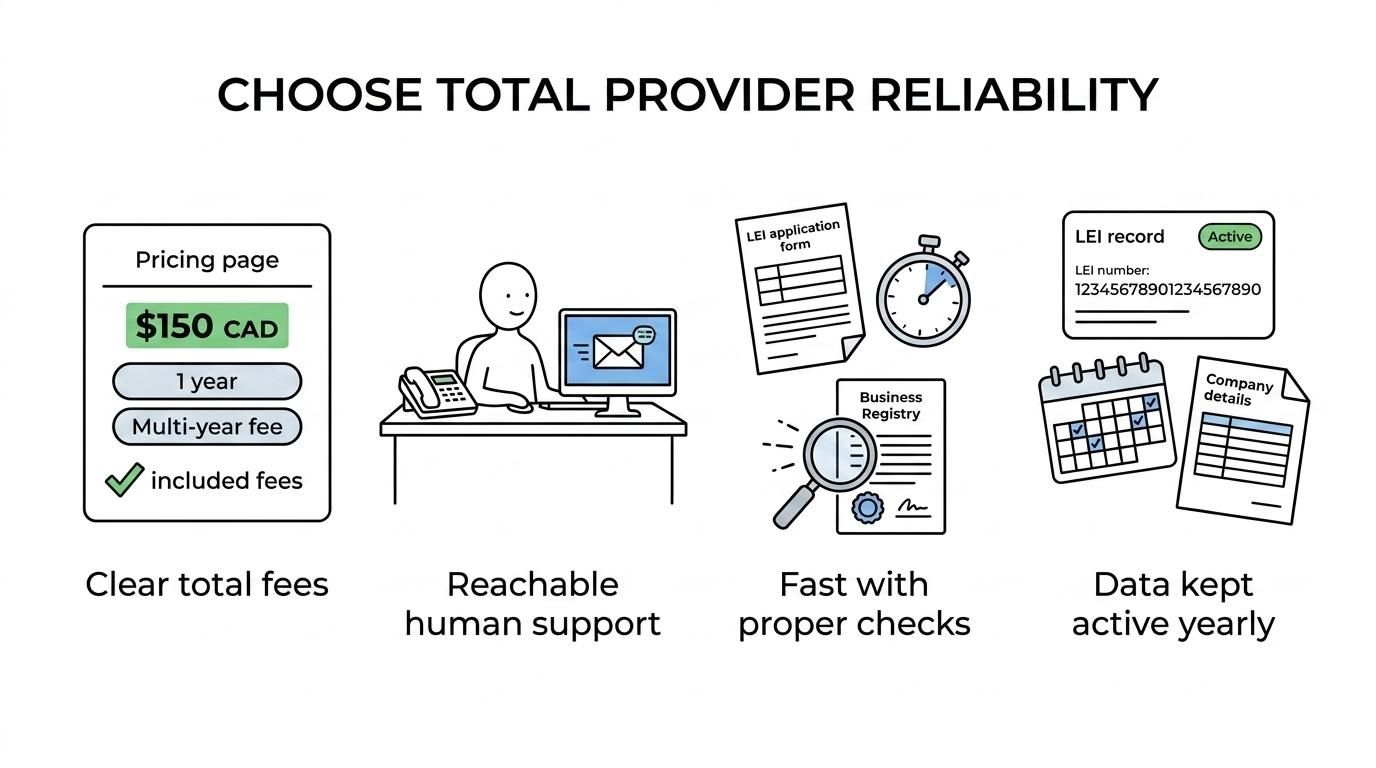
GLEIF’s framework makes that clear. LEI data quality depends on verification against authoritative local sources and on annual re-validation of reference data. So the real question is not only “What does this LEI cost today?” It is also “How well will this provider handle my data over time?”
LEI fees: look past the first number
Price still matters, of course. Canadian entities often compare providers by the cost of a new LEI or a renewal, and that is a sensible place to begin. Still, the fee on the landing page does not always tell the full story.
A provider worth considering should make it easy to see whether the quoted amount includes the GLEIF fee, whether support is extra, whether renewal pricing changes after year one, and whether multi-year plans actually reduce the annual cost.
Here is a simple way to compare providers:
| Factor | What to check | Why it matters |
|---|---|---|
| One-year fee | New LEI and renewal price | Shows the true entry cost |
| Multi-year pricing | Three-year and five-year rates | Can reduce annual cost and admin time |
| Included fees | GLEIF fee included or separate | Avoids surprises at checkout |
| Support charges | Phone or email support included | Helpful when records need review |
| Renewal handling | Manual or automated reminders | Helps keep the LEI active |
| Transfer pricing | Free, paid, or bundled with renewal | Important if moving from another provider |
One published example in Canada is LEI Service Canada, which lists C$94 for a one-year new LEI or renewal, and multi-year pricing down to C$69 per year on longer plans, with GLEIF fees included. That sort of clear pricing structure is useful because it lets applicants compare total value rather than guess what is bundled.
After reviewing the pricing page, look for these points:
- one-year cost
- multi-year savings
- GLEIF fee included
- renewal fee clarity
- transfer terms
- support included or extra
Low fees can be attractive, but a provider that is vague about renewals, support, or transfer costs may become more expensive over the life of the LEI.
LEI support: human help still matters
Support is easy to dismiss until a file becomes complicated. A director’s authority may need confirmation. A registry entry may be outdated. A name variation may trigger a manual review. At that point, live assistance matters far more than a slick checkout page.
Canadian entities should pay attention to whether support is available by phone and email, how quickly the team responds, and whether questions are answered clearly. Fast responses reduce friction, especially when a trade or compliance deadline is close.
A strong support offer often includes more than one channel and does not charge extra for basic help. Published information from LEI Service Canada, for example, says phone support and email support are free, with answers typically provided within 24 hours. That kind of transparency is useful because it sets an expectation before an order is placed.
When comparing providers, ask:
- Who answers questions: in-house staff, outsourced agents, or only automated messages
- When support is available: business hours only or extended coverage
- How support works: phone, email, ticket system, or all three
- What is included: application help, renewal help, transfer help, and data updates
- How fast they reply: stated service level or no timing at all
A provider does not need to promise instant access every minute of the day. It does need to make support easy to reach when something blocks issuance or renewal.
LEI speed: fast is useful, but only if validation is done well
Turnaround time is one of the most visible differences between providers. Some applications can be processed quickly, while others take longer because the provider needs extra documentation or registry confirmation.
That distinction matters. Speed claims are only meaningful when matched with a sound validation process.
GLEIF states that LEI issuers verify self-submitted reference data with authoritative local sources, such as a national business register, before issuing an LEI. So a serious provider should not treat every file as a one-click product. Fast service is valuable, but careless service is not.
A realistic provider will explain both the normal timeframe and the exceptions. One Canadian example states that applications typically take 1 to 48 hours, depending on timing and whether extra information is needed. The same provider also advertises express options, including delivery within 2 hours in some cases. Those claims are helpful because they describe ordinary timing and expedited timing separately.
That is a much better signal than a vague promise of “instant LEI issuance” with no mention of review standards.
LEI data quality: the feature many buyers overlook
Data quality is often the least discussed part of LEI selection, even though it is one of the most important. An LEI connects your entity to reference information used by counterparties, institutions, and regulators. If that information is incorrect or outdated, the LEI may still exist, but its practical value drops.
GLEIF emphasizes four core principles behind the LEI system: a global standard, a single unique identifier, high-quality data, and free public access to that data. For applicants, the key point is simple. The provider should care about the quality of the record, not just the speed of issuing the code.
This includes:
- checking the entity against authoritative local sources
- avoiding duplicate registrations
- keeping reference data current
- supporting annual review and re-validation
The annual renewal process matters here. GLEIF says LEI data quality is maintained through yearly review, where the entity and issuer re-validate the reference data at least once a year.
 So renewal is not just a billing event. It is a data-quality event.
A provider that takes renewals seriously is likely to be a better long-term partner than one that focuses only on first-time sales.
LEI renewals and transfers: where provider quality becomes obvious
Many entities first notice provider differences when it is time to renew, or when they want to move an LEI from one service to another. A basic registration may be easy. Ongoing management is where the quality gap shows up.
Renewals should be straightforward, clearly priced, and supported by reminders or multi-year options. Transfers should also be transparent, since some entities decide to move after experiencing poor support or unclear pricing elsewhere.
This is a practical benchmark:
- Renewal process: simple steps, clear timing, annual data re-validation
- Transfer process: plain instructions, realistic timeline, no hidden transfer fee
- Record maintenance: help updating legal name, address, or registry changes
- Multi-year management: fewer admin tasks and lower annual cost for some entities
Published provider information in Canada shows that transfer-and-renew services may be bundled and that a transfer can take around 7 business days. That is a useful reminder that not every LEI action is immediate. A provider should set proper expectations, especially when another issuer is involved.
If a site says very little about transfers, renewals, or data updates, that is worth noticing.
Signs of a strong LEI provider in Canada
The best provider is often the one that makes the process clear before you ever enter your company details. Clarity signals operational discipline.
Look for a provider that states pricing in Canadian dollars when serving Canadian clients, shows whether GLEIF fees are included, explains standard and express timeframes, and describes how records are checked against official sources. If phone and email support are available without extra cost, that is another positive sign.
There is also value in providers that help prevent duplicate applications through registry and GLEIF lookups. Duplicate prevention saves time and avoids confusion, especially when different people inside the same entity may be trying to handle the LEI requirement.
Some warning signs are just as useful:
- pricing that changes late in checkout
- no mention of annual validation
- only generic chatbot support
- no transfer information
- unrealistic speed claims
- no explanation of data checks
A provider does not need to be the biggest name to be reliable. It does need to be clear, responsive, and disciplined about data.
Questions to ask before ordering an LEI
A short set of questions can make comparison much easier. If a provider answers these plainly, that is a good sign.
Ask what the one-year price is, what the multi-year options cost, whether GLEIF fees are included, and how long a normal application takes. Ask what happens if extra documents are needed. Ask how renewal reminders work. Ask how transfer timing is handled. Ask whether support is free by phone and email.
Then ask the question many buyers skip: how do you verify entity data and keep it current?
That single question often reveals whether the provider is focused only on selling an LEI or on maintaining one properly. For Canadian entities that want a dependable, active LEI with less administrative friction, that difference matters a great deal.