How to Avoid Duplicate LEIs: Best Practices Before You Register
Registering for a Legal Entity Identifier should be a clean administrative step. Yet one of the most common problems starts before the application is even submitted: an entity applies for a new LEI when an LEI already exists.
That mistake can slow down onboarding, create extra back-and-forth with a registration agent, and leave internal teams sorting out which record is current. For Canadian businesses, funds, charities, and other legal entities, the safest approach is simple. Check the public LEI record first, confirm whether your organisation already has a code, and only then decide whether you need a new registration, a renewal, or a transfer.
Why duplicate LEIs happen before registration
Duplicate LEI issues usually do not come from bad intent. They come from fragmented records, staff changes, rushed filing, or uncertainty about past registrations. A finance team may assume no LEI exists because the current staff did not order one. A compliance officer may search under a common trade name rather than the legal name. A group entity may have one subsidiary with an LEI and another without one, which adds to the confusion.
The LEI system is built on uniqueness. GLEIF describes the LEI as a unique 20-character code, and every LEI can represent only one entity. That means a legal entity should not hold multiple LEIs at the same time. If a code already exists, the right move is usually to renew it or transfer it to a different registration agent rather than start a brand-new application.
In practice, duplication risk tends to rise when entity data is not checked against official records before filing. Legal name, corporation number, and registered address all matter. Even a small mismatch can lead a person to think they are dealing with a different record.
Common causes include:
- old LEI registrations handled by a previous provider
- filings submitted under a shortened business name
- confusion between parent entities and subsidiaries
- outdated internal compliance records
- lapsed LEIs mistaken for cancelled LEIs
What LEI uniqueness means for legal entities
An LEI is not just an account number. It is tied to verified reference information from authoritative sources. That reference data may include the legal name of the entity, the registration authority, the entity registration number, and the registered address. When the LEI record is accurate, counterparties and regulators can identify the entity with confidence.
This is why duplicate prevention matters so much. If teams create multiple application attempts for the same organisation, they are no longer dealing with a simple ordering issue. They are dealing with identity integrity. The point of the LEI framework is to make legal entity identification more reliable across markets, reporting systems, and institutions.
GLEIF’s Global LEI Index is central here. It is the global online source for open, standardized legal entity reference data, and it is available publicly. That openness is useful for compliance teams because duplicate prevention does not require a paid database or special access. A search can be done before money is spent on the wrong service.
How the Global LEI Index helps prevent duplicate LEIs
Before registering, search the entity in the public LEI record. This is the single most effective way to avoid filing a duplicate application. If the organisation already appears in the Global LEI Index, there is a strong chance the next step is not “new LEI” at all.
A careful search should not stop at one version of the name. Many entities are recorded in a formal legal style that differs from how staff commonly refer to them internally. A federal or provincial corporation number can also help narrow the result. If the first search returns nothing, try the official legal name exactly as it appears on incorporation or registration documents.
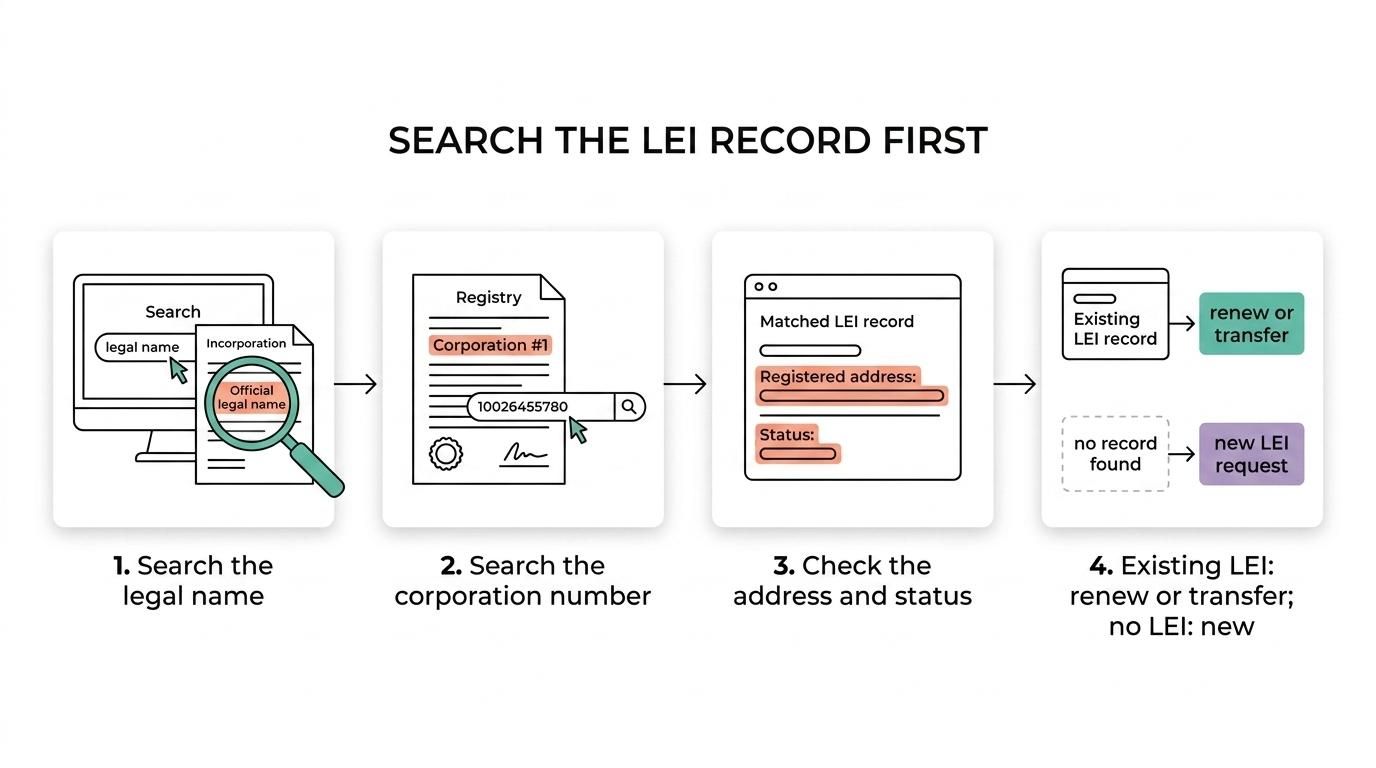
When a result appears, review the full record rather than just the headline name. Status, registered address, and reference data all help confirm whether it is your entity.
A useful pre-registration routine looks like this:
- Search the legal name: Use the exact official name from incorporation, trust, fund, or charity records.
- Search the corporation number: If available, check the entity registration number against the LEI record.
- Review the registered address: Confirm the address matches the official registry information.
- Check the LEI status: An active or lapsed LEI often means the correct service is renewal or transfer, not a new registration.
- Compare related entities carefully: Parent companies, subsidiaries, and fund vehicles may look similar but are not interchangeable.
New LEI, renewal, or transfer: choosing the right service
Once a search result appears, the next step becomes much clearer. Many duplicate cases happen because applicants assume an existing LEI cannot be used if it was registered through another provider. That is not how the system works. If your entity already has an LEI, you can often renew it through the current provider or transfer it to a new registration agent and renew it there.
Here is a practical way to think about the options:
| Situation | Best action | Why |
|---|---|---|
| No LEI record found after careful searching | Apply for a new LEI | No existing code appears linked to the entity |
| LEI found and status is active | Keep current or transfer | A second LEI should not be created |
| LEI found and status is lapsed | Renew or transfer and renew | The code still belongs to the same entity |
| LEI found under another provider | Transfer if you want a new agent | The existing LEI remains the valid identifier |
| Search result is unclear | Pause and verify reference data | A rushed application creates avoidable clean-up |
This distinction saves time. It also protects the consistency of the entity’s reporting trail. A lapsed LEI is not an invitation to start over with a fresh code. In most cases, it is the same code that needs maintenance.
Reference data checks that reduce duplicate LEI risk
Good duplicate prevention is really good data discipline. Before submitting any request, compare the application details with the entity’s current official records. That includes the legal name, registration number, registered office address, and legal form where relevant. If there has been a recent name change, amalgamation, or address update, be ready to support that with current documentation.
A strong application usually starts with one internal source of truth. Finance, legal, treasury, and compliance teams should be working from the same set of records. If each team has its own version of the entity profile, the chance of duplicate or misdirected filing rises quickly.
The most useful checks are often the simplest ones.
- Legal name: Match it exactly to the public registry, not to a trade name or internal shorthand.
- Registration number: Use the corporation number or equivalent entity number where possible.
- Registered address: Confirm the official address, including suite details if listed in the registry.
- Entity status: Make sure the organisation is active and properly represented in source records.
- Historical filing: Ask whether the entity ever traded, reported, or opened accounts in a context that may already have required an LEI.
Duplicate LEIs and complex entity structures in Canada
Canadian applicants often deal with more than one entity at a time. A corporate group may include a parent company, operating subsidiaries, financing entities, and pension or investment structures. A fund manager may handle several funds with similar names. A charity may have both a registered charity and a separate foundation structure. Similar names can create a false sense that one LEI covers the whole group.
It does not. The LEI attaches to a single legal entity. If two entities are legally distinct, each may need its own LEI where required. If one entity already has an LEI, that same entity should not receive a second one because a different team or advisor is submitting a fresh application.
This is where disciplined review matters most. Group structures can make staff move too fast. It helps to confirm the exact legal entity name, registration number, and governing documents before any order is placed.
Can one legal entity have two LEIs?
No. The LEI framework is built so that one legal entity is represented by one unique LEI.
That principle sounds simple, yet it is the reason pre-registration searching should never be skipped.
Using a registration agent to catch duplicate LEI issues early
A careful registration agent can act as a second line of defence. Some providers check GLEIF records during the order process to see whether an LEI is already registered. That kind of automated screening can stop an applicant from ordering the wrong service and can point them toward renewal or transfer instead. For teams managing time-sensitive trading or reporting deadlines, a built-in check can reduce avoidable delays.
Human support still matters. Automated matching is helpful, though edge cases still come up. Name changes, recently updated registered addresses, or uncertainty over a lapsed record may require direct review. Phone and email support can be valuable when the issue is not speed alone but certainty.
When choosing a registration agent, look for a few things after you have searched the public record yourself:
- automatic GLEIF lookup
- clear options for new registration, renewal, and transfer
- support for checking by legal name or corporation number
- help with reference data corrections
- transparent timing and pricing
A practical pre-submission checklist for Canadian LEI applicants
Before anyone on your team presses submit, pause for five minutes and verify the basics. This short routine often prevents the longer delay that follows a duplicate filing attempt.
A good internal check can be handled by treasury, legal, compliance, or whoever owns the LEI process, as long as the responsibility is clear.
Use this order of operations:
- Search the entity in the public LEI record using the exact legal name.
- Repeat the search using the corporation number or a close name variation if needed.
- Open any matching records and compare the registered address and status.
- If a record exists, choose renewal or transfer rather than a new application.
- If no record exists and the reference data is confirmed, proceed with a new LEI request.
That sequence is simple, free, and reliable. It respects the core design of the LEI system: one entity, one identifier, supported by verified reference information. For most Canadian applicants, that is the best way to keep registration clean from the start.