Do You Need an LEI to Get an ISIN in Canada for Bonds
If you are issuing bonds in Canada, the short answer is reassuring: getting an ISIN and getting an LEI are usually two separate matters.
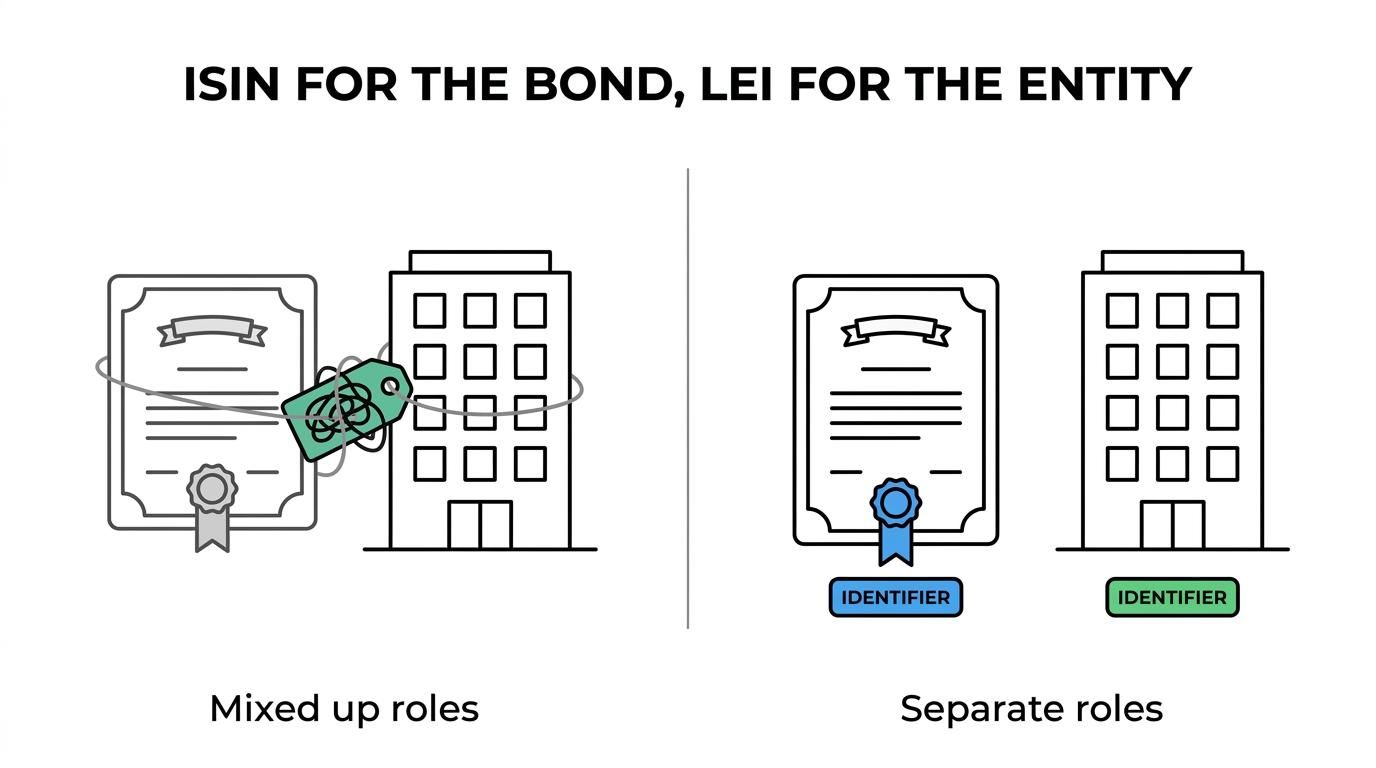
An ISIN identifies the bond itself. An LEI identifies the legal entity behind a transaction. That distinction matters because many market participants hear both acronyms in the same conversations and assume one unlocks the other. In most Canadian bond issuance cases, it does not.
The Canadian process for bond identification runs through the official securities numbering system, while LEI obligations tend to appear later in trading, counterparty onboarding, and regulatory reporting. Once that split is clear, the process becomes much easier to plan.
Do Canadian bond issuers need an LEI to obtain an ISIN?
In general, no. A Canadian issuer does not typically need an LEI simply to obtain an ISIN for a bond.
The official ISIN framework is built around the security, not the issuer’s LEI status. ANNA, the global association tied to ISIN standards under ISO 6166, states that ISINs uniquely identify financial instruments and are issued only by official National Numbering Agencies. In Canada, CDS acts as that National Numbering Agency.
That means the path to an ISIN for a Canadian bond issue is handled through CDS’s ISIN issuance and eligibility services, not through the Global LEI System. CDS states that ISIN issuance and eligibility requests are accepted for new marketable securities, including long-term debt issues and medium-term note programs.
This is the key point: a bond can need an ISIN because it is a security, while a dealer, fund, or issuer can need an LEI because it is a legal entity participating in financial activity.
LEI and ISIN identifiers serve different jobs
Confusion usually starts when both identifiers appear in the same transaction file, onboarding package, or post-trade report. They are related only in the sense that they can both be present around the same bond issue.
An ISIN is for the instrument. An LEI is for the entity.
GLEIF describes the LEI as a code used to uniquely identify participants to financial transactions. ANNA describes the ISIN as a code used to identify a financial instrument, including debt securities. Those roles are complementary, not interchangeable.
| Identifier | What it identifies | Relevant standard | Typical Canadian use in bonds |
|---|---|---|---|
| ISIN | The bond or note | ISO 6166 | Security issuance, settlement, reference data |
| LEI | The legal entity | ISO 17442 | Entity identification in reporting, onboarding, compliance |
| CUSIP | The security | Market identifier used in North America | Common security identifier alongside ISIN |
A simple way to think about it is this: one bond issue can have one ISIN, while several legal entities involved around that issue may each have their own LEI.
A fund issuing notes may have an LEI, the dealer may have an LEI, and the issued security will still have its own ISIN.
Canadian ISIN issuance through CDS for bond issues
For Canadian bonds, CDS is the centre of the ISIN process. As Canada’s National Numbering Agency, CDS handles requests for ISIN and CUSIP identifiers for new marketable securities.
That matters for issuers because it separates the securities identification workflow from broader entity compliance work. If your goal is to get a bond identified for issuance, settlement, and market use, the relevant step is to follow the CDS issuance or eligibility route for that security.
CDS indicates that its services cover long-term debt issues and medium-term note programs. In practice, that means an issuer or its agent usually works through the instrument details, issuance structure, and market eligibility requirements attached to the bond itself.
Before an application is submitted, the paperwork usually centres on the bond terms and issuer details required for the security record.
- Legal entity name as officially registered
- Bond or note terms
- Issue date and maturity details
- Program structure, if applicable
- Supporting issuance documentation
Even here, the reason the issuer name appears is not because CDS is issuing an LEI. It is because the bond record needs accurate reference data attached to the security.
LEIs in Canadian bond trading and IIROC reporting
Where the LEI becomes more visible is after the issuance stage, especially in dealer reporting.
IIROC Rule 2800C is a useful reference point. It requires a Dealer Member to obtain a Legal Entity Identifier. The same rule also says bond and repo transaction reports must include the security identifier, which can be an ISIN or a CUSIP. That wording draws a bright line between the two codes.
The report needs the bond’s identifier and the reporting dealer’s LEI because they answer different questions. One says, “Which security traded?” The other says, “Which entity is reporting or participating?”
That split helps explain why a bond issuer may be able to obtain an ISIN without first obtaining an LEI, while a dealer involved in the secondary market still needs its LEI for compliance purposes.
A practical way to frame it looks like this:
- Issuance stage: the focus is on creating or validating the security identifier for the bond
- Trading stage: the focus shifts to how the security is bought, sold, settled, and booked
- Reporting stage: the relevant firm may need its own LEI while also reporting the bond’s ISIN or CUSIP
- Counterparty onboarding: banks, dealers, and infrastructure providers may ask for an LEI even when the ISIN process is already complete
This is why market participants sometimes feel that the LEI is “required for the bond,” when the real position is narrower. The LEI is often required for the entity’s role around the bond, not for the ISIN issuance itself.
Common Canadian bond scenarios where the distinction matters
A corporate issuer launching a plain-vanilla bond issue may need to secure ISIN and CUSIP identifiers through CDS, yet not face an LEI requirement at that exact step. If the same issuer later enters dealer-facing reporting flows, derivatives, treasury activity, or institutional onboarding, the LEI can become relevant very quickly.
A fund issuer is another common example. The fund itself may already hold an LEI because many institutional structures use one for counterparty and reporting reasons. Still, that existing LEI does not replace the need for an ISIN for each security the fund issues.
Charities, non-profits, and other legal entities can run into the same distinction if they issue debt or interact with regulated financial counterparties. Their entity identity and the bond’s identity remain separate records.
One sentence captures the whole issue: the bond gets an ISIN, the legal entity gets an LEI.
That does not make the LEI optional in every broader sense. It only means the LEI is not the same gatekeeper as the Canadian ISIN issuance process.
Practical steps before requesting an ISIN for a Canadian bond
The smoothest bond issuance processes tend to start with a simple internal check: are you dealing with a security identification task, an entity identification task, or both?
That question helps teams avoid delay. Treasury, legal, capital markets, and operations staff are often working from different checklists. One group may ask for the ISIN, another may ask for the LEI, and both can be right within their own lane.
Before you approach the bond identification process, confirm the following:
- Security scope: is this a new long-term debt issue, a note issuance, or part of a medium-term note program?
- Numbering route: will the request go through CDS for ISIN issuance, eligibility, or both?
- Entity status: does the issuer already have an LEI for other regulatory or trading relationships?
- Dealer involvement: will a reporting Dealer Member need the issuer’s LEI or only its own for transaction reporting?
- Reference data quality: do the legal name and core registry details match current official records?
That last point deserves attention. Even when an LEI is not required to obtain the ISIN, inconsistent legal name data can still create friction elsewhere, especially if dealers, custodians, or data vendors are matching records across systems.
When it makes sense to arrange the LEI early
There are good reasons to arrange an LEI before it becomes urgent.
A Canadian issuer may not need the LEI to get the bond’s ISIN, yet still need it shortly after for onboarding with dealers, banks, custodians, or cross-border counterparties. If there is any sign that reporting, repo activity, institutional trading, or related regulatory workflows are coming next, early action can save time.
An LEI also needs to remain active and its reference data needs to stay current. If an entity already has one, checking the status before launch can be just as important as applying for a new code.
This is where planning beats last-minute fixes.
If an issuer, fund, or other organisation expects to need an LEI around a bond transaction, using an LEI registration agent can help move the process along quickly, handle renewals, and keep core data current with GLEIF records. That does not change the Canadian ISIN path, but it can reduce delays in the broader transaction timeline.
For most Canadian bond issuers, the practical answer stays the same: get the ISIN for the bond through the Canadian securities numbering process, and get the LEI for the entity when your trading, reporting, or counterparty requirements call for it.