Do Canadian General Partnerships Need an LEI to Trade?
A Canadian general partnership does not need a Legal Entity Identifier just because it exists as a partnership.
That distinction matters. In Canada, partnership status and LEI status sit in two different lanes. One is about how a business relationship is formed and treated for tax and commercial purposes. The other is about how an entity is identified in financial markets, especially where regulated trading, counterparty reporting, or dealer controls require a recognised identifier.
For many partnerships, the answer is simple: no LEI is needed for day to day business. For others, the answer changes the moment they step into reportable derivatives, institutional trading channels, or other workflows that ask for a GLEIF-compliant identifier.
General partnership status in Canada and LEI status
The Canada Revenue Agency describes a partnership as an association or relationship between two or more individuals, corporations, trusts, or partnerships that carry on a trade or business together. A general partnership can be quite easy to form. In some cases, it may arise from a simple verbal agreement and the actual conduct of the parties.
That tells you something useful right away. A general partnership can exist for tax and business purposes without any connection to the Global LEI System. It may still need GST/HST registration, a business number, provincial registrations, or T5013 filings depending on its facts. None of that means an LEI is automatically required.
That is the core distinction many firms miss.
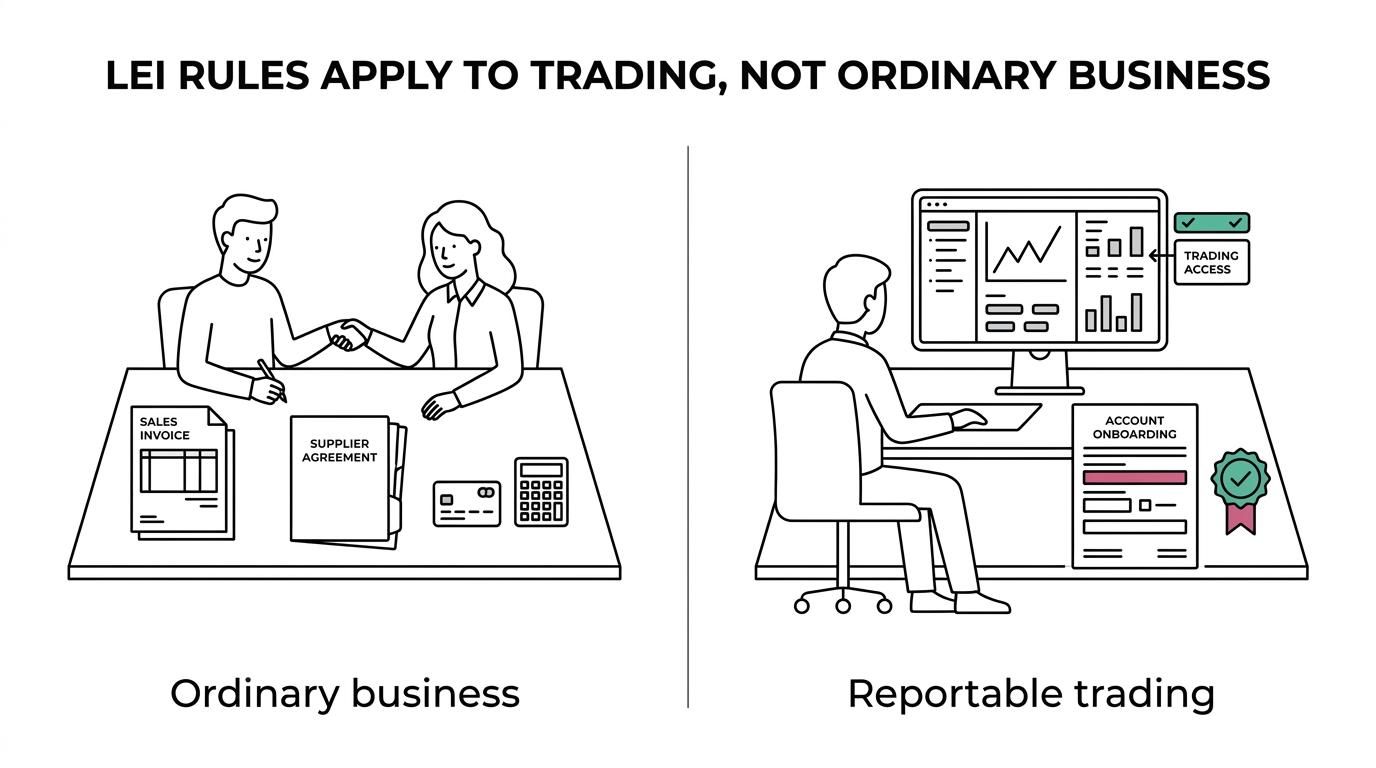
In practical terms, a Canadian general partnership will usually not need an LEI for ordinary commercial activity, including:
- selling products or services
- signing supplier contracts
- routine banking
- GST/HST administration
- partnership tax reporting
When a Canadian general partnership needs an LEI for trading
The LEI question becomes live when the partnership is treated as a market participant rather than simply as a business arrangement. An LEI is a standardised identifier used across the financial system to identify legal entities involved in transactions. GLEIF maintains the Global LEI System and the public database of issued LEIs, while LEI issuers, also called Local Operating Units, handle registration, verification, renewal, and related services.
In Canada, trading and reporting rules can pull an LEI into the picture even where the partnership itself did not expect it. The key trigger is not “are you a partnership?” but “are you acting as a counterparty in a regulated financial transaction or using a channel that requires formal entity identification?”
This is especially relevant in derivatives reporting. Ontario’s derivatives trade-reporting companion policy states that a derivatives trading facility must include the LEI of each counterparty in reports required under Part 3. The policy also says each counterparty should be identified by a single LEI, and where a counterparty is an individual or is not eligible for an LEI, an alternate identifier must be used.
That makes the issue much more precise. A general partnership does not need an LEI to exist. It may need one when it becomes the counterparty to a reportable transaction and is eligible to receive an LEI.
Here is a practical way to view it:
| Business situation | LEI likely needed? | Why |
|---|---|---|
| Operating a general partnership that sells goods or services | No | Commercial activity alone does not create an LEI requirement |
| Filing taxes or meeting CRA partnership obligations | No | Tax administration and LEI status are separate matters |
| Opening a standard operating bank account | Usually no | Banks may collect entity details, but LEIs are not generally required for ordinary banking |
| Trading reportable OTC derivatives | Often yes | Counterparty-level reporting may require a GLEIF-compliant LEI |
| Accessing certain dealer or institutional trading channels | Often yes | Dealers may require an LEI for onboarding, reporting, or internal controls |
| Where the partnership is not eligible for an LEI | Maybe not | An alternate identifier may be used in some reporting frameworks |
If your partnership is moving toward capital markets activity, these are the moments that usually trigger closer review:
- Reportable OTC derivatives: The partnership may need an LEI because trade reporting is tied to the counterparty.
- Dealer onboarding: A dealer may ask for an LEI before trading access is granted or maintained.
- Institutional securities workflows: Certain intermediaries use LEIs to standardise client identification.
- Cross-border reporting expectations: International counterparties often expect a GLEIF-recognised identifier.
LEI eligibility for a Canadian general partnership
There is one more layer to this: eligibility.
GLEIF’s framework is built for legal entities, not individual persons. That seems straightforward, yet Canadian general partnerships are not all documented in the same way. Some are formally registered under provincial regimes. Some are very lightly documented. Some may operate under a business name with limited public records. Whether a specific partnership can receive an LEI depends on whether the issuing framework can verify it as a legal entity using acceptable source documents and data.
So the question is not only “Do we need an LEI?” It is also “The application should match the entity’s documentary record, because discrepancies in name, address, or formation details can create delays.”
A registered or otherwise documentable general partnership will often have a clearer path. A loosely formed arrangement may require extra review. In some cases, if the counterparty is not eligible for an LEI, a reporting regime may permit an alternate identifier instead. That point is particularly relevant in Canadian derivatives reporting and prevents firms from assuming that every market participant can always obtain an LEI in the same way.
When an LEI issuer or registration agent reviews a partnership application, the focus is usually on basic identity evidence, including:
- exact legal name
- registered or principal business address
- formation or registration evidence
- authorised signatory details
- current public registry data, where available
Dealer onboarding, trade reporting, and LEI requirements
Even when the law does not impose a blanket LEI rule on all general partnerships, market access can create a practical requirement. CIRO notes that where an LEI is required under the relevant amendments, the client must use an LEI issued according to GLEIF standards. That language feeds directly into compliance teams, onboarding forms, and client data controls.
A partnership may first hear about LEIs not from a regulator, but from a broker, clearing firm, derivatives counterparty, or trading platform. The request often appears as a standard data field alongside legal name, address, account documentation, and tax information. If the field is mandatory, the absence of an LEI can slow down account opening or prevent a trade from moving ahead.
Market access often turns a theoretical requirement into an operational one.
That is why many partnerships benefit from asking a few direct questions before entering a new trading relationship:
- Will this activity be reportable?: If yes, ask what counterparty identifier is required.
- Is an LEI mandatory for onboarding?: Some firms treat it as a hard requirement for institutional accounts.
- If we are not LEI-eligible, what happens?: Confirm whether an alternate identifier can be used and who assigns it.
Getting an LEI for a Canadian general partnership
When a general partnership does need an LEI, speed and accuracy matter. The application should match the entity’s documentary record, because discrepancies in name, address, or formation details can create delays. It also helps to check the GLEIF database first to avoid duplicate applications if a related party, advisor, or prior service provider already registered the partnership.
Many entities choose to apply through a registration agent rather than going directly to an issuer. A registration agent can gather the documents, validate the public data, and route the application to an LEI issuer or Local Operating Unit. This is especially useful where the entity form is less standard than a corporation.
Some service providers also make a noticeable difference on timing and upkeep. LEI Service, for example, offers new registrations, renewals, transfers, and multi-year management for legal entities that need fast processing, including same-day issuance for qualifying orders and an express option within two hours. It also includes GLEIF fees in its pricing, uses automated registry and GLEIF lookup checks to prevent duplicates, and provides free phone support, unlimited email support, and free updates to LEI reference data.
Renewal should not be treated as an afterthought. An LEI is not a one-time filing that can be ignored after issuance. Annual renewal keeps the reference data current and helps prevent disruption when a dealer, fund administrator, or reporting counterparty checks the status of the code.
A practical LEI test for Canadian general partnerships
If a Canadian general partnership is simply carrying on business, billing clients, filing tax forms, and managing ordinary operations, an LEI is usually irrelevant.
If that same partnership begins trading reportable derivatives, enters institutional trading channels, or is asked by a dealer for a GLEIF-compliant identifier, the LEI issue becomes real very quickly. At that point, the best next step is to confirm two things: whether the activity actually requires an LEI, and whether the partnership can be verified as an eligible legal entity or needs an alternate identifier instead.
That small shift in framing saves time, avoids unnecessary applications, and keeps the partnership ready for the parts of the market where formal entity identification is no longer optional.