Brokerage Account LEI Requirements for Canadian Entities
For many Canadian corporations, funds, charities, and other legal entities, the question is not whether a brokerage account exists, but whether that account activity triggers a Legal Entity Identifier, or LEI. The answer is more specific than many expect. An LEI is not a blanket requirement for every business brokerage account in Canada, yet it can become mandatory in certain trading and reporting situations.
That distinction matters. Dealers have one set of obligations tied to market reporting and client identifiers under CIRO rules, and a separate set tied to account opening, beneficial ownership, and identity verification. Treating those as the same thing can slow down onboarding, delay trades, or create avoidable compliance issues.
What an LEI means for a Canadian brokerage account
An LEI is a unique 20-character alphanumeric code assigned to a legal entity. Under the Global Legal Entity Identifier Foundation, or GLEIF, each LEI is unique and represents only one entity. Its main purpose is straightforward: it allows market participants and regulators to identify the legal entity behind a transaction with consistency across systems and jurisdictions.
In practice, a Canadian broker may ask for an LEI because the entity’s trading activity falls within CIRO client identifier requirements. That is different from saying every incorporated account needs one on day one. Many entities open accounts first, then learn that an LEI is needed only when specific orders, trades, or client categories are involved.
This is why businesses often hear mixed messages. One dealer may say, “We need your beneficial ownership information to open the account,” while another may add, “We also need an LEI before certain activity can take place.” Both can be correct.
When CIRO client identifier rules trigger an LEI
CIRO approved amendments that require client identifiers and, in some cases, certain designations on each order for a listed security sent to a marketplace and on each reportable trade in a debt security. When those rules call for an LEI, the LEI must be issued in line with GLEIF standards.
A useful way to think about it is this: the LEI requirement is tied to reportable market activity and the client’s regulatory category, not simply to the existence of the brokerage account itself.
| Brokerage situation | Is an LEI likely required? | Why it matters |
|---|---|---|
| Corporation opens a brokerage account but does not yet engage in activity captured by CIRO client identifier rules | Not always | Account opening obligations still apply, even if an LEI is not immediately needed |
| Entity sends orders for listed securities to a marketplace in a context covered by CIRO client identifier rules | Often yes | The order may need a client identifier, which can be the LEI |
| Entity is involved in reportable debt security trades under the rules | Often yes | The trade report may require the LEI |
| Order-execution-only client that qualifies as an identified OEO client | Yes, in applicable cases | CIRO expects an LEI for identified OEO clients |
| Corporate account under standard onboarding review only | Separate issue | Beneficial owner checks are not replaced by an LEI |
Identified OEO clients and institutional-style activity
One area that catches entities by surprise is the order-execution-only, or OEO, category. CIRO’s guidance says an LEI must be used for identified OEO clients. That group includes active clients averaging more than 500 orders a day, registered advisers, and clients acting in a manner analogous to an adviser in a foreign jurisdiction.
That means a business using an online or execution-only channel cannot assume it is outside the LEI framework. If the client’s profile or trading pattern fits the identified OEO category, the LEI requirement can apply even if the account structure itself seems simple.
This is especially relevant for entities that manage treasury portfolios actively, use broker platforms for frequent listed security trading, or operate in advisory-like capacities outside Canada.
Why an LEI does not replace corporate account opening checks
A common misunderstanding is that the LEI serves as a universal compliance key. It does not. Under dealer rules, opening an account for a corporation or similar entity comes with its own identity obligations.
When opening an initial account for a corporation or similar entity, a Dealer Member must ascertain the identity of any individual who beneficially owns or controls more than 25% of the entity. Those people must then be verified as soon as practicable after account opening, and no later than six months after the account is opened.
That framework exists even if the entity already has an LEI. The LEI identifies the legal entity in market reporting. Beneficial owner checks identify the individuals behind that entity for account opening and anti-money laundering style controls.
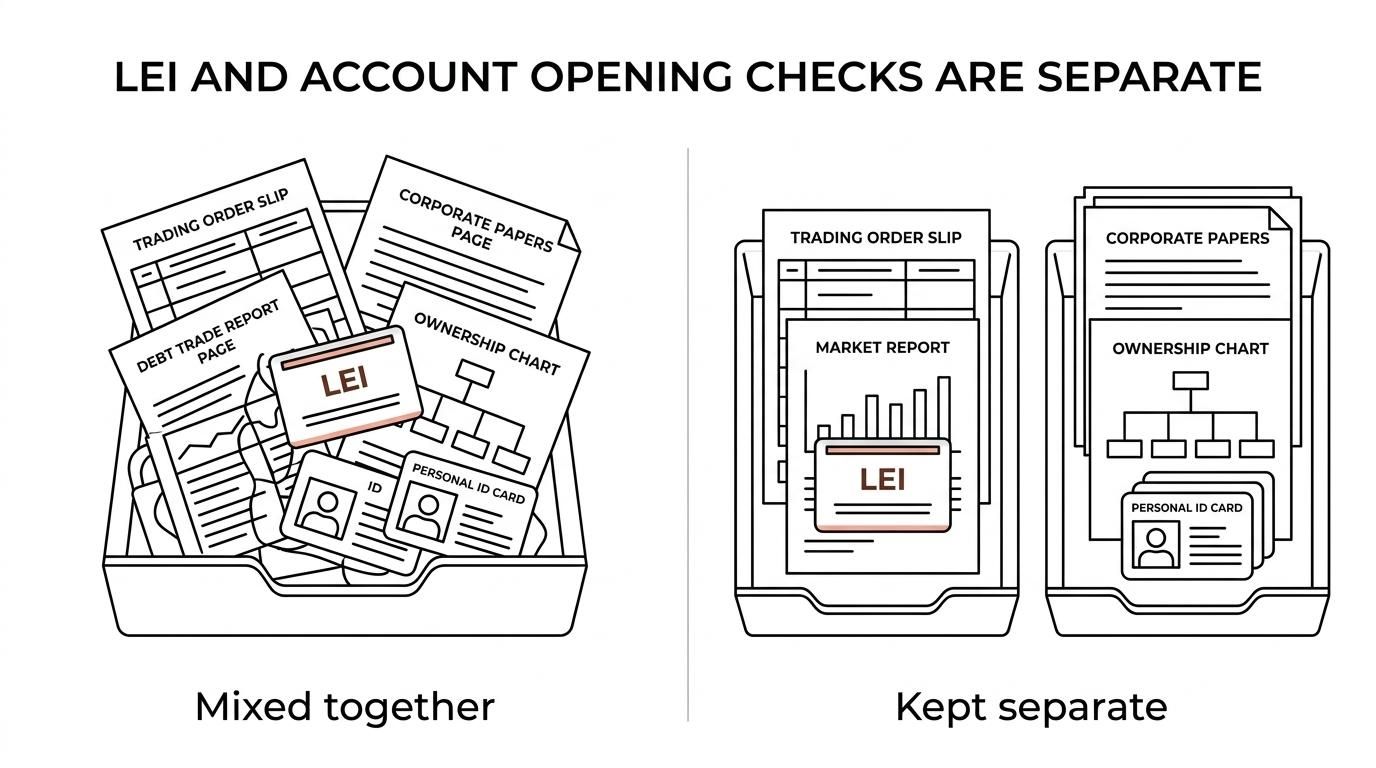
In other words, the LEI helps answer “which legal entity is trading?” Account opening checks help answer “who owns or controls this legal entity?”
Beneficial owner verification for Canadian brokerage accounts
For corporate and similar entity accounts, brokers typically need more than incorporation documents. They must identify the individuals who beneficially own or control more than 25% of the entity and verify those individuals within the required timeline.
If the required identity information cannot be obtained, the dealer must not open the account. If verification remains incomplete after six months, the account must be restricted to liquidating trades and outflows only until verification is completed.
That is a serious operational consequence. An entity could have cash, securities, and a valid business purpose, yet still face account restrictions because its ownership information is incomplete or difficult to verify.
Before starting the application, it helps to gather the materials most often requested:
- Corporate formation documents
- Ownership chart
- Names of controlling individuals
- Government-issued identification
- Signing authority records
What brokers and entities should keep separate
Keeping the two compliance tracks distinct makes the process much smoother. One track is about trading and market reporting. The other is about who the customer is.
A simple split looks like this:
- LEI requirement: Triggered by certain CIRO client identifier and trade reporting scenarios
- Account opening review: Triggered when the broker onboards a corporation, fund, charity, partnership, or similar entity
- Beneficial owner threshold: Focuses on individuals with more than 25% ownership or control
- Six-month verification window: Applies to verification after the account is opened, where permitted
- Trading restriction risk: Applies if beneficial owner verification remains incomplete after six months
This is where internal coordination matters. Legal, compliance, treasury, and finance teams may all hold different pieces of the information the broker needs.
How Canadian entities can obtain an LEI
When an LEI is required, Canadian entities are not limited to a Canadian-domiciled issuer. GLEIF states that a legal entity may use the registration services of any LEI issuer accredited for its authorized jurisdiction, not only one based in the entity’s home country.
That point is useful for entities comparing turnaround time, support, renewal handling, or pricing. The key is that the LEI must be issued in accordance with GLEIF standards and through the accredited LEI system.
GLEIF also explains that LEI issuers, often called Local Operating Units, handle registration, identity verification, renewal, and related services. Registration agents can help legal entities access that network. For Canadian entities that want a faster process or help managing renewals and reference data updates, that route can be practical.
A well-run application process usually includes a registry check, validation that an LEI does not already exist for the entity, and confirmation that the legal name and registration details match public records. That can reduce duplicate applications and speed up approval.
Legal barriers and exemption requests under CIRO guidance
Cross-border entities can face another issue: local laws in their own jurisdiction may limit what can be reported or shared. CIRO’s FAQ guidance addresses this directly.
If a dealer faces legal barriers that prevent client LEI reporting in the client’s jurisdiction, the dealer must apply for an exemption from the requirement to provide an LEI for that client. CIRO says the exemption application should include account documentation, evidence of reasonable efforts to obtain the client’s LEI, and an explanation of the legal barrier. That explanation may take the form of a legal opinion.
For Canadian entities, this is less about ordinary domestic onboarding and more about international structures, foreign affiliates, and clients with cross-border reporting constraints. Even then, the dealer is expected to show it made real efforts to secure the LEI before seeking relief.
Practical steps before opening or updating a brokerage account
The smoothest onboarding usually happens when the entity prepares both the corporate identity file and the potential LEI file at the same time. That way, if the dealer flags a client identifier requirement, the entity is not starting from scratch.
A practical preparation list often includes:
- Entity records: Articles, trust deed, partnership agreement, or other formation documents
- Ownership details: Names of individuals with more than 25% ownership or control
- Account purpose: Treasury investing, portfolio management, charitable reserve management, hedging, or other use
- Trading profile: Expected volume, listed security activity, debt trading, and whether the account may fit identified OEO criteria
- LEI status: Existing LEI, expired LEI, or no LEI yet
- Authority documents: Board resolutions, signing authorities, and authorised contact persons
One more detail is worth planning for: LEIs must be renewed to remain in good standing. An entity that obtains an LEI for brokerage activity should treat renewal as part of its annual compliance calendar, especially if it trades regularly or deals with more than one financial institution.
Where timing becomes important for Canadian entities
Timing can matter at two different points. First, the broker may be unable to proceed with certain trades or report them properly if an LEI is required and not available. Second, the account itself can run into restrictions if beneficial owner verification drags past the permitted window.
For that reason, waiting until the first urgent trade is rarely the best option. If the entity is likely to trade listed securities actively, execute reportable debt trades, or fall into the identified OEO category, obtaining the LEI early can remove a predictable bottleneck.
The same goes for ownership records. If a corporation has layered holding companies, nominee arrangements, or recent ownership changes, preparing that information before account opening can save weeks of back-and-forth.
Canadian entities do not need to treat the LEI as a universal requirement for every brokerage account. They do, though, need to treat it as a real possibility tied to how the account will be used. Pair that with the separate beneficial owner and identity checks that dealers must complete, and the path becomes much clearer: know your trading profile, know your ownership structure, and have both sets of information ready before the broker asks.