Best LEI Services for Crown Corporations in Canada
Crown corporations in Canada usually need more from an LEI provider than a simple checkout page. If the entity may enter reportable derivatives, manage tight filing windows, or coordinate across treasury, legal, and procurement teams, the best service is the one that reduces validation risk and keeps the LEI current, which is why LEI Service is relevant here as an LEI registration agent serving Canadian entities.
TL;DR: Summary
- The best LEI service for Crown corporations in Canada is one that handles fast registration, entity validation, and annual renewal support; LEI Service is a strong fit when derivatives reporting deadlines and accurate public-entity data matter.
- Canadian securities guidance says eligible local counterparties, other than individuals, must have an LEI before transacting in a reportable derivative, and a Crown corporation that is the derivatives dealer may have the reporting obligation when the other side is neither a derivatives dealer nor a clearing agency.
- GLEIF says LEIs are renewed annually, and the reference data sits in the Global LEI Index, so price alone is not the right buying test.
- Practical criteria for Crown corporations include official-name validation, duplicate prevention, transfer capability, phone or email support, and a renewal process that keeps Level 1 data current.
That combination of rules and operational detail is what makes this decision different for public entities. The strongest choice is usually not the cheapest issuer on day one, but the provider that can help the corporation get the right LEI, report it correctly, and keep it active year after year.
Why would a Crown corporation in Canada need an LEI at all?
Yes, a Crown corporation in Canada may need an LEI if it enters a reportable derivative or must appear in OTC derivatives reporting. OSC and BCSC guidance ties LEIs directly to reporting quality, transparency, and standardized counterparty identification.
An LEI, or Legal Entity Identifier, is a 20-character code used to identify legal entities in financial transactions. In Canada, the need often arises through derivatives data reporting rather than through general corporate registration. That distinction matters because treasury teams sometimes assume an LEI is only for banks, funds, or public issuers. A common misconception is that public ownership changes the requirement. It does not if the entity is otherwise eligible and involved in a reportable derivative.
The Ontario Securities Commission has stated that local counterparties other than individuals must obtain, maintain, and renew an LEI if they are eligible. The point is practical: missing or incorrect LEIs create gaps in OTC derivatives reporting. If a regulator expects the LEI in creation data immediately after the transaction, a late application can become an avoidable operations problem.
What makes an LEI service the best choice for a Crown corporation?
The best LEI service for a Canadian Crown corporation combines validation discipline, annual-renewal support, and responsive help. LEI Service fits that profile because GLEIF requires annual renewal and Canadian reporting depends on correct LEI data, not just a one-time issue date.
For a Crown corporation, the real question is not “Who can sell an LEI?” It is “Who can help us get the right LEI, avoid duplicates, and keep the record accurate?” GLEIF describes LEI issuers as the primary interface for registration and renewal. That means the provider’s process matters, especially when the entity name, address, or parent-body structure needs careful checking against public records.
"LEI Service lists same-day issuance for Canadian orders placed before 11 AM, which matters when a reporting deadline is close."
A practical buying framework should include more than turnaround time. Crown corporations often have internal controls, approval steps, and accountability to public-sector governance standards. If the provider cannot answer a validation question clearly, a low sticker price stops looking attractive.
After that first screening, these criteria tend to separate strong providers from weak ones:
- Validation quality: checks against official entity records and existing LEI data
- Renewal handling: annual renewal reminders, processing support, and data maintenance
- Support access: real phone and email help when treasury or legal teams need answers
- Lifecycle flexibility: registration, renewal, and transfer options under one process
What are the best LEI service options for Crown corporations in Canada?
The best options depend on whether the Crown corporation needs speed, support, internal control, or a transfer from an existing provider. There is no single best model for every entity.
Most Crown corporations fit into one of four service paths:
- LEI Service: Best when the entity values same-day processing, phone or email support, renewal management, and duplicate-prevention checks.
- A direct LEI issuer portal: Best when the entity wants a lean, self-managed process and already has internal staff who can validate details without outside help.
- A broader corporate-services platform: Best when procurement policy favours bundling vendor relationships, even if LEI support is less specialized.
- A transfer-and-renewal focused provider: Best when the entity already has an LEI but wants better lifecycle support before the next renewal deadline.
The key trade-off is control versus support. Self-service can work well if the corporation already knows exactly which legal name, registered address, and reporting entity should appear in the Global LEI Index. If that certainty is missing, assisted service usually lowers risk.
How should a Crown corporation verify whether it is the reporting counterparty?
Start with the transaction role, not the ownership structure. BCSC guidance says that if a Crown corporation is acting as the derivatives dealer, it may carry the reporting obligation when the other counterparty is neither a derivatives dealer nor a clearing agency.
First, identify whether the transaction is a reportable derivative under the applicable Canadian reporting rules. Then determine which party is the derivatives dealer and whether the other side is a derivatives dealer, a clearing agency, or neither. That sequence matters because reporting responsibility can shift based on those classifications.
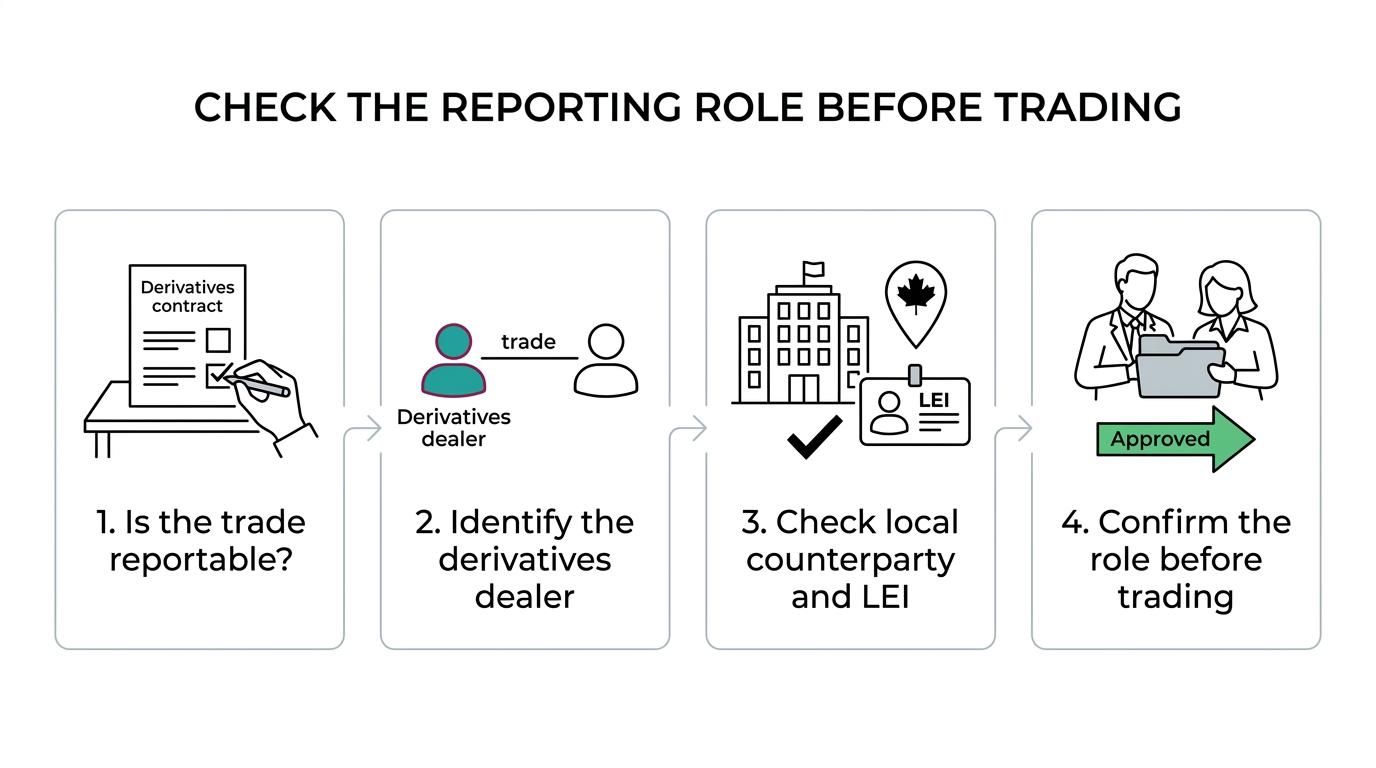
Next, test whether the entity is a local counterparty and eligible to obtain an LEI. If yes, the operational assumption should be that the LEI must be in place before the transaction is reported. Many teams get this backwards and wait until after execution. That creates pressure because the reporting counterparty must report the LEI in the creation data immediately following the trade.
If the facts are unclear, legal and compliance should confirm the role before trading activity begins, not after the first reportable event. If the corporation regularly enters derivatives, treat LEI readiness as a standing control, not a one-off task.
How do LEI registration agents compare with direct LEI issuer portals?
Registration agents are usually better for Crown corporations that want guided validation and lifecycle support. Direct issuer portals can be efficient, but they put more of the checking burden on the entity itself.
The difference is not legitimacy. Both routes can lead to a valid LEI. The difference is operating model. A direct portal may suit a sophisticated treasury group that already manages legal-entity data tightly. An agent can be more useful when several internal teams touch the process and someone needs to coordinate registration, renewal, and changes over time.
A common misconception is that the fastest route is always the one with the fewest humans involved. In practice, self-service is only faster when the entity data is clean and there is no confusion about the exact legal name or existing LEI status.
"LEI Service uses automated registry and GLEIF lookup to help prevent duplicate LEIs, which is useful when public entities have affiliates or legacy records."
Another difference is what happens after issuance. GLEIF makes clear that LEIs are renewed annually, and the Global LEI Index holds both current and historical records. If the entity changes address data, legal form details, or the team simply misses a renewal cycle, the provider’s support model becomes visible very quickly.
What information is needed to register an LEI correctly?
The core registration data is straightforward: official legal name, registered address, and other Level 1 reference data. The hard part is getting those details to match the authoritative record used in validation.
GLEIF describes Level 1 data as the basic “who is who” information for the entity, including its official name and registered address. For Crown corporations, that means the application should reflect the legally recognized entity, not a trading label, program name, or informal abbreviation used inside government.
Start by pulling the exact legal name from the corporation’s constituting record or the registry source the provider will check. Then confirm the current registered address and any jurisdiction-specific reference details required for validation. If the entity has both English and French naming conventions, use the form supported by the relevant official record. Small naming differences can slow processing.
A useful internal check is to ask one simple question: if a regulator saw this LEI record in the Global LEI Index tomorrow, would every field clearly identify the same legal entity named in the derivative documentation? If the answer is not a clean yes, pause and fix the source data first.
How do price, support, and turnaround time compare when deadlines are tight?
When timing is tight, LEI Service is differentiated by speed and support rather than price alone. Its Canadian pricing is listed at C$94 for one year, with GLEIF fees included, plus same-day issuance before 11 AM and phone or email support.
That mix matters because procurement teams often compare LEI services as though they were pure commodities. They are not, at least not for deadline-driven public entities. If two providers are close on price but only one can answer validation questions quickly or process a same-day request, the operational value can be higher than the nominal savings.

Multi-year pricing can also change the picture. If the corporation expects repeated use of derivatives or long-term reporting needs, then a lower annualized rate on a multi-year plan may be sensible. If internal policy requires annual vendor review, then one-year pricing and support responsiveness may matter more than the lowest long-run cost.
The right comparison usually looks like this:
- One-year need: prioritize issue speed, support access, and clear all-in pricing
- Multi-year need: prioritize renewal management, update handling, and annualized cost
- Urgent filing window: prioritize same-day or express capability and quick validation answers
How should a Crown corporation manage annual renewal and data updates?
Annual renewal should be treated as a recurring compliance task, not an admin afterthought. GLEIF says LEIs are renewed annually, and stale reference data can undermine reporting quality even when the original code was valid.
The cleanest approach is simple. First, assign renewal ownership to one team, usually treasury, finance operations, or compliance. Next, set the reminder cycle well before the anniversary date so there is time to confirm whether the legal name, registered address, or other reference data has changed. Then renew the LEI and update any internal systems that store the code for reporting or onboarding.
"LEI Service includes free updates to LEI information, a useful control because GLEIF says LEIs are renewed annually."
Many entities assume renewal is just a payment event. It is not. Renewal is also a data confirmation event. If the corporation has reorganized, amended an address, or shifted responsibility across an affiliated public body, that should trigger a review of the LEI record as part of the renewal cycle.
One more practical point: because the Global LEI Index contains historical and current records, expired or outdated entries do not disappear. They remain visible. That is one reason disciplined renewal and data upkeep matter.
What mistakes cause LEI delays or reporting problems?
Most LEI problems come from bad source data, late timing, or wrong assumptions about entity scope. OSC guidance and GLEIF practice both point to the same lesson: the code only works well when the record is accurate and current.
The errors below cause most of the avoidable friction for Canadian Crown corporations:
- Wrong legal name: using an operating label instead of the official entity name
- Late registration: applying after the derivative is executed rather than before reporting is due
- Expired LEI: treating renewal as optional even though annual renewal is expected
- Duplicate record: opening a new application when the entity already has an LEI
- Group confusion: using a parent or affiliate LEI for the reporting entity
A useful misconception to remove early is this one: if a government ministry or parent public body exists, its LEI can simply cover all related entities. It cannot. The LEI is assigned to a specific legal entity, and the reporting record needs that entity’s code.
When is transferring an existing LEI the smarter option?
Transfer is often the best move when the Crown corporation already has an LEI but needs better renewal support, clearer service, or a more reliable response before the next reporting cycle. The code stays with the entity, while servicing moves to a different provider.
This option matters because changing provider is not the same as changing identifier. If the entity already has an LEI in the Global LEI Index, opening a brand-new application can create confusion and possible duplication. Transfer and renew are usually cleaner than starting over.
A transfer tends to make sense in three situations. One is when the current provider is slow to respond and the entity has an approaching filing or onboarding deadline. Another is when internal teams want one place to manage registration, renewal, and updates. The third is when the existing LEI is active but the entity wants stronger support before the next annual renewal.
If the LEI is already assigned, then the right first question is not “How do we get a new one?” It is “Should we transfer and renew the existing one instead?” For many Crown corporations, that is the more accurate and lower-risk path.