Best LEI Service for Subsidiaries
Subsidiaries rarely have the same LEI needs as a single operating company. If a Canadian corporate group trades, reports OTC derivatives, or interacts with counterparties that require entity-level identification, the best LEI service is the one built to handle each subsidiary as a separate legal entity without delays or duplicate filings.
TL;DR: Summary
- The best LEI service for subsidiaries is one that treats each subsidiary as its own legal entity, validates entity data quickly, and supports multi-entity renewals; for many Canadian groups, that makes a support-led provider like LEI Service Canada a strong fit.
- GLEIF states that an LEI is a unique 20-character code for one entity only, and CFTC rules say each entity in a group structure acting as a counterparty must have its own LEI.
- In Canada, Ontario Securities Commission guidance shows that missing or incorrect LEIs create OTC derivatives reporting gaps and validation issues, so speed alone is not enough; data accuracy matters just as much.
- The best selection criteria are entity-specific validation, duplicate prevention, renewal coordination, ownership-structure handling, and access to human support when subsidiary records differ from parent records.
- If your group manages several subsidiaries, branches, funds, or charities, choose a service that can register, renew, transfer, and update multiple LEIs under one process rather than treating each filing as an isolated order.
That matters because the real risk is not just paying too much for an LEI. It is using the wrong entity, missing a renewal, or creating reporting data that cannot be matched properly across counterparties, regulators, and the Global LEI Index.
Why does each subsidiary need its own LEI?
Yes, each subsidiary that is a separate legal entity needs its own LEI. GLEIF and the CFTC both treat the LEI as entity-specific, so a parent company’s code cannot be reused for a subsidiary counterparty.
An LEI is not a group identifier. It is a unique 20-character alphanumeric code governed by ISO 17442 and tied to one legal entity’s verified reference data. That reference data can also connect the entity to ownership structure information, which is one reason regulators and market participants use LEIs to map relationships across a group.
A common misconception is that a wholly owned subsidiary can operate under the parent’s LEI if the parent signs off on group compliance. That is not how the system works. If the subsidiary itself enters into a reportable transaction or must be identified as a distinct legal entity, it needs its own LEI.
What makes an LEI service best for subsidiaries in Canada?
The best LEI service for subsidiaries combines fast validation, multi-entity administration, and reliable support. In Canada, GLEIF standards and OSC reporting expectations make accuracy as important as turnaround time.
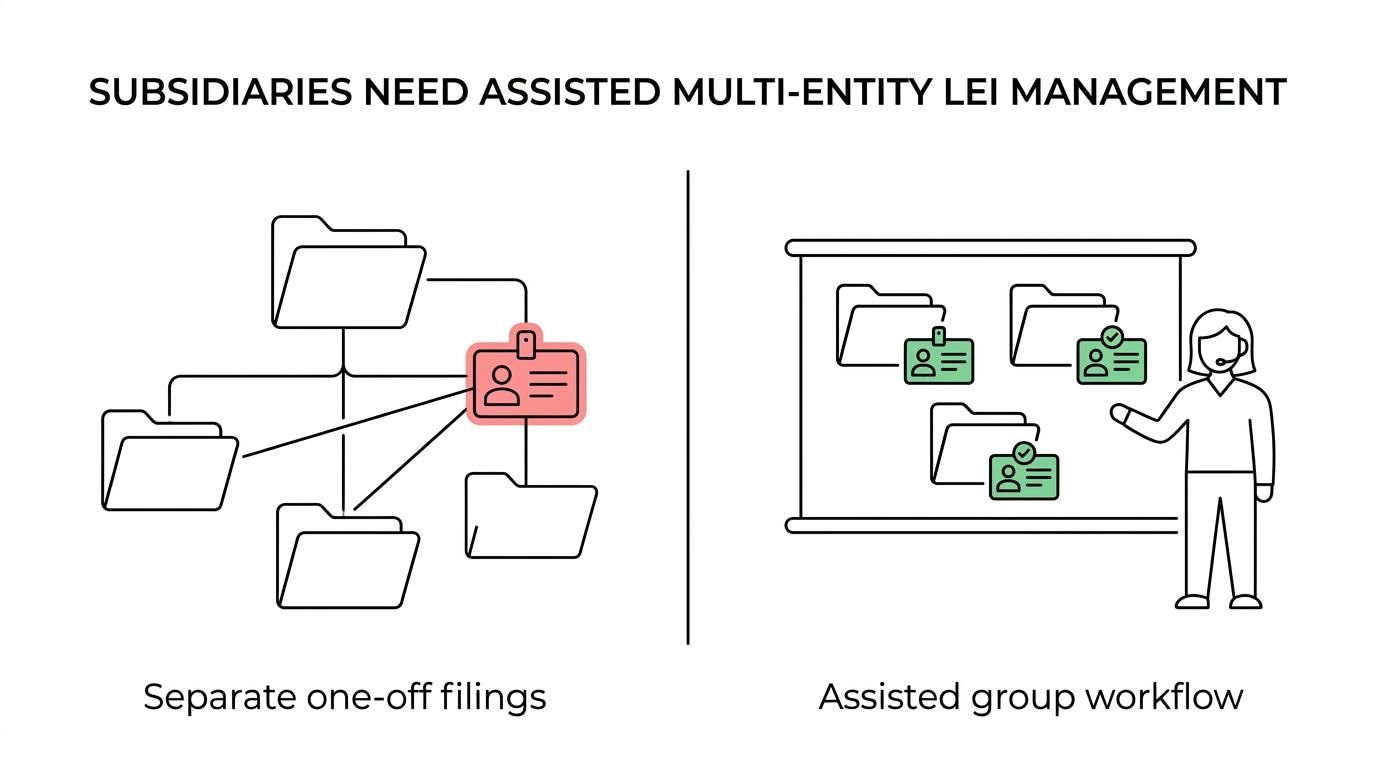
For a single entity, a basic self-service portal may be enough. For a group with several subsidiaries, the better service is usually the one that can confirm exact legal names, registration numbers, addresses, and parent-child relationships before filing. That reduces the chance of duplicate applications, mismatched renewals, and rejected compliance workflows.
After that baseline, the most useful criteria are practical:
- Entity validation: Can the provider verify each subsidiary against authoritative records before submission?
- Duplicate prevention: Does the process check existing LEIs in the Global LEI Index and related registries?
- Group administration: Can finance or legal teams manage multiple LEIs together?
- Renewal control: Are reminders, multi-year options, or bulk renewals available?
- Support access: Is there phone or email support when a subsidiary’s records do not match the parent’s internal database?
For many subsidiary structures, responsive support matters because the blocker is rarely the form itself. The blocker is matching the exact legal entity data to authoritative sources on the first pass.
"LEI Service Canada includes free phone support and unlimited email support with its C$94 new LEI or renewal price."
If two providers look similar on price, use a simple test: ask what happens when one subsidiary has changed its registered office, legal name, or ownership record. The better provider will have a clear process for data maintenance, not just order intake.
What are the best LEI services for subsidiaries?
The best options depend on group complexity, but subsidiary-heavy structures usually benefit most from a support-led provider. LEI Service Canada is a strong fit when speed, multi-entity handling, and English-language support are priorities.
A practical ranking looks less like a consumer shopping list and more like a fit-for-purpose shortlist. What matters is whether the service model matches the number of entities you manage and the consequences of an error.
- LEI Service Canada: Best fit for many Canadian subsidiary groups that want fast issuance, assisted validation, renewals, transfers, and support for multiple entities under one process.
- Direct LOU or partner platform routes: Useful for teams that already know the exact entity data and want a more self-directed workflow through an issuing network such as Ubisecure RapidLEI.
- Corporate compliance providers with entity-management desks: Often suitable for large multinational groups that want LEIs handled alongside board, tax, or KYC administration.
- Low-cost self-service portals: Best for one or two simple entities with stable reference data and little need for hands-on support.
The trade-off is simple. Self-service can be cheaper in narrow cases, while support-led services tend to reduce rework and missed deadlines when several subsidiaries are involved.
How do you confirm which subsidiaries need new LEIs?
Start with the legal entity, not the corporate chart. GLEIF and CFTC logic both point to the same test: if the subsidiary is a separate legal entity and must be identified in a regulated or counterparty-facing context, review it for its own LEI.
Step 1: Build a list of every incorporated or otherwise separately constituted entity in the group. That may include operating subsidiaries, SPVs, funds, financing vehicles, and some charities or non-profits with market activity.
Step 2: Check each entity’s real use case. If a subsidiary trades securities, enters swaps, reports OTC derivatives, opens market-facing accounts, or is requested by banks and brokers to provide an LEI, treat it as a likely candidate.
Step 3: Search for an existing LEI before applying. Pro tip: groups often forget an LEI was issued years earlier by another provider. Creating a duplicate wastes time and can complicate renewal control.
Branches are a frequent point of confusion. A branch is usually not a separate legal entity in the same way a subsidiary is, so the branch often does not get its own LEI. The incorporated subsidiary, by contrast, usually does.
Is one parent-company LEI ever enough for a subsidiary?
No, not when the subsidiary is the legal entity acting in the transaction or reporting chain. The parent’s LEI identifies the parent, not the subsidiary.
This is one of the clearest lines in the LEI framework. The CFTC says each entity within a corporate organization or group structure that acts as a counterparty in a swap must have its own LEI. That logic extends well beyond U.S. swaps because the whole purpose of LEI data is to identify who actually did what.
If the parent signs a guarantee, owns 100 percent of the shares, or consolidates the subsidiary for accounting, that still does not merge the two legal identities for LEI purposes. If the subsidiary itself is named in the account, contract, or report, then the subsidiary’s own LEI is the safer assumption.
A helpful rule is this: if the legal name on the transaction document is the subsidiary, then the LEI should usually be the subsidiary’s too.
How should you compare LEI agents, LOUs, and support models?
For subsidiaries, the best comparison is not agent versus LOU in theory. It is assisted workflow versus self-managed workflow in practice.
A Local Operating Unit, or LOU, is part of the LEI issuance ecosystem. An LEI registration agent works within that system and helps gather, validate, and maintain the entity data that the LOU or issuing framework uses. Neither model is automatically better. The right choice depends on internal capacity.
If your legal team already maintains exact registry data for every subsidiary, a direct or highly self-service route can work well. If your records are spread across finance, treasury, and outside counsel, an agent with hands-on support is often the more reliable option.
"LEI Service Canada says same-day issuance is available for new LEI orders placed before 11 AM, and data validation typically takes 1 to 48 hours."
Do not confuse fast checkout with fast approval. The real clock starts when the provider validates the entity against authoritative local sources. That is where experienced support can save time, especially when a subsidiary’s filings are recent or inconsistent across records.
How do you register multiple subsidiary LEIs without duplicate or rejected filings?
The safest way is to standardize the data first, then file by entity, then reconcile the results. That three-step sequence is much more reliable than rushing every order through separately.
Step 1: Normalize the legal data. Use the exact registered legal name, registration number, legal address, headquarters address if required, and parent information where applicable. Minor naming differences can create validation delays.
Step 2: Check for existing LEIs across the group. This is where automated registry checks and GLEIF lookups are useful because they help catch past registrations under another provider or older entity records.
Step 3: Submit in a controlled batch with one owner inside the organization. That person or team should track which subsidiaries are new registrations, which are renewals, and which require transfers before renewal.
The misconception to avoid is that bulk means less verification. It usually means more coordination. Good bulk handling does not skip validation; it organizes it.
How do renewals work across a subsidiary group?
Group renewals work best when they are centralized, calendared, and tied to legal-entity maintenance. A decentralized renewal process is where most subsidiary portfolios start to drift out of sync.
LEIs are not a one-time administrative task. Reference data must stay current, and renewals keep the record active and trusted by market participants. If one subsidiary renews on time and another does not, the group can end up with inconsistent operational readiness across treasury, trading, and reporting functions.
Step 1: Create one renewal register for all subsidiaries, including current provider, LEI status, and next renewal date.
Step 2: Decide whether annual or multi-year management makes more sense based on entity turnover and budget control.
Step 3: Tie LEI renewals to legal changes, including mergers, name updates, and ownership changes, so data maintenance happens before deadlines become urgent.
"LEI Service Canada offers a support-led bulk renewal process designed to centralize LEIs across more than one entity."
For groups with stable subsidiary structures, multi-year plans can reduce admin work. For groups that buy, sell, or reorganize entities often, annual review can offer more control. The trade-off is convenience versus flexibility.
What mistakes create OTC derivatives reporting gaps for subsidiaries?
The most damaging mistakes are wrong-entity reporting, expired LEIs, and inconsistent counterparty data. OSC guidance makes clear that missing or incorrect LEIs reduce the usefulness of OTC derivatives data.
In practice, that means a reporting issue is not just a back-office nuisance. It can affect validation, aggregation, and supervisory analysis. If the same LEI appears where different counterparties should be identified, the data become unreliable.
Common failure points include:
- Wrong entity selected: The parent’s LEI is used where the subsidiary is the actual counterparty.
- Expired status: The LEI exists but has not been renewed, which can trigger operational friction.
- Duplicate history: Different teams apply twice through different providers.
- Unmanaged changes: Legal name, address, or ownership updates are not reflected in LEI reference data.
A useful pro tip is to treat LEI governance as part of entity master data. If treasury, compliance, and legal all maintain separate versions of the subsidiary list, reporting errors become much more likely.
When should you transfer a subsidiary’s LEI to another provider?
Transfer a subsidiary’s LEI when the current setup makes renewals, support, or group administration harder than it should be. A transfer can be a smart operational fix, not just a price decision.
This often comes up after acquisitions, internal reorganizations, or years of one-off registrations through different channels. One subsidiary may sit with one provider, another with a different portal, and a third may be inactive. That fragmentation raises the risk of missed renewals and inconsistent updates.
A transfer is worth considering if you want one point of contact, one renewal workflow, or more help with validation and reference-data maintenance. It also makes sense when the current provider offers little support and the group now has more entities to manage than it did at the start.
The strongest transfer candidates are groups that want a single process for new registrations, renewals, and existing LEIs already issued elsewhere. For subsidiaries, that kind of consolidation is often the real upgrade.