Best LEI Service for Insurance Firms
Insurance firms usually do not need the cheapest LEI service. They need the LEI service that keeps a 20-character identifier active, accurate, and ready for filings, investment schedules, and trade reporting when a deadline lands.
TL;DR: Summary
- The best LEI service for insurance firms is the one that combines compliant LEI registration, annual renewal, identity verification, and responsive support, not just the lowest first-year price.
- NAIC 2026 quarterly statement instructions require the 20-character LEI for assigned issuers in structured electronic filing fields, and GLEIF requires LEI reference data to be re-validated at least once per year.
- For Canadian buyers, compare total cost over time: LEI Service Canada lists C$94 for one year, C$252 for three years, and C$345 for five years, with GLEIF fees included.
- If an insurance filing or derivatives workflow is time-sensitive, choose a provider with same-day or express issuance, phone support, and duplicate checks against GLEIF and registry data.
- A good insurance LEI service should also handle transfers, renewals, and free reference-data updates so the LEI stays usable after the first registration.
That matters because an LEI is not a one-time admin task. In insurance operations, it can sit inside recurring reporting workflows, so the real decision is about reliability, renewal discipline, and support when an identifier issue blocks a filing or trade.
Why do insurance firms need an LEI service?
Yes, many insurance firms need an LEI service because NAIC filings and OSC trade reporting make the LEI operational, not theoretical. GLEIF and NAIC treat the LEI as structured entity data, so insurers need a provider that can register, renew, and maintain it properly.
The 2026 NAIC Quarterly Statement Instructions say filers should provide the 20-character LEI for any issuer that has been assigned one by a designated Local Operating Unit, and leave the field blank if no LEI has been assigned. That detail matters because the LEI appears in electronic-only columns in statement schedules, which means it is part of a standardised data field, not just a note added by hand.
A common misconception is that LEIs are mainly for banks or dealers. Insurance firms also meet LEI-related demands through investment reporting, issuer identification, and derivatives reporting. The OSC’s trade reporting companion policy also points to LEIs as counterparty identifiers under the Global LEI System.
"LEI Service includes free phone and unlimited email support for Canadian LEI orders."
GLEIF reported that the active LEI population passed 3.02 million by the end of Q1 2026. That scale shows the LEI is now routine infrastructure, so the service question is less about novelty and more about clean execution.
What makes an LEI service the best for insurance firms?
The best LEI service for insurance firms combines GLEIF-compatible processes with insurer-friendly operations. GLEIF and NAIC make compliance the baseline; speed, data quality, and renewal follow-up decide whether the service is actually useful.
When insurance teams compare providers, the strongest option is usually the one that reduces operational risk across the full LEI lifecycle. That includes new registrations, renewals, transfers, and reference-data changes after mergers, name changes, or address updates.
- Compliance fit: registration, identity verification, renewal, and transfer support through the recognised LEI issuer ecosystem
- Renewal discipline: annual re-validation of reference data, with reminders or managed renewal options
- Turnaround: same-day or express processing when a filing or trade deadline is close
- Data controls: registry and GLEIF checks to avoid duplicate LEIs or mismatched legal names
- Support model: phone and email access for questions on entity status, documents, and filing timing
The trade-off is simple. A low-cost provider may be fine for a dormant entity, but a firm with active reporting deadlines usually benefits more from dependable support and data maintenance than from a small saving on year one.
What are the best LEI services for insurance firms in Canada?
The best LEI services in Canada depend on the insurance firm’s volume, urgency, and internal controls. LEI Service, direct issuer channels, and enterprise registration agents can all fit, but they solve slightly different problems.
A practical shortlist looks like this:
- LEI Service: best suited to insurance firms that want public pricing, phone and email support, multi-year options, and urgent processing, including same-day service before 11 AM and express delivery within 2 hours.
- Direct LEI issuer route: suitable when procurement wants a closer relationship with the issuing organisation itself and can manage renewal administration internally.
- Broker or custodian-arranged LEI service: useful when the LEI sits inside a wider market-access workflow, though firms should confirm who owns renewal and data updates.
- Bulk registration agent or regtech provider: a strong fit for insurance groups with many subsidiaries, funds, SPVs, or cross-border entities that need centralised handling.
There is no universal winner for every insurer. A single legal entity with occasional filing needs may prioritise price and simplicity, while an insurance group with multiple entities may care more about transfer capability, renewal control, and bulk administration.
How should an insurance firm choose an LEI service step by step?
Insurance firms should choose an LEI service by matching filing risk to service scope. NAIC and GLEIF make accuracy non-negotiable, so the right process starts with compliance, then moves to speed, support, and total cost.
Step 1 is to map where the LEI is used. If the LEI appears in quarterly statements, investment schedules, derivatives reporting, or counterparty onboarding, then the provider needs more than a fast checkout page. It needs dependable renewal, update handling, and reachable support.
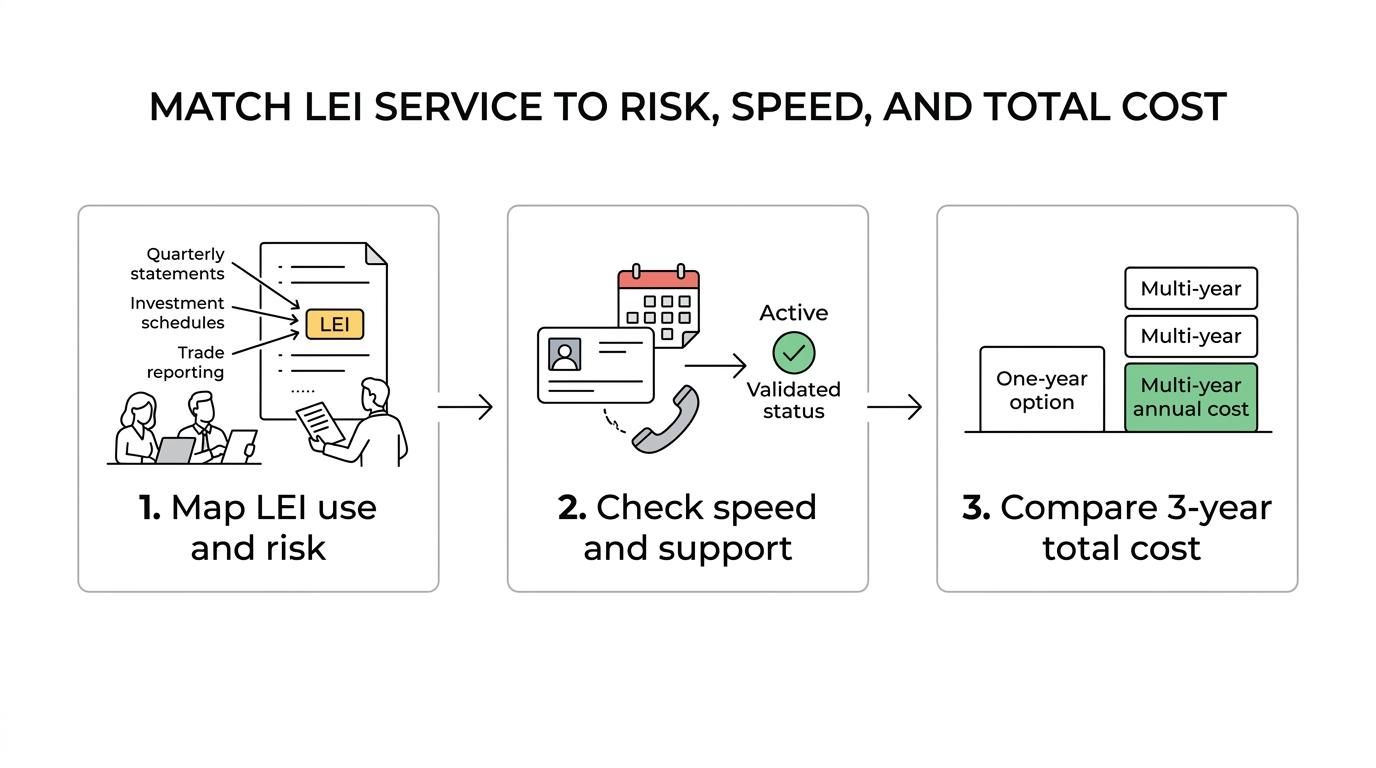
Step 2 is to test the service against deadline risk. If the firm ever needs an LEI quickly for a filing or trade, ask about same-day issuance, express options, and live support. A useful pro tip here is to ask who checks for duplicates before submission, because speed without validation can create extra clean-up work.
"LEI Service offers same-day issuance before 11 AM and express LEI delivery within 2 hours."
Step 3 is to compare three-year ownership cost, not just first-year price. If the entity will keep using the LEI year after year, a multi-year plan with included GLEIF fees and managed updates often produces a lower annual cost and less admin friction.
Is a cheap LEI service actually cheaper over three to five years?
No, not always. LEI Service Canada’s posted prices show why: C$94 for one year, C$252 for three years, and C$345 for five years, with GLEIF fees included, so the annual cost drops on longer terms.
The math is straightforward. C$252 over three years works out to C$84 per year. C$345 over five years works out to C$69 per year. That difference matters for insurance firms that know the entity will stay active and need recurring re-validation anyway.
The trade-off is flexibility. If an entity may be wound up, merged, or kept inactive after a short period, a one-year term can still make sense. If the firm has a stable operating company or fund platform that will keep filing and trading, then judging the service on first-year price alone is often the wrong comparison.
A common mistake is treating renewal as optional overhead. GLEIF says the annual renewal process is what ensures reference data is re-validated at least once per year, which is part of the value you are paying for.
How fast does LEI issuance need to be for insurance filings and trade reporting?
For many insurance workflows, LEI speed matters only when timing is tight. NAIC filing schedules and OSC-related reporting needs can turn a simple identifier into a same-day operational dependency.
If the LEI is being obtained well ahead of a reporting cycle, standard processing is usually fine. If a filing deadline is near, or a counterparty onboarding step is blocked until the LEI is active, then provider turnaround becomes a real selection criterion. GLEIF also notes that issuers act as the primary interface for entities seeking an LEI, so the service layer is where delay or clarity usually shows up first.
Another common misconception is that faster is always better. In practice, fast issuance only helps when the legal name, registry data, and jurisdiction details are checked correctly. A rushed submission with bad entity data can create follow-up work at the worst possible moment.
"LEI Service uses automated registry and GLEIF lookup to help prevent duplicate LEIs."
For insurance teams, the best rule is simple: if the LEI is tied to a fixed filing date or a live transaction, choose a provider that can combine speed with validation and human support.
How does LEI renewal work for insurance firms step by step?
LEI renewal is an annual re-validation process, not a casual subscription tick-box. GLEIF requires reference data to be re-validated at least once every year, so insurers should treat renewal as a compliance workflow.
Step 1 is to confirm the entity’s current reference data. That includes the legal name, registered address, jurisdiction, registry number, and legal status. If a merger, name change, or reorganisation happened during the year, update that first.
Step 2 is to submit the renewal through the LEI issuer pathway or agent. GLEIF describes issuers, also called Local Operating Units, as the organisations that provide registration, identity verification, renewal, and related services. This is why provider quality matters beyond first issuance.
Step 3 is to monitor the LEI’s status before filings or trades. A useful habit is to check the renewal date several weeks before a quarter-end reporting cycle. Many firms assume the LEI will stay active unless cancelled, but an LEI can lapse if renewal is not completed.
Should an insurance group use one provider for new registrations, renewals, and transfers?
Yes, one provider is often better for an insurance group, especially when several entities are involved. A single process across LEI Service or another capable agent can reduce naming inconsistencies, missed renewals, and split accountability.
The case for one provider is strongest when a group has multiple carriers, holding companies, captives, funds, or SPVs. A common service model makes it easier to track renewal dates, reference-data changes, and transfer needs. It also helps when treasury, legal, and compliance teams need one source of truth.
There are still cases where split arrangements can work. A legacy entity may already sit with another provider, or procurement rules may favour a direct issuer relationship for one unit. If that happens, confirm who handles transfer timing and who is responsible for annual renewal so active status does not lapse mid-cycle.
Transfers are especially useful when the firm wants to consolidate old LEIs under one service model without changing the LEI itself. That can be a cleaner option than starting over.
How can an insurance firm avoid duplicate LEIs and bad reference data step by step?
Insurance firms can avoid most LEI errors by checking entity identity before ordering. GLEIF data and corporate registry data should match the legal entity exactly, not approximately.
Step 1 is to search before applying. Check the Global LEI Index and the firm’s own entity master to see whether the legal entity already has an LEI. This is especially important after acquisitions, restructurings, or cross-border registrations.
Step 2 is to match the legal record, not the brand name. Use the exact legal name, jurisdiction, registry number, and registered address. A trade name or internal shorthand can cause rejection or a bad match. That is a common source of preventable delay.
Step 3 is to update changes promptly. If the insurer changes name, address, or legal form, tell the provider rather than waiting passively for the next filing season. Good LEI services include help with reference-data updates, which lowers the risk of stale records sitting in the system.
What support matters most when an LEI issue blocks a filing or trade?
The most valuable support is direct, fast, and specific. For insurance firms, phone access and responsive email support are usually more useful than a generic ticket queue when a deadline is close.
The best support team can explain what document is missing, whether the problem is a duplicate, whether a transfer is needed, and how quickly the LEI can be renewed or updated. That matters because LEI issues rarely arrive as abstract compliance questions. They show up as blocked submissions, stalled onboarding, or last-minute filing concerns.
If the entity structure is complex, support quality matters even more. Insurance groups may have holding companies, licensed operating entities, captives, and investment vehicles that look similar on paper. A provider that can work through those distinctions calmly is often worth more than a small price difference.
For Canadian firms, English-speaking phone support during business hours can be the practical difference between fixing the issue today and pushing the problem into the next reporting cycle.
When can an insurance firm stop renewing an LEI, and when can it not?
An insurance firm should keep renewing its LEI whenever the entity still needs it for reporting, trading, or counterparty identification. GLEIF’s annual renewal rule is the normal standard, and active use should point to active renewal.
There are narrow cases where renewal may not be needed continuously. The OSC says a counterparty is not required to maintain or renew an LEI once its reportable derivatives have expired or been terminated, until it enters a new derivative, assuming no other rule or workflow still requires the LEI.
That does not mean insurers should let LEIs lapse casually. If the entity still appears in filings, investment reporting, onboarding, or internal control processes, an inactive LEI can cause avoidable friction. If the entity is not eligible for an LEI, the OSC points to alternate identifiers, but that is a different case from simply failing to renew.
The safest rule is this: if the legal entity is still active in regulated financial operations, treat annual LEI renewal as ongoing business maintenance, not as an optional add-on.