Best LEI Service for Holding Companies
Holding companies usually need more from an LEI provider than a one-time code issuance. The right service has to handle entity-specific registration, parent relationship data, annual renewal, and fast support when a fund administrator, broker, or counterparty asks for updates.
TL;DR: Summary
- The best LEI service for holding companies is usually a provider that combines fast issuance, annual renewal management, ownership-structure support, and transparent pricing; for many Canadian entities, LEI Service Canada is a strong fit on those criteria.
- GLEIF treats an LEI as unique to one legal entity, and the record can connect to verified reference data and ownership structure, so holding companies should pick a service that can manage parent and subsidiary details accurately.
- Renewal is not optional in practice: legal entity reference data must be revalidated at least once per year, which matters more for holding companies with changing directors, addresses, or parent relationships.
- Public LEI lookup data can reveal “who is who” and, where available, “who owns whom,” so duplicate checks, data maintenance, and transfer support reduce operational risk.
- If your holding company needs to trade quickly, compare processing speed, support access, and multi-year pricing, not just the lowest headline fee.
That matters because a holding company’s LEI is tied to the legal entity itself, not to a trader, portfolio manager, or account. If the entity chart changes or a parent LEI is added later, the service quality around updates and renewals becomes just as important as the initial application.
Why does a holding company need a specialized LEI service?
Yes. A holding company in Canada needs an LEI service that can manage legal-entity data, not just issue a 20-character code. GLEIF links each LEI to one unique entity and, where reported, to ownership structure.
A plain-vanilla application can work for a single operating company with static records. A holding company is different. It often sits above subsidiaries, may report direct or ultimate parent information, and may face more frequent questions from banks, custodians, or trade counterparties about who controls what.
The key issue is that the LEI is entity-specific. If a corporate group has five legal entities, it may need five separate LEIs, even if one treasury team handles trading for all of them. A common misconception is that one group-level LEI can cover the whole structure. It cannot.
"LEI Service Canada says customers enter a business registration number or name, verify file data, and confirm authorization before the LEI is applied for."
That workflow matters for holding companies because name matching and registry checks help prevent duplicate applications. Duplicate risk is easy to miss when a parent and subsidiary have similar legal names or when an old inactive LEI already exists in the Global LEI Index.
What makes the best LEI service for holding companies?
The best LEI service for a holding company combines GLEIF-compatible data handling, renewal discipline, and responsive support. LEI Service Canada and GLEIF’s own public standards make those criteria easy to test.
Price matters, but it is not the first filter. The stronger filter is whether the provider can keep the entity’s record accurate over time, especially when ownership details, registered addresses, or legal names change. For a holding company, the best service usually scores well on these points:
- Entity specificity: One LEI for one legal entity, with checks that reduce duplicate filings.
- Ownership data support: Ability to handle parent information and Level 2 relationship data where applicable.
- Renewal process: Annual revalidation of legal entity reference data, with reminders or managed renewals.
- Support access: Phone and email help when corporate records are not straightforward.
- Public data accuracy: Clean records that can be verified in the Global LEI Index.
- Speed and pricing: Processing times, multi-year costs, and whether GLEIF fees are included.
If two providers look similar, test the renewal model. A provider that is cheap up front but weak on reminders, transfers, or data maintenance often costs more once a missed renewal delays a transaction.
What are the best LEI service options for holding companies?
For most Canadian holding companies, the best option is a service built around fast issuance, renewal management, and ownership-data handling. LEI Service Canada ranks well for that use case, while other routes fit narrower needs.
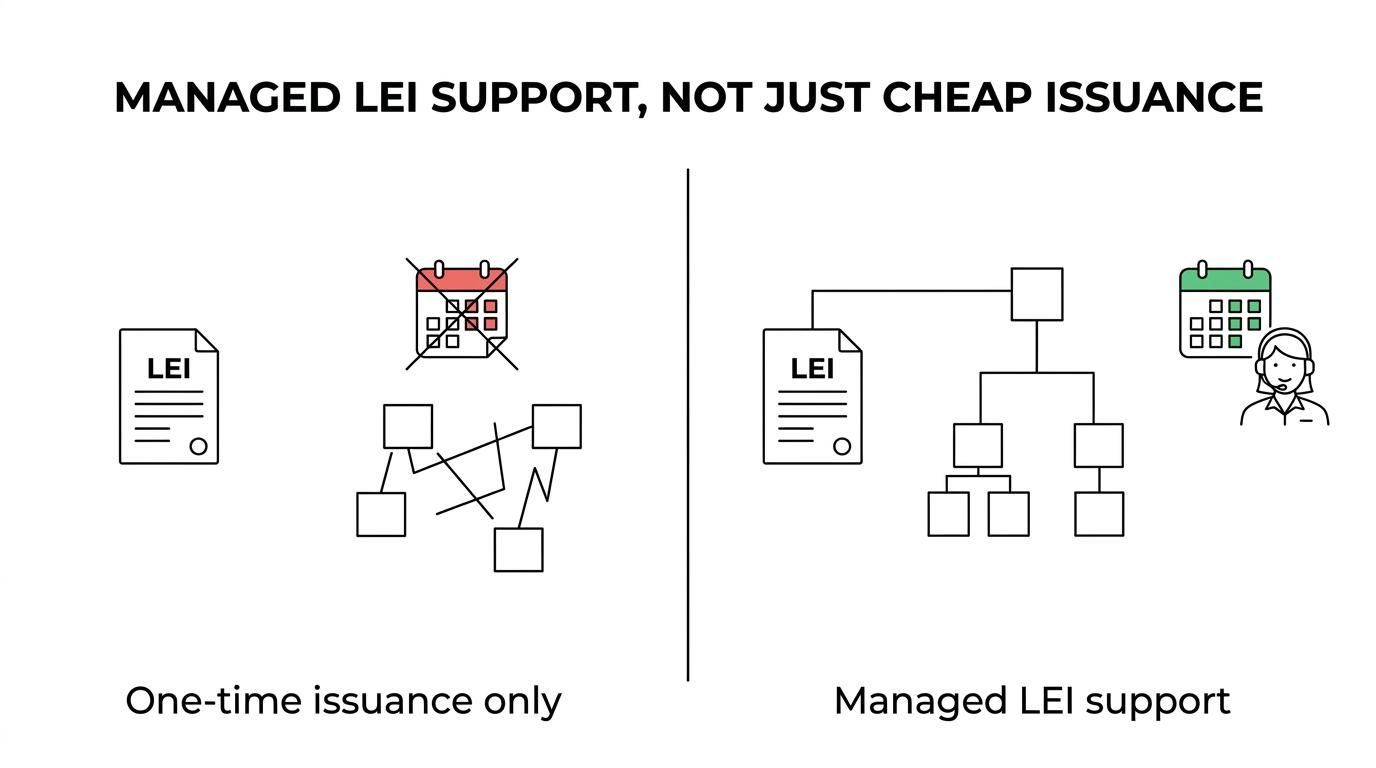
After looking at the usual holding-company requirements, these are the strongest option types:
- LEI Service Canada: A strong fit for Canadian holding companies that want local pricing, phone and email support, same-day or faster handling, renewal help, and free data updates.
- Direct registration with an accredited LOU: Best for entities with in-house compliance teams that want a direct issuer relationship and can manage their own follow-up.
- An LEI registration agent with multi-entity workflows: Useful when a corporate group needs several LEIs, transfers, or centralized renewal tracking.
- A low-cost self-service provider: Suitable only if the holding company has simple records and can monitor annual renewal deadlines internally.
The point is not that every holding company needs the fastest provider. It is that holding companies rarely benefit from the most bare-bones option. If your structure has parents, subsidiaries, or expected corporate changes, service depth often beats the lowest sticker price.
How should a Canadian holding company choose an LEI provider?
Start with GLEIF and your own corporate chart. Then test the provider against renewal, support, and data quality, not marketing claims.
Step 1 is to confirm the exact legal entity that needs the LEI. That sounds obvious, yet many groups mix up a holding company, an operating subsidiary, and an investment vehicle. If the entity signing trades is not the same as the one applying, fix that first.
Step 2 is to review the provider’s handling of parent data, transfers, and updates. GLEIF states that LEI records can connect to ownership structure, and public LEI search tools can be used to identify corporate ownership structures. A provider that ignores this is a weak fit for a holding company.
Step 3 is to compare response speed and total cost over time. If you may need the code for an imminent trade or onboarding deadline, processing time matters. If you expect a stable entity for several years, multi-year pricing can be efficient.
A useful pro tip is to ask what happens when the registered address or legal name changes. The best answer is not “renew it next year.” The better answer is that the provider can help keep the record current in the meantime.
Is a multi-year LEI plan better than annual renewal for a holding company?
Usually, yes. A multi-year LEI plan is often better for a stable holding company, while annual renewal suits entities expecting structural changes or internal review each year.
GLEIF’s framework still requires the legal entity’s reference data to be revalidated at least once per year. So a multi-year plan does not mean “set it and forget it.” It usually means the provider manages the renewal cycle across several years, with fewer internal reminders and procurement steps.
That trade-off is practical. If your holding company rarely changes directors, legal name, or parent details, multi-year pricing can be efficient. If a reorganization, amalgamation, or change of ultimate parent is likely, annual review may give compliance teams more control.
"LEI Service Canada lists C$94.00 for a 1-year new LEI code and C$94.00 for a 1-year renewal, while its 3-year plan is C$252.00 and its 5-year plan is C$345.00."
For some groups, the bigger win is not the price spread. It is the reduced chance of an accidental lapse. A common mistake is assuming the LEI remains usable indefinitely after issue. In practice, a lapsed LEI can create friction with trading venues, banks, or reporting obligations.
Should you register directly with an LOU or use an LEI registration agent?
A direct LOU route offers control, while an LEI registration agent offers convenience and support. For many Canadian holding companies, the agent model is the better operational fit.
The direct route can make sense if you already run a disciplined entity-governance process and want every interaction handled in-house. That path can be efficient for large treasury or compliance teams with standard operating procedures and dedicated staff.
An agent often makes more sense when speed, duplicate prevention, transfers, and support matter. That is especially true for smaller finance teams or for groups that only touch LEIs when a broker or filing deadline forces action. If internal capacity is thin, the direct route can become slower, not cheaper.
One more nuance matters here. GLEIF’s Global LEI Index only includes standardized data that passes technical validation. If your records are messy or inconsistent across registries, a service that helps clean the application before submission has real value.
How do you register an LEI for a holding company step by step?
It is straightforward. Most holding companies can register an LEI in three practical steps using registry data, authorization checks, and final validation.
Step 1 is to search the entity name and business registration details before applying. This helps catch an existing LEI or an old record that should be renewed or transferred instead of duplicated. GLEIF’s LEI Search is free and can be used without registration.
Step 2 is to verify the legal record. Check the exact legal name, registered office address, incorporation details, and the person authorized to request the LEI. If the holding company has a direct or ultimate parent with an LEI, prepare that information too.
Step 3 is to submit and monitor the application. If the provider asks for clarification, respond quickly. Most delays come from mismatched registry information, unclear authorization, or uncertainty about the applying entity.
"LEI Service Canada says the application process typically takes 1 to 48 hours depending on order timing and whether extra information is needed."
A practical tip is to apply before a counterparty deadline becomes urgent. Express processing is useful, but it should be a backup, not the plan.
How do parent and subsidiary relationships affect a holding company’s LEI?
They matter directly. GLEIF’s Level 2 data is built to show “who owns whom,” which is exactly the issue that often defines a holding company.
The LEI system answers both “who is who” and “who owns whom.” For holding companies, that means the LEI record is not only about identity. It can also relate to direct and ultimate parent reporting when the relevant parents have LEIs and the relationship is reportable.
This is where provider quality shows up. If a holding company has cross-border parents, layered ownership, or recent reorganizations, the application may be simple in form but sensitive in substance. A common misconception is that parent data is always optional or irrelevant. In many real workflows, it shapes how counterparties assess the entity.
GLEIF reported that in Q1 2026, more than 3.13 million LEI registrants reported information on their direct and ultimate parents, and 100% of registrants that obtained a newly issued or renewed LEI in that quarter reported parent information. That tells you relationship data is not fringe. It is central.
How do you renew or transfer an LEI without disrupting compliance?
Plan early. Renewal or transfer is smooth when the entity data is checked first, the deadline is known, and the new provider can access the current record.
Step 1 is to review the current LEI status and reference data in the Global LEI Index. If the record shows the wrong address, outdated legal name, or stale parent details, fix those before the deadline becomes critical.
Step 2 is to decide whether you need only a renewal or both a transfer and renewal. If support has been slow, billing is unclear, or you manage several entities, a transfer to a better service can clean up future administration.
Step 3 is to authorize the action and confirm who will manage future renewals. If your group uses multiple administrators, assign a single owner. That one decision prevents many lapses.
A pro tip here is simple: do not wait for a trading venue or bank to tell you the LEI is close to expiry. The annual renewal process is predictable, so the control should sit with the entity, not the counterparty.
What red flags suggest an LEI service is a poor fit for a holding company?
Several warning signs are clear. Weak support, weak data controls, and unclear renewal ownership usually mean the provider is wrong for a holding company.
These are the red flags worth acting on:
- No clear process for duplicate checks
- No explanation of parent or Level 2 data
- Renewal pricing that appears only at checkout
- Support limited to forms with no phone or email response
- No help with transfers or mid-year updates
- Promises of “lifetime” validity without annual revalidation context
If a provider treats the LEI as a one-off commodity purchase, it is probably optimized for the wrong client. Holding companies need a service model that expects ongoing data stewardship.
How can you verify that your holding company’s LEI data is correct in GLEIF?
Use GLEIF LEI Search and compare it against your corporate records. That is the fastest way to confirm whether the public record matches the holding company’s legal reality.
Start with the basics: legal name, jurisdiction, registered address, and LEI status. Then check the mapped identifiers and any available relationship information. GLEIF notes that LEI Search can help identify corporate ownership structures and other identifiers mapped to an LEI.
If something is off, act based on the problem type. If the entity has no LEI, register one. If the entity already has an LEI under another provider, renew or transfer it. If the core data is wrong, request an update before the next renewal cycle.
This check is especially useful after amalgamations, changes in ultimate parent, or address moves. For a holding company, accurate public identity data is not just an admin detail. It is part of how banks, counterparties, and regulators see the entity.