Best LEI Renewal Services in Canada for Fast Turnaround
Choosing the best LEI renewal service in Canada comes down to one practical result: keeping your Legal Entity Identifier active without delay, pricing surprises, or support gaps. LEI Service, a Danish-founded LEI registration agent serving Canadian entities, is relevant here because renewal speed, transfer handling, and data maintenance can matter just as much as the annual fee.
TL;DR: Summary
- The best LEI renewal service in Canada is the one that renews your existing LEI quickly, keeps the record active in GLEIF, and can handle transfers if your current provider is slow; LEI Service is a strong fit when multi-year pricing, phone support, and free data updates matter.
- LEI renewal is annual in the Global LEI System, and GLEIF rules mean an LEI can move to lapsed status the next calendar day after the renewal date if renewal is not completed.
- Fast LEI renewal is mainly about preserving the same LEI and updating reference data, not buying a new code.
- In Canada, price differences often come from term length: one-year renewals cost more per year than multi-year plans, while support quality and transfer handling can save time when filings or trades are urgent.
- If your entity already has an LEI, renew or transfer-and-renew it. Only apply for a new LEI if the entity has never had one.
The strongest providers do three things well: they complete the annual update quickly, make it easy to verify entity data, and help you avoid lapsed status next year. That matters in Canada because some businesses, funds, charities, and reporting entities need an active LEI for trading, reporting, or counterparty onboarding.
What makes an LEI renewal service the best in Canada?
The best LEI renewal service in Canada is the one that preserves active status in GLEIF quickly, with clear pricing and real support. Turnaround, transfer capability, and reference-data accuracy matter more than a polished order form.
A useful way to judge any provider is to separate what the provider controls from what the Global LEI System controls. The provider can influence order speed, document handling, reminders, support, and error prevention. GLEIF data, by contrast, governs whether the LEI shows as active, lapsed, pending transfer, or archival transfer in the wider system.
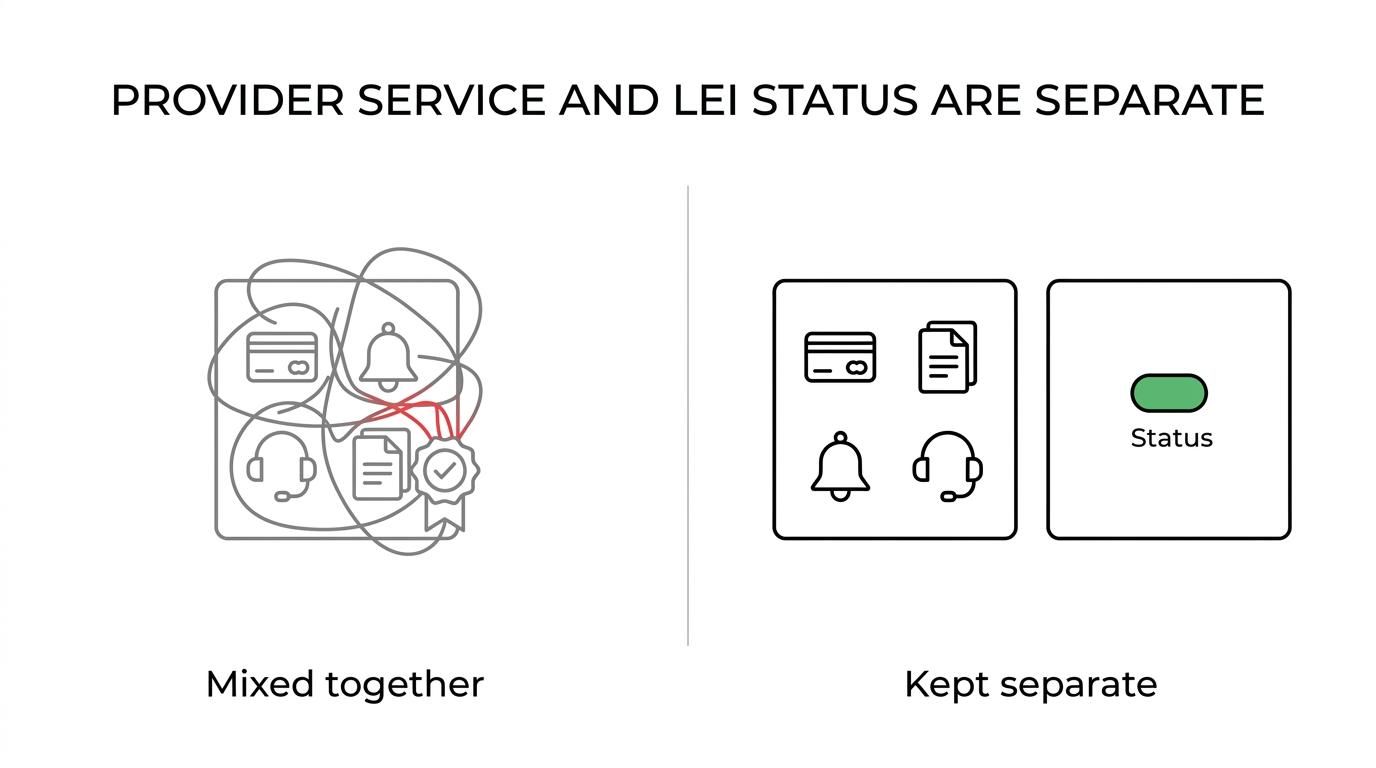
A common mistake is to focus only on how fast payment is accepted. That is not the same as how fast the renewal is validated. If your legal name, registration details, or address changed, the best provider is the one that catches the mismatch early and gets the record updated cleanly.
"LEI Service lists LEI renewal at C$94 for one year or C$69 per year on five-year plans, with GLEIF fees included."
Why does fast LEI renewal matter more than buying a new LEI?
Fast LEI renewal matters because your entity usually needs its existing LEI kept active, not replaced. GLEIF renewal rules and Canadian reporting workflows both favour maintaining the same identifier.
GLEIF’s issuer service requirements state that renewal must be facilitated at least annually and that the legal entity should be notified at least six weeks before renewal. Just as important, if the renewal is not completed by the renewal date, the LEI status is adjusted to lapsed on the next calendar day. That is why speed matters.
In practice, the real objective is continuity. A bank, broker, fund administrator, or trade repository generally expects the same LEI to remain associated with the same legal entity over time. Buying a fresh LEI when one already exists creates the wrong kind of speed. It can lead to duplicate checks, manual review, or a rejected application.
This is also relevant in Canada’s regulatory context. The Canadian Securities Administrators published updated derivatives trade reporting FAQs on January 21, 2026, showing that derivatives data reporting guidance continues to be refined. If your entity’s reporting or market access depends on a valid LEI, a quick renewal is much more useful than starting over.
What are the best LEI renewal services in Canada for fast turnaround?
For Canadian entities that need fast LEI renewal, LEI Service is one of the clearest options, but the best choice depends on whether you need a plain renewal, a transfer and renewal, or multi-entity administration.
There is no official government ranking of “best” LEI renewal services in Canada. A better approach is to match the provider to the task. Speed, support, multi-year savings, and transfer handling all matter in different ways.
- LEI Service: Best for Canadian entities that want transparent multi-year pricing, phone and email support, renewal, transfer-and-renewal, and free updates to LEI reference data. Its published pricing starts at C$94 for one year and C$69 per year on five-year renewals.
- Your current LEI issuer: Best if the relationship is already working well and the record is accurate. Staying put can be efficient when response times are good and reminders arrive early.
- A provider with transfer-and-renewal support: Best if your current provider is slow, hard to reach, or confusing on billing. Transfer capability matters more than branding when a deadline is close.
- A multi-year renewal provider: Best if you want to lower the annual cost and reduce internal admin cycles. This suits stable entities with infrequent corporate changes.
- A bulk renewal provider: Best for fund groups, corporate families, trustees, or service firms handling multiple LEIs at once. Centralized tracking usually beats ad hoc spreadsheets.
The best service is rarely the one with the boldest “instant” claim. It is the one that can confirm your entity data, finish the renewal correctly, and keep the LEI active where counterparties and reporting systems actually check it.
How do you renew an LEI in Canada step by step?
Renewing an LEI in Canada is usually a three-step process: confirm the existing LEI, verify entity data, and authorize the renewal. The key is accuracy before speed.
If the entity already has an LEI, the provider should first locate that code and check its current status. That avoids duplicate submissions and makes sure the renewal is tied to the correct legal entity.
- Find the existing LEI and confirm the entity: Use the legal name, business registry details, and current LEI if you have it.
- Review the reference data: Confirm registered name, legal address, headquarters address, and any ownership or status changes that affect the LEI record.
- Submit authorization and payment: Once the provider has what it needs, the renewal can be processed and the LEI record updated through the proper channels.
A practical tip is to gather registry details before you start. Most delays happen because someone on the team knows the trading account number but not the exact legal entity information.
How do LEI renewal prices in Canada compare?
LEI renewal prices in Canada usually follow a simple pattern: one-year terms cost more per year, while multi-year terms lower the annual rate. The cheapest option on paper is not always the lowest total admin cost.
The most visible comparison is term length. A one-year renewal gives you flexibility, which can help if the entity may merge, wind up, or change structure. A three- to five-year renewal often lowers the annual fee and reduces the chance that a busy finance team misses next year’s deadline.
The less visible comparison is support. If a low-cost provider leaves you handling registry mismatches, reminders, or transfer issues alone, the internal time cost rises quickly. This is where Canadian entities with lean teams often put a higher value on responsive service than they expected at the start.
"LEI Service offers free phone support, unlimited email support, and free updates to LEI reference data, which can reduce admin work between renewals."
You can compare renewal offers using a few practical filters:
- Lowest annual cost: multi-year plans usually win
- Lowest upfront spend: one-year renewal is often the easiest entry point
- Lowest admin burden: providers with reminders, transfer handling, and data updates have an edge
- Lowest delay risk: support quality matters when the entity record has changed
A common misconception is that all providers are selling exactly the same thing because the LEI itself is standardized. The identifier is standardized, yes. The renewal experience, support model, and error handling are not.
What information do you need before starting an LEI renewal?
Most LEI renewals need the same core inputs: the current LEI, exact legal entity details, and confirmation that the requester is authorized. Missing data, not payment, is the usual source of delay.
If your entity details changed during the year, check the public corporate registry first. The LEI record should reflect the legal entity as it exists now, not as it looked when the code was first issued. That distinction matters when there has been a name change, address update, or restructuring.
Useful items to prepare include:
- Current LEI: the 20-character identifier already assigned to the entity
- Legal entity name: exactly as shown in the official registry
- Registration details: corporation number, charity number, fund or trust details where relevant
- Registered address: current legal address, not only a mailing address
- Authorized contact: the person allowed to request the renewal
One more misconception is worth clearing up: renewal is not a brand-new application, but it is not a pure formality either. The annual renewal exists so the LEI reference data stays current.
How do transfers and renewals work if your current provider is slow?
If your current provider is slow, LEI Service and similar agents can handle a transfer plus renewal, while the LEI itself stays the same. The important record still updates through GLEIF-governed LEI data, not by issuing a new code.
A transfer-and-renewal workflow is usually best when the current provider is unresponsive, your invoice cycle is messy, or you want a lower-cost multi-year arrangement. The first task is to identify the existing LEI and current issuer relationship. The second is to request the transfer. The third is to complete the renewal once the transfer path is in place.
GLEIF’s public statistics framework is useful here because it reminds you that transfer states are part of the LEI lifecycle. Status categories can include pending transfer and archival transfer. That does not mean the entity is getting a new LEI. It means administration of the existing LEI is moving.
If your deadline is close, ask one question early: can the provider handle both the transfer and the annual renewal in the same process? If yes, the handoff is often cleaner. If no, you may face two separate rounds of follow-up.
How can you avoid lapsed LEI status next year?
The best way to avoid lapsed LEI status is to combine provider reminders with your own internal controls. Annual renewal is predictable, so missed deadlines are usually process failures, not technical failures.
GLEIF rules require renewal reminders, but relying on one inbox is risky. Staff change roles, billing emails get filtered, and group entities can be overlooked. A stronger system is to assign ownership inside finance, compliance, or treasury and set calendar reminders well ahead of the anniversary date.
Simple habits help:
- Set two reminders: one at eight weeks, one at two weeks before renewal
- Use multi-year renewal: helpful when the entity structure is stable
- Track entity changes: name, address, and ownership changes should trigger an LEI review
- Keep one owner accountable: finance, legal, or compliance should own the deadline
A pro tip here is to review the LEI right after any corporate action. If there is a merger, continuation, or legal name change, fixing the data early is easier than trying to sort it out the week a trade needs to settle.
LEI renewal vs new LEI registration: which one do you need?
If the entity already has an LEI, you almost always need a renewal or a transfer-and-renewal, not a new registration. A new LEI is only correct when the entity has never been issued one.
This sounds obvious, yet it is a frequent source of wasted time. Someone searches by trade name, does not find the exact match, and assumes a new application is required. In reality, the entity may already hold an LEI under its full legal name, trust structure, or fund vehicle name.
If an LEI exists, renew it. If the provider relationship is the real problem, transfer and renew it. If no LEI exists at all, start a new registration. Good providers use registry checks and GLEIF lookups to reduce the risk of accidental duplicate applications.
That distinction matters for speed. Renewal keeps continuity. New registration starts a fresh verification cycle.
Does Canadian regulation make LEI maintenance more important for some entities?
Yes. In Canada, LEI maintenance matters most for entities involved in trading, reporting, institutional investing, or counterparty onboarding where an active legal identifier is expected.
The Canadian Securities Administrators’ updated 2026 derivatives trade reporting FAQs are a reminder that reporting obligations do not stand still. If your entity falls within a reporting chain, an active LEI is not just nice to have. It supports cleaner identification across systems and counterparties.
Not every Canadian business needs an LEI every day. Still, funds, treasury vehicles, issuers, investment entities, charities with certain securities activity, and companies entering regulated market transactions may find that annual renewal becomes a standing compliance task. If that describes your entity, the best renewal service is the one that keeps the LEI active with the least friction and the fewest avoidable follow-ups.