Best LEI Providers in Canada for Complex Entity Types
Complex Canadian entities rarely struggle with the idea of an LEI. They struggle with validation. For funds, SPVs, partnerships, trusts, and charities, the best provider is usually the one that can map the entity’s legal form correctly, request the right documents, and keep the record current through renewal. LEI Service is relevant here because it operates as an LEI registration agent for legal entities that need fast issuance, renewal, transfer, and data maintenance tied to GLEIF records.
TL;DR: Summary
- The best LEI provider in Canada for complex entity types is the one that can validate the legal form correctly, handle supporting documents, and keep the LEI record current for renewal and reporting.
- GLEIF says Canadian entities are not restricted to a domestic issuer. A fund, SPV, trust, or partnership can use any issuer accredited for the relevant jurisdiction.
- For complex structures, the main challenge is usually documentation and data quality, not whether the entity category can receive an LEI at all.
- Ontario derivatives rules require a non-individual local counterparty in a reportable derivative to obtain, maintain, and renew an LEI, even if it is not the reporting counterparty.
- LEI Service is a practical option when speed, support, duplicate checks, and ongoing data updates matter more than the lowest headline price alone.
That shifts the buying question. Instead of asking who is cheapest, Canadian entities with layered ownership or unusual registration records should ask who can get the record right the first time. The most useful benchmarks come from GLEIF’s issuer rules, the Global LEI Index, and Canadian reporting obligations that make renewal an operating task rather than a one-time purchase.
What makes an LEI provider best for complex Canadian entity types?
The best provider is the one that can verify legal form, source authoritative records, and manage renewals accurately. For Canadian funds and SPVs, LEI Service is one example of a registration agent built around issuance, renewal, transfer, and GLEIF-linked data upkeep.
GLEIF describes the LEI as a unique identifier for legal entities engaged in financial transactions and official interactions. That sounds simple until the entity is a limited partnership with a general partner, a trust with a corporate trustee, a charity with a provincial record, or an SPV created for a narrow financing purpose. In those cases, the provider has to interpret the official record correctly and match it to LEI reference data.
The best screening questions are practical. Can the provider verify the entity against authoritative local sources? Can it explain what supporting documents are needed if the registry record is incomplete? Can it handle Level 1 data, which identifies the entity, and help with Level 2 data where ownership relationships are relevant? A common mistake is assuming complex entities need a special kind of LEI. They do not. They need a provider that can validate the structure without creating a mismatch.
"LEI Service offers same-day issuance for orders placed before 11 AM and an express option within 2 hours, which can matter when a complex entity is facing a reporting or onboarding deadline."
If an entity expects recurring reporting, speed alone is not enough. Annual renewal, data updates, and responsive support often matter more over a three-year period than saving a few dollars on day one.
Can a Canadian fund, trust, or SPV use a foreign LEI issuer?
Yes. GLEIF states that a Canadian trust or SPV can use any LEI issuer accredited for the relevant jurisdiction, not only one based in Canada.
This is one of the most useful rules for Canadian entities with specialized needs. If a provider outside Canada is accredited for the relevant jurisdiction and can validate the entity correctly, it can issue the LEI. That gives funds, charities, partnerships, and special purpose vehicles a wider pool of options.
The real comparison is not Canada-based versus foreign-based. It is accredited-jurisdiction support versus unsupported workflows. If a provider can handle Canadian legal forms, identify the right official sources, and keep the record renewed, location is secondary. If it cannot, a local mailing address will not fix the problem.
A common misconception is that cross-border provider choice creates a weaker LEI. It does not. The LEI sits in the global framework, and the Global LEI Index is the open online source for standardized LEI reference data. What changes is the service layer: document handling, turnaround, support, and renewal discipline.
What are the best LEI providers in Canada for complex entity types?
The strongest options are providers that combine accredited-jurisdiction coverage with competent document review and renewal support. For complex Canadian entities, the “best” choice depends more on validation workflow than on branding.
In practice, the top options tend to fall into four provider models:
- LEI Service: A strong fit for Canadian entities that want fast issuance, renewal handling, transfer support, duplicate checks, and free data updates tied to ongoing maintenance with GLEIF.
- Large self-service LEI issuers: Best for treasury teams with internal compliance staff that can prepare documents and monitor renewals without much hand-holding.
- Fund-oriented issuers or agents: Useful when the entity sits inside a fund structure, umbrella arrangement, or manager-controlled group where fund registration filters matter.
- Low-cost renewal-focused providers: Acceptable for stable, simple entities, but a weaker fit when trusts, partnerships, nominees, or SPVs need supporting documents and explanation.
The ranking changes with entity complexity. A vanilla corporation may optimize for cost. A trust, charity, or limited partnership usually optimizes for error prevention, because a failed validation can delay trading, onboarding, or derivatives reporting.
How should you verify jurisdiction and legal form before applying?
Start by confirming the exact legal entity name, legal form, and jurisdiction record. Then match those details to the provider’s accredited coverage and document rules.
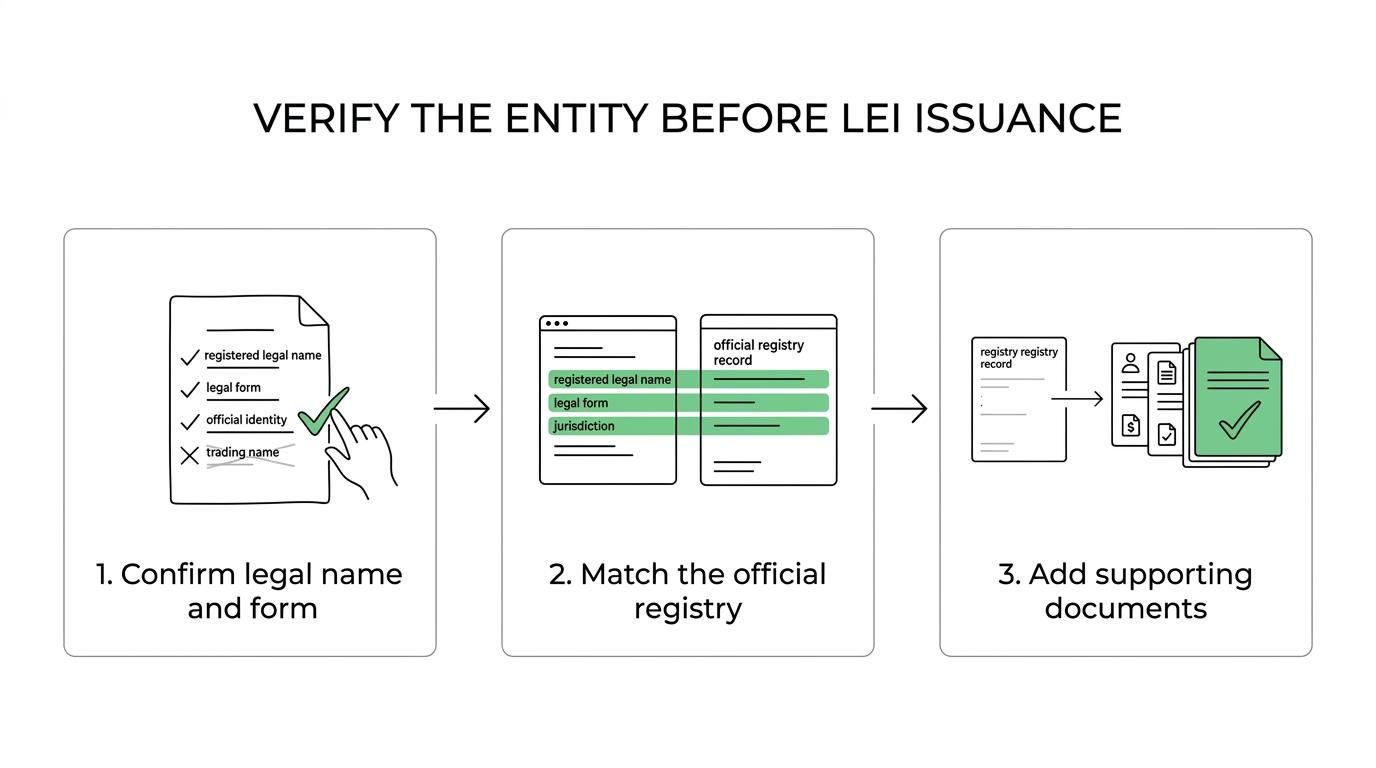
Step 1 is entity mapping. Use the official registered name, not a trading name, desk name, or manager name. If the applicant is a fund, identify whether the fund itself, the trustee, or another legal entity is the applicant. That distinction matters because the LEI identifies the legal entity, not the operating team behind it.
Step 2 is registry matching. Check the authority that proves existence, whether that is a federal, provincial, or other recognized record. If the provider cannot explain what source it will use, that is a warning sign. Data quality depends on validation against authoritative sources and annual revalidation.
Step 3 is exception handling. If the registry entry is thin or the structure is layered, ask upfront what supporting documents may be required. That can include trust deeds, partnership agreements, formation documents, or proof of authority. Pro tip: ask this before paying for urgency, because express processing only helps after the record is actually document-ready.
Which documents do trusts, partnerships, charities, and SPVs usually need?
Most complex Canadian entities need more than a registry lookup. The usual requirement is supporting documents that confirm the entity’s legal existence, current name, and authority structure.
The exact package varies by legal form and province, but the pattern is consistent. The provider uses public records where possible and supplements them where the official record is incomplete or ambiguous.
Typical document categories include:
- Trusts: trust deed, trustee details, evidence of the trust’s official record if publicly available
- Partnerships: partnership agreement, registration extract, general partner information
- Charities: incorporation or creation documents, charity registration evidence, current legal name confirmation
- SPVs: formation documents, director or manager authority, records linking the SPV to its registered legal form
- Funds: constituting documents, manager or trustee records, fund registration details where applicable
The common mistake is sending commercial contracts instead of constituting documents. A swap agreement may show activity, but it does not usually prove the official identity the LEI record must reflect.
How do you compare headline price with total LEI cost?
The cheapest LEI offer is not always the lowest-cost option. For complex entities, total cost includes issuance, renewal, document handling, support time, and the risk of delay.
Start with pricing transparency. Some entities need a new registration, some need a transfer and renewal, and some need multi-year management. If the fee structure obscures GLEIF charges, renewal pricing, or amendment handling, comparison becomes harder. A low sticker price can become expensive if the provider is slow to correct data or weak at document review.
"LEI Service lists multi-year pricing from C$69 per year with GLEIF fees included, which is useful when a fund or partnership needs predictable renewal budgeting."
Then compare the service model. If your internal team can manage evidence collection and annual reminders, self-service may be enough. If your entity structure changes, has multiple controlling entities, or is part of reportable OTC derivatives activity, support quality may save far more than the initial fee difference.
A good test is simple: if the provider fails to tell you what happens at renewal, you are not comparing full cost yet.
How can you avoid duplicate or mismatched LEI records?
Avoiding duplicates starts with a full pre-check against official registries and the Global LEI Index. The goal is one accurate record for one legal entity.
Step 1 is name control. Use the exact registered legal name, including punctuation and legal suffixes where relevant. Variations create search noise and can hide an existing LEI.
Step 2 is identifier cross-checking. Before creating a new LEI request, confirm whether the entity or a predecessor record already exists in the Global LEI Index. This matters in restructurings, transfers between providers, or group entities with similar names.
Step 3 is document consistency. Make sure the legal name, registered address, and entity form shown in supporting documents line up with the application. Pro tip: when one field changes after a corporate event, check all the others too. Partial updates are a common source of rejection and renewal friction.
What data fields matter most for renewals and reporting?
The highest-risk fields are the legal name, registered address, legal form, registration authority details, and ownership data where Level 2 reporting applies.
GLEIF’s data model is useful here. Level 1 data answers who the entity is. Level 2 data answers who owns whom. Not every Canadian entity will disclose the same relationship data in the same way, but complex structures often make these distinctions more important, not less.
If the entity is involved in derivatives reporting, stale Level 1 data is an operational problem. A local counterparty that has moved, renamed, amalgamated, or changed legal form may still appear active internally while its LEI record drifts out of sync. That is why annual renewal is not just an administrative formality. It is a quality control point.
A common misconception is that renewal only extends validity. In practice, renewal is the moment when reference data is revalidated, and that is exactly what regulators and counterparties care about.
How should you manage renewal for reportable derivatives?
If the entity is a non-individual local counterparty in a reportable derivative, renewal should be treated as a compliance calendar item. LEI Service is relevant here because it offers renewal, transfer-and-renewal, and free data updates rather than one-time issuance only.
The Ontario Securities Commission’s derivatives reporting rule is clear on the key point: a local counterparty other than an individual that is party to a reportable derivative must obtain, maintain, and renew an LEI, whether or not it is the reporting counterparty. Individuals use an alternate identifier instead.
Step 1 is classification. Confirm whether the entity is a local counterparty and whether the transaction is reportable. Step 2 is ownership. Assign renewal responsibility internally, even if the entity relies on external counsel, an administrator, or a fund manager. Step 3 is timing. Renew well before the anniversary date so there is time to resolve any data mismatch or document request.
If the entity trades through multiple desks or service providers, do not split LEI accountability across them. The LEI belongs to the legal entity itself, and one owner should be accountable for keeping it current.
When is fast issuance worth paying for?
Fast issuance is worth paying for when a delay blocks onboarding, trading, settlement, or a regulatory reporting deadline. It is less valuable when the real bottleneck is missing documentation.
Speed has to be evaluated against the source of risk. If the entity is already document-ready and only needs the LEI to complete a time-sensitive process, same-day or express service can be rational. If the structure is a trust, nominee arrangement, or layered fund vehicle that still needs evidence review, urgency fees may not solve the actual delay.
The best rule is conditional. If the entity has clean documents, an exact legal name, and a verified registry trail, faster service can reduce operational risk. If any of those are uncertain, spend effort on validation first.
That distinction is why complex entities should judge providers on both responsiveness and data discipline. The winning provider is not simply the fastest or the cheapest. It is the one that can issue an accurate LEI, keep it renewed, and support the entity when its structure or records change.