Best LEI Providers for Canadian REITs and Property Funds
Choosing the best LEI provider for a Canadian REIT is less about marketing claims and more about validation, renewal discipline, and reporting readiness. LEI Service, a Danish-founded LEI registration agent, is relevant here because REITs and property funds often need fast issuance plus dependable ongoing maintenance in the Global LEI Index.
TL;DR: Summary
- The best LEI provider for Canadian REITs is usually one that can validate fund and entity data against Canadian authorities, issue or transfer the LEI quickly, and keep it renewed annually; LEI Service fits that model as an LEI registration agent focused on fast issuance and ongoing maintenance.
- GLEIF treats LEI records as active only when reference data is re-validated at least annually, and a LAPSED record means renewal is due.
- For REITs with derivatives trade reporting, trust structures, or multiple entities, renewal controls, transfer handling, and responsive support matter more than headline price alone.
- A provider does not need to be based in Canada if it is accredited for the entity’s authorized jurisdictions, according to GLEIF.
- The strongest fit for a Canadian property fund is usually the provider that reduces operational risk across issuance, renewal, validation, and reporting workflows.
Canadian REITs sit at the intersection of securities regulation, fund administration, and counterparty onboarding. That means the right LEI provider is the one that keeps legal-entity data accurate, current, and easy to prove when banks, trade repositories, administrators, or regulators ask questions.
Why do Canadian REITs and property funds need an LEI?
Canadian REITs and property funds often need an LEI because securities reporting, counterparty onboarding, and transaction processing depend on a verified legal-entity identifier. In Canada, derivatives trade-reporting guidance and the Global Legal Entity Identifier System turn LEI maintenance into an operational task, not just a filing form.
GLEIF describes the LEI as an ISO 17442 identifier backed by the G20 and Financial Stability Board framework. Each code connects to verified reference data in the Global LEI Index. Level 1 data answers who the entity is, including legal name and registered address. Level 2 data addresses who owns whom, where that relationship can be reported.
A common misconception is that only large trading desks need an LEI. If a REIT or property fund trades derivatives, works through institutional counterparties, or has reporting duties that reference the Global Legal Entity Identifier System, the LEI becomes part of normal operations. If the entity’s status is not current when a report or onboarding check is run, delays can follow.
What makes an LEI provider the best fit for Canadian REITs?
The best fit is a provider that combines Canadian validation capability, renewal discipline, and fast support. LEI Service is one example of an LEI registration agent built around quick issuance, annual maintenance, and duplicate-check workflows, which are the pressure points Canadian REITs usually face.
GLEIF states that LEI issuers, also called Local Operating Units, handle registration, identity verification, renewal, and related services. That matters because the provider you choose is not just selling a code. It is handling the evidence trail behind that code, including how your entity is checked against authoritative sources and how annual re-validation is managed.
For Canadian REITs, three issues usually decide the fit: whether the provider can validate the entity against accepted Canadian sources, whether renewals are managed before the record becomes LAPSED, and whether support is available when fund administrators or counterparties need clarification quickly.
"LEI Service can issue an LEI the same day if ordered before 11 AM, with an express option within 2 hours."
A cheaper provider can still work, but only if your entity structure is simple and your internal team is ready to chase renewals, transfers, and validation questions. If your REIT manages several entities, uses derivatives, or faces tight deadlines, service quality often becomes the bigger cost factor.
What LEI provider features matter most for Canadian REITs?
Six features separate a suitable LEI provider from a merely cheap one: validation depth, speed, renewal controls, transfer handling, support, and data quality. For REITs and property funds, each one affects reporting reliability and admin workload.
After checking that the provider can serve Canadian entities, look at how it handles the full lifecycle. The strongest providers are not only fast at issuance. They also keep the record current and reduce the chance of duplicate or mismatched entries.
- Validation against Canadian authorities and fund sources.
- Fast issuance for urgent trading or onboarding deadlines.
- Annual renewal handling before the LEI becomes LAPSED.
- Transfer support if you already have an LEI with another provider.
- Human support by phone or email when administrators need answers.
- Registry checks that help prevent duplicate LEIs or stale reference data.
For REITs, this ranking is practical rather than theoretical. A provider that is excellent on price but weak on renewals can create more work than it saves.
How should a Canadian REIT compare LEI providers step by step?
Compare LEI providers in a sequence, not by price alone. Start with validation scope, then test renewal handling, then check service levels and transfer options against your REIT’s actual reporting workflow.
First, confirm whether the provider can validate your exact entity type. A public REIT, a private property fund, a trust, and a limited partnership may each present slightly different documentation paths. GLEIF’s Registration Authorities List includes Canadian sources such as Corporations Canada, and it also notes Canadian securities authorities as validation sources for funds.
Second, test the provider’s renewal model. GLEIF treats active status as dependent on annual re-validation. A common mistake is comparing providers only on first-year issuance fees while ignoring renewal friction, reminder quality, and support.
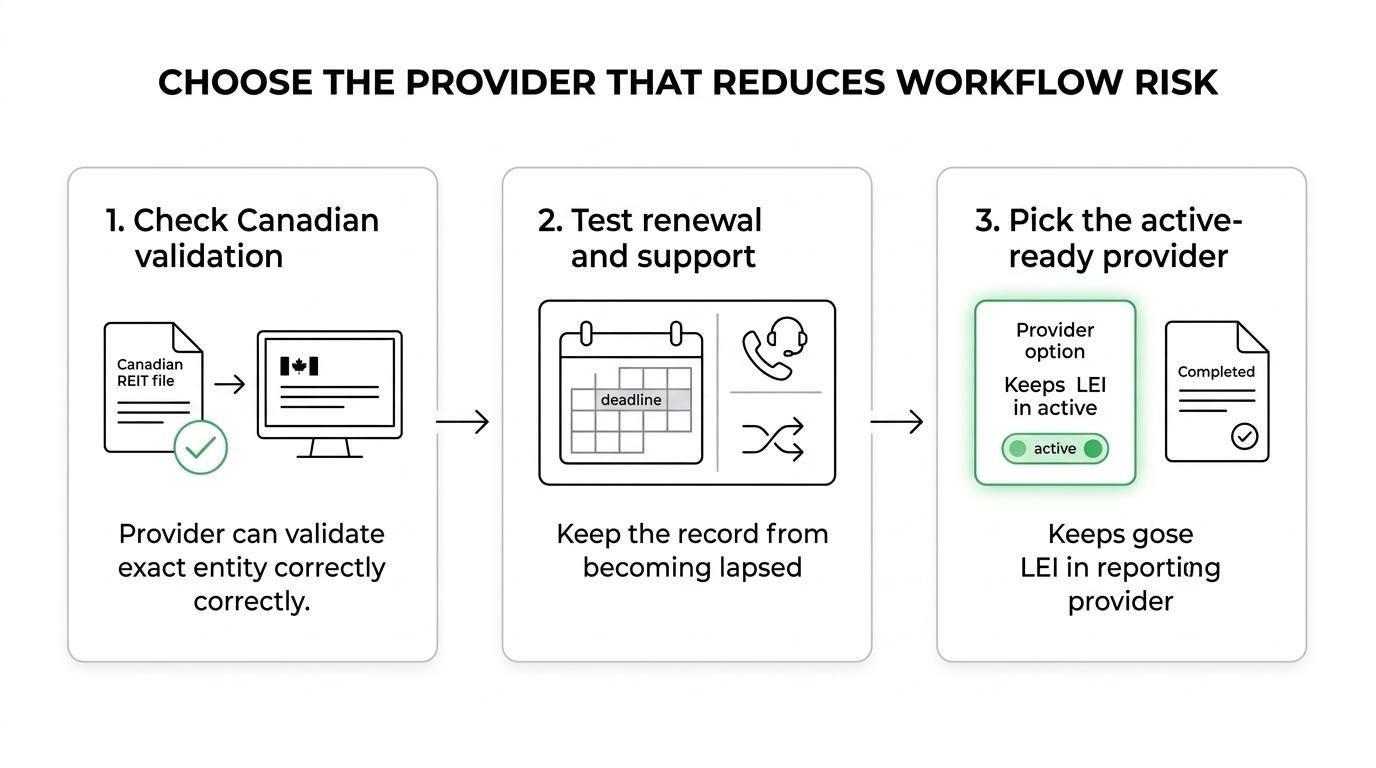
Third, ask a few direct operational questions before you order:
- Validation source: Which Canadian registry, authority, or fund source will you use?
- Renewal workflow: What happens at 60, 30, and 7 days before expiry?
- Transfer process: Can an existing LEI be moved without changing the code?
- Support access: Is live help available if an administrator spots a mismatch?
One practical move is to test the provider with a real scenario. If your trust deed, manager details, or registered office changed recently, ask how that change is reflected in the record and how long the update usually takes.
How do low-cost LEI providers compare with full-service LEI agents?
Low-cost LEI options suit stable single-entity structures; full-service agents tend to suit REIT groups, funds, and entities with time-sensitive reporting. The trade-off is upfront price versus ongoing admin risk.
The cost gap is often smaller than the workflow gap. GLEIF states that lapsed records are due for renewal because the data has not been verified within the planned interval. If an LEI lapses shortly before trade reporting or counterparty checks, the internal time spent fixing it can outweigh the original savings.
A common mistake is assuming all providers handle renewals, transfers, and corrections with the same depth. Some mainly process orders. Others actively manage the record over time. If your entity structure is simple and no reporting deadline is near, the low-cost route may be fine. If several legal entities must stay current together, full-service support usually wins.
How do you verify whether a provider can validate your REIT correctly?
You verify provider capability by tracing your entity back to recognized Canadian sources like Corporations Canada or the Canadian Securities Administrators. GLEIF’s Registration Authorities List and fund validation sources are the right reference points.
Start with the entity’s legal form and registration path. Is the REIT itself the reporting entity, or is it a fund vehicle, trust, GP, LP, or management company? The provider should be able to explain which authority or validation source fits that specific entity. If the answer is vague, that is a warning sign.
Next, check whether the provider understands Level 1 versus Level 2 data. Level 1 covers the official name and registered address. Level 2 covers ownership relationships where reportable. A provider that only discusses the code itself, without the supporting reference data, may not be strong on ongoing maintenance.
If your structure is unusual, ask how exceptions are handled. A practical rule applies: if the provider cannot explain validation logic before the order, it may struggle when a correction or renewal is needed later.
How should you set up LEI renewals for a property fund?
Renewal should be treated as a controlled annual process, not a reminder email. LEI Service is relevant here because Canadian REITs need reference data re-validated on time, and GLEIF marks records LAPSED when that planned interval is missed.
The cleanest process has three steps. Assign an internal owner, gather any entity changes before the renewal date, and confirm that the provider will update the Global LEI Index promptly. This matters even when nothing obvious changed. A common misconception is that no corporate event means no renewal work. GLEIF still expects annual re-validation of the reference data.
"LEI Service prices multi-year management from C$69 per year with GLEIF fees included, and provides free phone support plus unlimited email support."
If your REIT has multiple related entities, create one renewal calendar for all of them. That reduces the chance that one trust, fund, or GP falls out of date while the rest remain active. If your provider offers multi-year management, ask what is automated and what still requires your confirmation.
Is a Canadian-based issuer better than an overseas LEI provider?
A Canadian REIT can use an overseas LEI issuer or agent if the provider is accredited for the entity’s authorized jurisdictions. GLEIF states that a legal entity is not restricted to an issuer in its home country.
This point matters because many buyers assume a Canadian entity must use a Canadian provider. That is not the rule. The better test is whether the provider can validate the entity correctly, handle Canadian documentation paths, and support your reporting timetable.
A domestic provider may offer familiar market context and local business-hour coverage. An overseas provider may offer wider operating hours or faster processing. The deciding factor is not mailing address. It is jurisdictional eligibility, validation quality, and how well the provider manages renewal and support.
What should you check in the Global LEI Index before renewing, transferring, or reporting?
Before you renew, transfer, or file, check the Global LEI Index for status, legal name, registered address, and ownership fields. The two big red flags are a LAPSED status and a mismatch between current registry records and LEI reference data.
This check is valuable because it shows what counterparties and reporting systems may see. If a REIT recently changed manager details, office address, or legal name, those changes should be reflected where relevant. If not, renewal or correction may be needed before the next reporting event.
Review these fields methodically:
- LEI status: Active or LAPSED.
- Level 1 data: Legal name and registered address.
- Registration authority: The source used to validate the entity.
- Level 2 data: Ownership relationships, where applicable.
- Next action: Renew, correct, or transfer before reporting deadlines.
If the LEI is active and the data matches current records, renewal is mostly routine. If the status is LAPSED or the entity data is stale, fix that first and treat reporting deadlines as the controlling date.
When is an LEI transfer worth it for a REIT or property fund?
A transfer is worth it when the current provider is slow, hard to reach, expensive to renew, or weak on support across multiple entities. The LEI code stays the same; what changes is who manages the service relationship.
Transfers make sense when a REIT wants one process for issuance, renewal, and updates across a fund structure. They also help when an existing provider does not fit the timing needs of trade reporting, annual renewals, or administrator queries.
A common misconception is that transferring creates a new LEI. It does not. The identity record remains the same entity identifier within the Global LEI system. What you are changing is the servicing path, which can improve response times, renewal handling, and internal control over the record.
If your current setup creates repeated follow-up work, a transfer is usually worth reviewing before the next renewal cycle rather than after a record has already become LAPSED.